


It has been five years since the Covid-19 pandemic wreaked havoc across the world. Education was hit particularly hard, with schools being shut for several months at a time and children learning remotely online. Whilst the pandemic may now be a distant memory, has there been a larger impact on state school education and GCSE attainment than initially meets the eye?
To put this into context, we need to return to the start of Covid. Boris Johnson announced on March 18th 2020 that GCSE and A-Level exams would not be taking place in the UK and that schools were closed indefinitely - the first national school shutdown in modern British history.
It was decided that students would be given ‘Teacher Assessed’ grades by Ofqual, the non-ministerial exam regulation department. Teachers supplied the board with estimated grades for each student based on predictions, previous test results and completed coursework. This was then fed into an algorithm that integrated every individual school’s performance in each subject from the previous three years.
However, this algorithm, which was intended to moderate the results, faced massive backlash. Students in disadvantaged areas and schools received unfairly low grades, forcing the board to make a U-turn, ultimately resulting in higher grades being awarded.
Boris Johnson responded to this during an inquiry:
“We had to find a way of adjudicating on the academic achievement of the kids that didn’t involve an exam,
“And Ofqual came up with this system. I was not expert enough to comment on whether it was viable or not, but plainly it let down a lot of kids whose grades didn’t reflect their abilities and their achievements.
“And so to answer your question, yes, I regret very much.” ITV News
However, the impact of Covid-19 on education stretched far beyond exam results, with students who were due to sit their GCSES in 2020, describing the long-term setbacks they continue to face.
Researchers from the UCL Centre for Education Policy and Equalising Opportunities and The Sutton Trust interviewed a cohort of individuals who were in Year 11 in 2020/2021. They found that “a staggering 80% of young people say their academic progress has suffered as a result of the pandemic and half report feeling less motivated to study and learn.” The Sutton Trust
Interestingly, it was also found that state school pupils are more than twice as likely to feel that they have fallen behind their classmates than independent school pupils and nearly 45% of pupils state that they weren’t able to catch up on lost learning. The Sutton Trust
During an interview, a parent of a student who was studying for their GCSEs in 2021 explained that:
“My child’s education was massively impacted. Online school was being run, however this of course was not as engaging or motivating for students. I feel like my child did massively miss out on the most important stage of her education.”
Whilst it’s clear that Covid-19 had an impact on education, how have England’s state schools recovered since then, 5 years on, and are the essential GCSE grades still being attained? Are we in an education crisis, or are we improving as a country in our delivery of schooling?
When comparing pre- and post-pandemic GCSE results, there is a contrast in the percentage of state-educated students achieving grades 5+ in English and Maths.
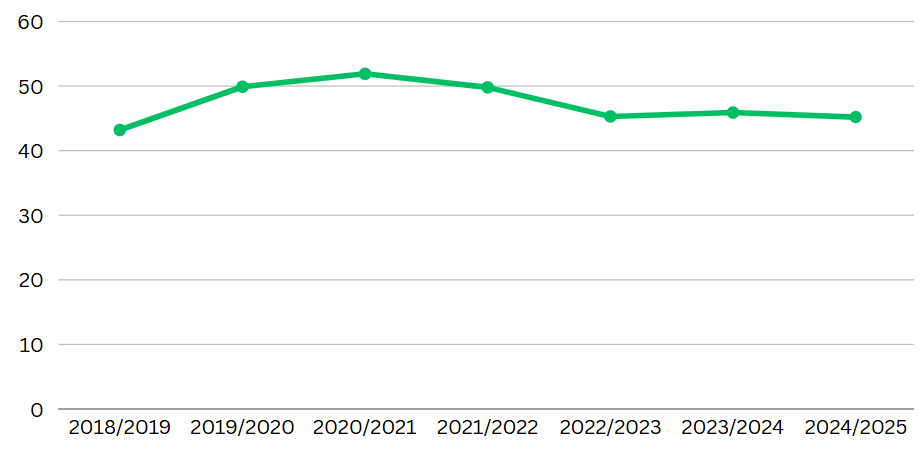
However, surprisingly this contrast is positive. Data collected and analysed from the Department of Education suggests that there has been a 2% improvement:
In 2018/2019, 43.2% of English state school students attained grades 5+ in English and Maths GCSEs compared to 45.2% in 2024/2025.
There was a spike in 2020/2021 with 51.9% of students nationwide achieving these grades, a 2% increase compared to the year before. This can be attributed to the teacher-assessed grades system, as previously mentioned.
Comparing the National Average of Grade 5 English and Maths GCSE Attainment in State Schools, 2018/2019 to 2024/2025
However, education attainment and success is not evenly distributed across the country, with significant gaps attributed to geographic and economic factors.
The South of England produces higher results. London in particular consistently outperforms other regions, with 52.6% of their state school students achieving grades 5+ in English and Maths in 2024/2025, a 3.6% increase since 2018/2019 (49%). They repeatedly reinforce and strengthen their status as the highest-achieving city in the UK.
Prior to the pandemic, it is fair to say that the North East of England struggled. Data revealed them as the worst performing region in 2018/2019 with only 39.6% students achieving grade 5s. However, they have since made improvements, attaining a 3.3% increase (42.9%) in 2024/2025. This has left the West Midlands as the lowest achieving region in 2024/2025 with only 41.4% of students attaining grades 5 in English and Maths GCSE.
When zooming in even further and analysing the performance of upper-tier local authorities, the results become more shocking and the disparity between different areas is even more clear.
Kingston-Upon-Thames, located in Outer London, achieved great success in 2024/2025, with a whopping 69.1% of state students achieving at least grade 5s English and Maths GCSE, closely followed behind by Sutton (67.8%), also located in Outer London.
In fact, four out of five of the top achieving local authorities are in the London region, with the only exception being Trafford (North West England) attaining 63.6%. Furthermore, Southwark, Richmond Upon Thames, and Wandsworth have all made incredible improvements of at least 8% in grade 5 achievements since before Covid.
London’s consistent excellence can be attributed to gentrification, high pay for teachers, and a higher concentration of schools. ‘The London Challenge’, whilst established a long time ago in 2003, also continues to have a lasting positive effect. It radically transformed the schools of the city, improving leadership, teaching, higher budgets and extending academisation.
On the other end of the spectrum, Knowsley (North West England) shows the lowest levels of educational achievement and is significantly performing under the national average, with only 24.6% of students achieving grades 5+.
They are however showing signs of improvement with a 7% increase since 2018/2019, a year in which a harrowing 17.6% of students achieved 5s in English and Maths. This is an incredibly shocking figure, particularly when considering that fewer than one in five students achieved the minimum success.
Knowsley’s concerning underperformance is inherently linked to the socioeconomic disadvantage of the area. It is the third most deprived local authority in England and has an Index Multiple Deprivation score of 10 (with 10 being the most deprived), along with having one of the highest crime rates in the UK. Ofsted data also shows that 51.2% of secondary school students in Knowsley receive free school meals, compared to the national average of 27.5%, again demonstrating the area’s extreme deprivation.
It has also been revealed that “more than 15% of the working-age population of Knowsley have no educational qualifications, compared with a national average of 8%.” The Guardian
The consequences of deprivation paired with the issues that Covid brought are not only isolated to Knowsley. Regardless of geographic location, disadvantaged children consistently struggle in grade attainment. In 2024/2025, the national average of disadvantaged, state school students achieving grades 5+ in GCSE Maths and English was only 25.6%, whilst students who are ‘not known to be disadvantaged’ had a national average of 52.8%.
Comparing the National Averages of State School ‘Disadvantaged’ Children against ‘Not Known to be Disadvantaged ‘ Children Achieving Grades 5+ in GCSE Maths and English Pre- and Post- Covid
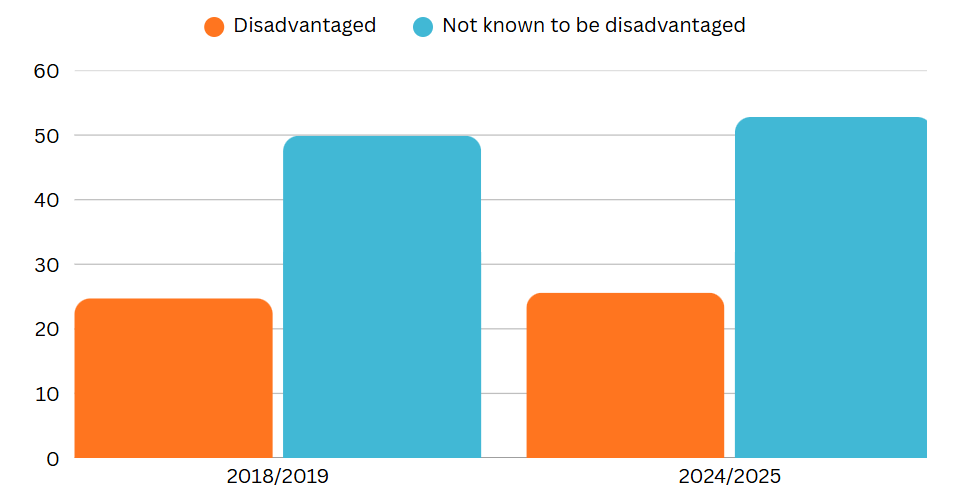
The pandemic didn’t significantly change these averages, establishing disadvantage as a consistent, contributing factor to poor educational outcomes. However, the combination of poor socioeconomic background and Covid-19 impacted children in ways that don’t solely relate to grades.
The Sutton Trust found that 31% of those with the lowest incomes had not been able to spend anything on their child’s learning from home. This could be anything from stationary, textbooks, reliable internet access and most notably computers. Only "5% of teachers in state schools reported that all their students have access to an appropriate device for remote learning, compared to 54% at private schools.” The Sutton Trust
This lack of easy access to remote learning instantly disconnects the child from the education system and being unable to attend online lessons created gaps in knowledge, disengagement with education and poor mental health outcomes due to isolation.
An interview with GCSE/A-Level science teacher and content creator ‘Miss Estruch’ further confirmed the impacts of online learning on student’s mental wellbeing when they returned to school:
“The biggest challenges were linked to mental health: students struggling to settle back into normal routines, and a lot of anxiety and overwhelm generally, particularly around exams.”
She also took time to explain the support generally provided to students following the pandemic:
“There were budgets available for revision and catch-up sessions, which were used to pay staff extra to support students and to bring in external companies and tutors. That support did help, but it wasn't enough to reach every student, only those identified as most impacted received it.”
The picture regarding Covid-19’s long-term impact on GCSE outcomes and education is a complicated one. Contributing factors like deprivation and location cannot be disregarded, however, analysis shows that these aspects all worked hand-in-hand with the pandemic. Many areas in the UK, like Knowsley, still need significant intervention to aid the futures of state-educated children.
However, data shows that as a collective nation, state school education is improving. 123 out of 157 local authorities in England have improved or maintained their GCSE outcomes since 2018/2019. Changes still need to be made and the residual impacts of Covid-19 on education may still be present for some time, but it is clear that we are on the road to recovery.