


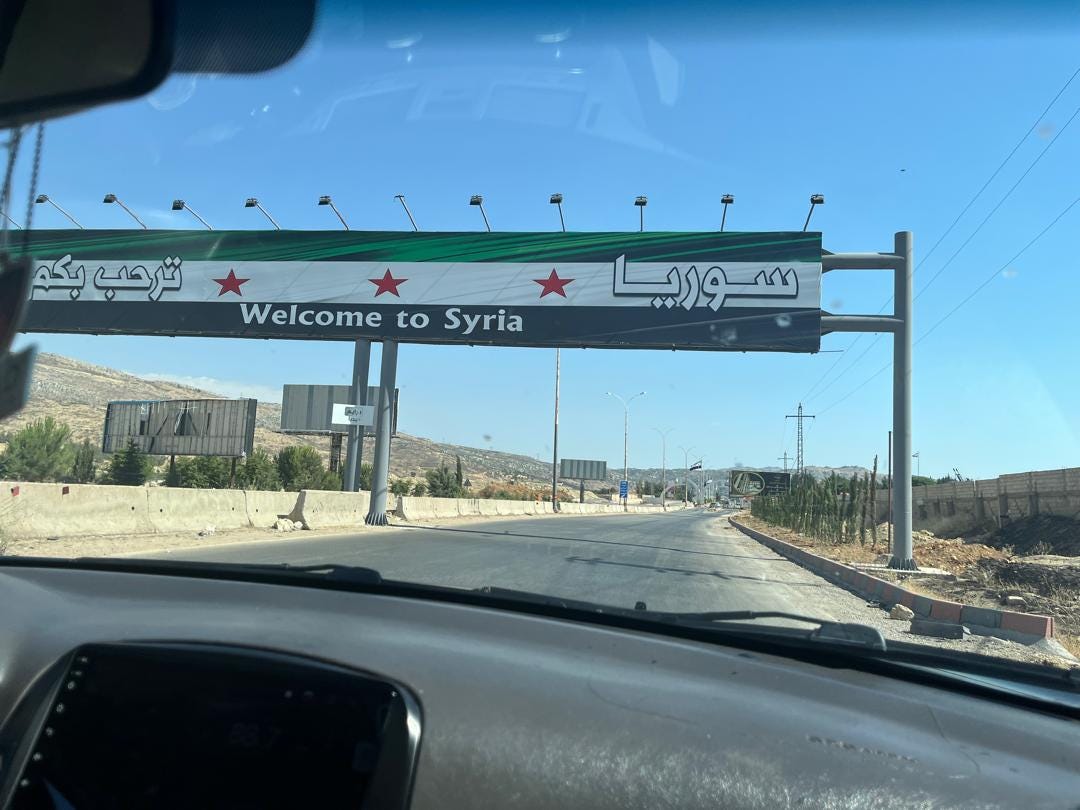
There are finally new cars in Syria. And Pringles, Mars, Snickers, plenty of Turkish products. The US Dollar is no longer uttered in hushed codes of akhdar (green), mlukhiye (a spinach dish), or nana (mint). All the stashed and secretly exchanged USD against Syrian pounds in the last 14 years of civil war is out in its green glory.
Syrians don’t have to wait for months and pay bribes to get their passports. Syrian men don’t have to enrol in university, or go abroad, to escape compulsory military service.
The fuel is available aplenty to everyone, albeit at a price. No more ‘smart cards’ and the much awaited weekly text to collect the 25 litre quota of fuel and gas.
Electricity is still scarce, but is being distributed more equitably across urban and rural areas.
Limited international flights have now started operating from Damascus airport. Embassies have reopened in Damascus. Syria’s new President has been on a diplomatic charm offensive to the White House and Europe.
Sanctions against Syria have been lifted.
Amjad Saftly, 32, calls it the ‘freedom shock’ which Syrians experienced after the stunning collapse of Assad family rule on 8 December 2024.
As a former aid worker in Syria, I am pleasantly surprised by all these economic and access related developments. However, in a country with religious diversity – Sunni, Alawites, Christians, Druze, Shia – emerging from 14 years of civil war and five decades of one family’s stronghold, there are bound to be old wounds and resentments which might be still bubbling under the surface.
I interviewed Syrians across religious and regional communities at the anniversary of the fall of Assad regime in December 2025 to uncover the unsaid and the nuances behind these economic developments.
The hopefuls
‘This is the first time in 14 years I can cross check points, and not have any fears’
Most Sunni community members seem hopeful and realistic about their country’s future. All admitted to looking at their new leader – Ahmad Al-Sharaa (previously known as Golani–his nom de guerre) – initially with skepticism due to his past alliances with Al Qaeda, and conservative interpretation of Islam.
Abdelkader Dabbagh (Abd.), a Sunni, is from Aleppo governorate. Abd. was an undergraduate student in 2011 when the conflict began. To escape military service, he spent six years completing his undergraduate studies, six years doing his Master’s, and two years on a PhD.
When he could no longer take the education route, he left Syria to work in Yemen with an international NGO. After returning from his foreign gig, he planned to pay the hefty amount many Syrian men ended up paying to the Assad regime just to escape military service.
Aleppo was the first city to fall from Assad regime’s control in late November 2024. Abd. was on his way to Yemen when he heard about the clashes in Aleppo and Idlib between Hayat Tahrir al-Sham (HTS) and Assad forces. Such clashes were routine affairs every few weeks in his city.
However, this time it felt different, more serious, more organised.
He feared for his family, and potential separation for years in case he was stuck outside Syria. He made arrangements the next morning to return to Syria.
When he reached Aleppo, he found dead bodies on the streets.
‘For me in the beginning we were afraid of HTS, as we haven’t had any connection with them for years. Some of the groups were known to be very conservative.’
After two days of HTS forces taking over, Aleppo was bombed by the Assad government forces. Aleppians were shocked – the government which was supposed to protect them was bombing them, while the HTS soldiers from ‘the other side’ were distributing bread.
‘I was shocked to see diesel available in the market, as earlier there was such scarcity’
Abd. shares overnight the restrictions on importing most goods disappeared and there was no struggle in finding food. In fact, new cars were available from the second week of regime change. Aleppians were able to travel to Idlib and shop in malls.
Abd. considers the cultural differences between Assad ruled territories and HTS ruled territories to be normal, which can be lived with, and worked on with more interaction as time passes.
This view is shared by Abdulmoute AlDroubi, from Homs governorate. Abdulmoate works in north-east of Syria in Deir Ez Zor governorate with an aid agency. Deir Ez Zor governorate was earlier divided between Assad forces and Syrian Democratic Forces (SDF) [Kurdish controlled]; HTS forces have taken over the previously controlled Assad areas. He observes that the previous smuggling routes between SDF and Assad government across the Euphrates river have stopped, as the country has opened for import and most goods and services are available in the market.
He feels his city, and in fact the whole of Syria, avoided the worst ethnic and religious clashes that were expected immediately after a regime change of such nature.
Syrians across governorates and religious divides agree that there is finally access to a variety of goods and services.
And that’s where the agreement ends
Mahmoud Bieruti, a Sunni, a Syrian Palestinian, left Syria more than five years ago to Belgium in search of a better life. When he visited Syria in early 2025 for a few days, he could feel the sense of joy and relief amongst all sections of Syrians.
However, Mahmoud doesn’t agree with the current government’s treatment of Alawites, and Druze communities.
‘We need to avoid creating the new leader as a hero, as a saviour. We are only recreating the old model this way. People need to be educated about democracy, their rights. Democracy cannot be expected after 53 years of one family’s dictatorship.
‘The HTS were unprepared for such a sudden and quick takeover of Damascus. They lack the experience to rule such a diverse demographic. There is a contradiction between the current government’s claims and their actions towards minorities.’
Minority Report
‘We were scared to put up our Christmas tree’
Noor Baladi*, 44 years old, an Orthodox Christian, left Syria with her husband and two children to a country in Western Europe in October 2025. After living through 14 years of civil war, she couldn’t jeopardise her children’s future to more uncertainties anymore.
For Noor, the fall of the Assad regime was a scary unknown.
‘We didn’t know who was coming. And those people we had in mind were jihadis, they were in Idlib, they would come and kill everybody who chose to stay here (Assad controlled Syrian areas), because they would assume we were living here and we were okay with the regime of Al Assad.
‘We were against the Assad regime, but we kind of found a way to live with the restrictions of not being able to talk about politics, not being able to criticise the President and his party, and to work in places that are not political.’
Noor shares that in summers she was afraid to wear sleeveless clothing (which is quite normal in Damascus). She instructed her 16 year old daughter to also not wear shorts or anything revealing. Her son, 11 years old, was stopped twice for wearing shorts.
‘Some of them were distributing brochures and posters posted on some of the public institutions’ doors, how you should enter, to work here, how you should cover your hair, the halal (lawful) way of wearing things. So we were afraid of the people because they will start accusing us of being a kufar (non believer).’
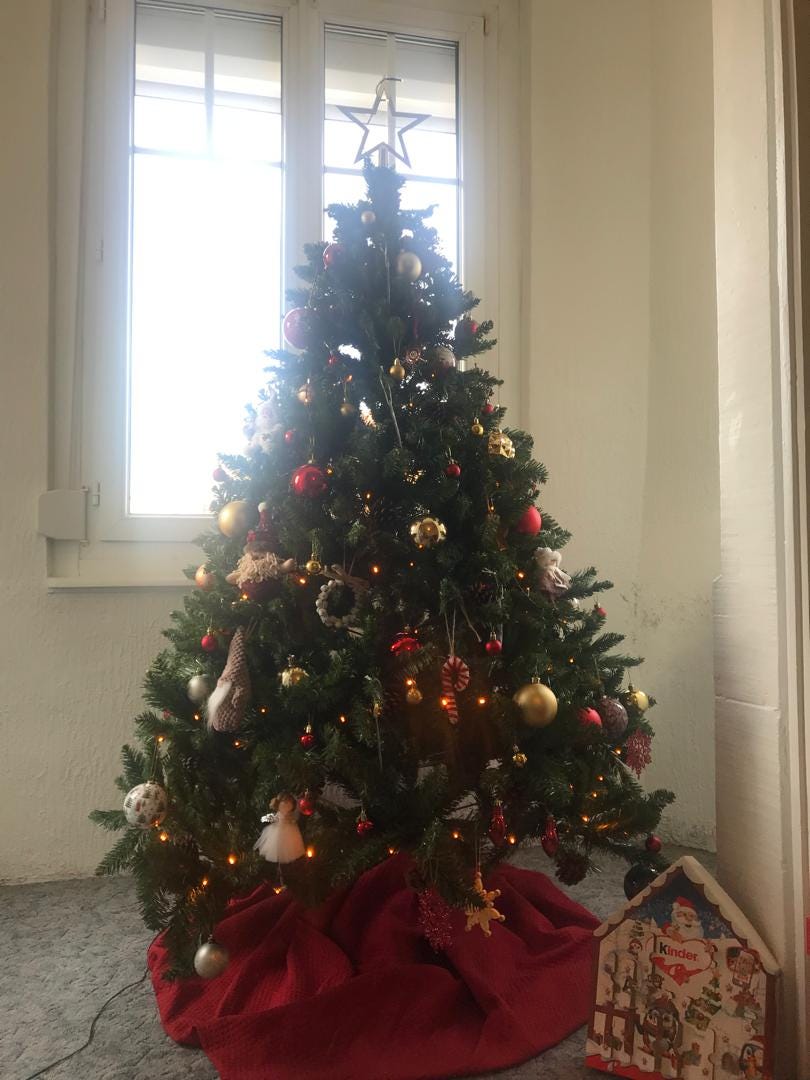
That December Noor says, ‘We were a little bit scared to put up our Christmas tree, as it might attract attention. We didn’t put any cross either.’
Noor still felt hopeful in the months that followed, with transitional government formation, recognition by the West, and Syria finally shedding its pariah status.
This hope was short-lived. In March 2025 there were clashes, or massacres as minority communities describe it, in the coastal areas of Syria between the government forces and Alawite community.
And then the deadly clashes happened in Sweida – governorate with a large Druze community. Noor’s husband belongs to Sweida, and his parents were stuck for weeks with limited provisions.
That seemed to be the last straw.
When an opportunity arose in Europe, they grabbed it despite the risk of pulling out their children in the middle of the school year. She now has a chance to give a better life to her children.
Noor was also able to put up the Christmas tree last year.
‘For me enough is enough’
Amjad Saftly, a Christian Orthodox, is also hoping for a better, safer life. He left for Germany in February 2026. He fears after Alawite and Druze massacres, soon it could be Christians who could be targeted.
Amjad was living in Jaramana – a suburb of Damascus, where primarily the Druze and Christian minorities reside.
He feels just like the Assad government is to be blamed for the horrors during the long rule, similarly it is the government of the day which needs to bear the responsibility for these clashes with minorities.
‘We don’t trust the system anymore. We see that the government is using one colour [community] to fill any gap, to fill important positions with one colour – mostly Muslim Sunnis, from Idlib.’
‘For me enough is enough. I am leaving my mother behind, which is not an easy decision. But after the massacres, I see more focus on external relations with the USA and Europe, which is great, but not fixing things inside.’
Amjad observed for the first three to four months there were no bribes, no favouritism, or nepotism, but now everything is running the same old way. Maybe in spheres like traffic police, there are lesser bribes, but in governmental departments, bribing still exists.
For fixing things internally, Amjad recommends major steps need to be taken by the new government: reconciliation and peace with Alawite and Druze communities, sharing some high ranked political positions with minorities, introducing hate speech regulations, and justice for the old regime’s victims.
Sweida Saga
‘I feel devastated. What was I doing for people all these years who are now seeing me as someone who supports Israel?’
Ehab Al Matni, 32, belongs to the Druze community, and has lived in the Jarmana neighbourhood for many years.
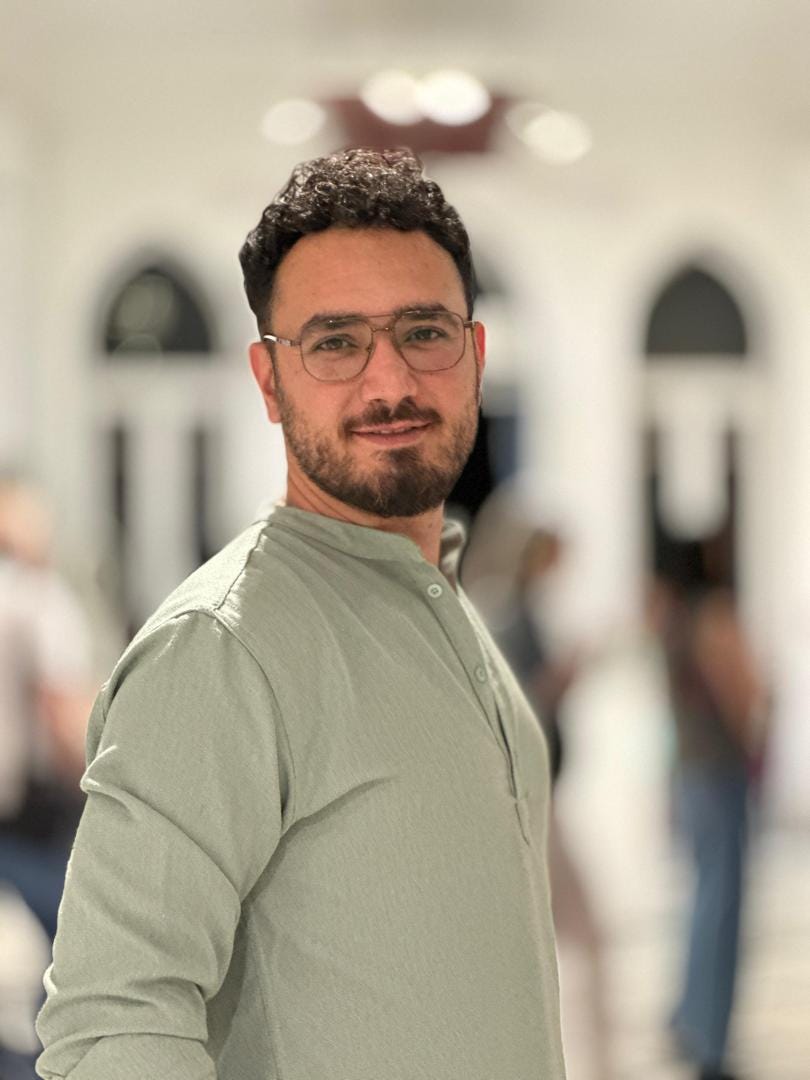
Despite the initial misgivings about the new regime, Ehab was encouraged by the new regime’s takeover of Aleppo, and their treatment of people there. The situation was surprisingly calm. There was no revenge on the streets. People were celebrating in Damascus.
‘So we decided this is our time. And we can do something for the country. We waited for years for the Assad regime to fall. We started doing meetings, public sessions on constitution, transition, and invited analysts in Jaramana.’


However, the coastal clashes took place and mass killings of the Alawite community were reported.
‘I started to freak out, as Jaramana is a place consisting mostly of minorities and a massive surrounding area of majority of Muslims.
‘As someone who lived in Jaramana, and spent all my life in Damascus, and most of my career working for and with people who suffered from the Assad regime, I felt what was I doing in those 14 years, for people who are now seeing me as someone who supports Israel?’
Ehab secured a visa for a Gulf country in August 2025. He has no plans to return to Syria.
Alawite Angle
‘We Syrians can now adapt to anything’
Atheel Mohammad, 30, an Alawite, lives in a suburban neighbourhood of Damascus, which mostly comprises Alawite community. Atheel’s neighbourhood was traditionally divided into the civilian side and the Syrian Arab army side. Post Assad regime’s collapse, there have been massive demographic changes in the neighbourhood, which has been worrying for the Alawite community, fearing revenge from thr Sunni community. The former Assad military side of the neighbourhood now consists of the new government’s army personnel.
At 4 am on 8 December 2024, she heard frantic footsteps in her building, and opened the door to a neighbour saying ‘Khalas (finish), Damascus has fallen.’
As an Alawite, she feels most of the community felt protected as a minority community under Assad regime. But that’s that. In terms of services, they suffered just as much as others. When the Assad regime fell, she felt collective shame on learning the horrors of Sednaya prison.
She doesn’t feel safe travelling between Damascus and the suburb, returns home before sunset, dresses more conservatively, and uses a trusted taxi driver.
‘I was not into politics earlier, but now as a minority, we see a pattern, and feel excluded as Alawites, Druze, Shias, Christians.’
She does however feel hopeful.
‘This hate is not the true Syrian people. Syrian people love to live, laugh. Ideally I would not like to leave a place where I have childhood memories, my people.’
‘I don’t have much, but it is my country.’