


Almost 1 million young people are out of work, with shocking statistics showing that one in six young people are out of work or education, the highest these figures have been in 12 years.
However, ‘Gen Z’ are still being told by employers, ‘they’re not ready for work’ using excuses like, covid 19 resulting in a lack of social awareness and instead urged by employers to get ‘Saturday’ jobs to build up the necessary skills. Whilst, Covid 19 may have impacted young peoples social lives and skills, it is a hard sell to equate it to being the sole reason for unemployment today.
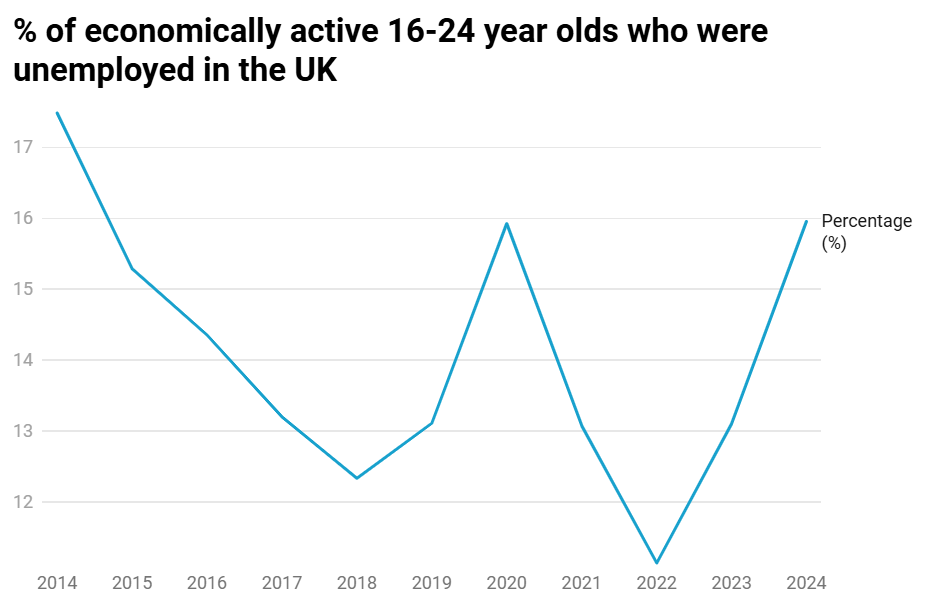
(Graph made by Data wrapper and figures sourced from The Social Mobility Commission)
These figures, released by the The Social Media Commission, show a sad reality for young Brits, who make up a generation referred to as the ‘ lost’ generation. This description seems soberingly accurate, faced with increasing job pressures only to find there are very little jobs around.
For previous graduates, getting a job out of university felt certain, almost expected if they were to put in the hard graft during their three years and earn a good degree. However, that reality has since changed, and it seems harder than ever to get a graduate job.
The daily reality for young people is hundreds of applications, countless cover letters, only to send them off into the seemingly abyss, more than likely to never hear from that employer again.
The Office for national statistics (ONS) said the rate of unemployment rose to 5.2 per cent in the three months to December, up from 5.1 per cent in the three months to November.
Therefore, these continued figures show a concerning story, one that reflects the reality that it has never been harder to exist as a young person as it has today. The phrase the ‘lost generation’ rings true, the countless rejections, the silence from potential employers take a huge toll on the mental health of young people looking for work.
The opportunities for young people are shrinking, and with the help of A.I graduate roles are disappearing particularly in areas such as Law, as Danni Hewson, AJs Bell’s head of financial analysis urges people to understand in an interview with The Independent that; “Weaving AI into businesses to increase productivity is a positive move and may be the answer to a decades-old issue. But for young people in particular, already struggling to get their first taste of work, AI could result in a scarcity of entry-level posts”.
The competition for graduate roles is off the scale, with in 2024, over 1.2 million applications for just 17,000 graduate roles available.
However, there is light in this very dark tunnel for young people. The government has announced a new employment play, backed by £1 billion, that will help introduce over 200,000 new jobs for young people. Sir Keir Starmer announced to the house of commons in March; “Backing young people is one of the most important investments we can make in this country’s future.” and that “We are determined to tackle the rise in youth unemployment by expanding practical routes into work, boosting apprenticeships, and giving employers the clarity they need.”
M&s are also doing their bit to help youth unemployment. In July of this year, applications will open for their new unemployment scheme that will introduce 1,400 new jobs for 18-25 year olds. This will see an eight fold increase in the number of unemployed people taken into work experience at M&S.
The placements will include, a four week programme with up to 37 hours a week spent training on the shop floor or, three days of specially tailored training modules aimed at raising participants’ knowledge of the retail industry, developing workplace and life skills, including CV writing, networking and confidence building and a structured in-store job training curriculum with regular feedback and evaluation provided to ensure M&S standards of service, sales and behaviours.
Tanith Dodge, HR Director at Marks & Spencer, said: “There are nearly a million young people not in employment, education or training and we risk having an entire generation missing out on their chance to show their working potential and make a contribution to society.” M&S has continued to urge all their suppliers to step up and do their bit in making sure that youth unemployment does not go unnoticed and that there are the right opportunities and support for the youth of today.
Applications for the M&S scheme will open on 27th July, and will be rolled out annually.
Moreover, it is important to recognise the new opportunities that are being created for young people, who are far more qualified to work, than some employers seem to admit.
The reality is that the working climate just does not have enough available opportunities to give young people, and that does not come without its consequences. Admittedly, the government support, large scale companies like M&S are paving the way for future companies to introduce youth employment schemes to help tackle this problem, and look forward to a more hopeful youth inclusive work environment.