



The prominence of teenagers and young adults vaping is becoming a growing public health concern in Britain, with many articles across the internet explaining and increasingly reporting of the risks of nicotine addiction, the marketing of e-cigarettes and their accessibility to younger people.
Studies focusing on young people and nicotine have prompted government intervention, The House of Commons Library stressing concerns expressed by school leaders of vaping on school grounds, e-cigarettes being marketed towards youth, and the sale not being properly monitored.
With policies focussed on protecting younger users, new figures suggest that vaping isn’t a habit that is exclusive to young people.
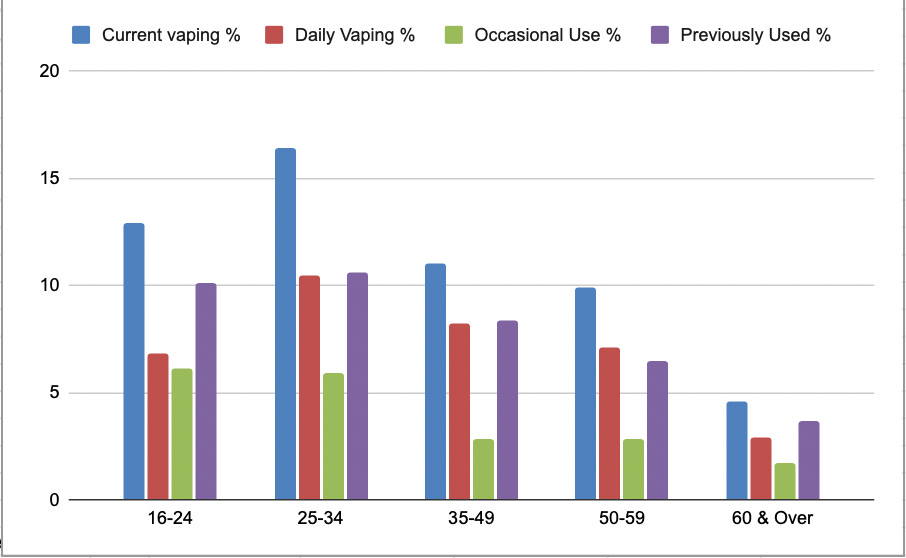
According to the Office for National Statistics (ONS), 16.4% of 25-34 year olds in Great Britain reported currently using e-cigarettes in 2025, compared to 12.9% of 16-24 year olds, a difference of 3.5 percentage points.
The figures also show us that daily vaping is not bound to the youngest adults, with an estimated 8.2% of 35-49 years vaping daily, compared to 6.8% of those aged 16-24.
NOTE: ONS figures cover people aged 16 and over in Great Britain.
How vaping habits differ by age in Great Britain, 2025.
ONS Table 8.
Data from the Office for National Statistics, visualised by me in Google Sheets
Note: Current vaping is daily and occasional vaping added.
With there being so much public interest focused on the younger generation, this data asks a bigger question: are Britain’s vaping habits being explored across all age groups, or is the discussion overlooking adult users?
With younger people remaining central to discussions around vaping, the ONS figure table above shows the differences in frequency of vaping in age groups. Amongst 16-24 year olds, the rate of daily, 6.8%, and occasional vaping 6.1% is fairly similar. Yet among 35-49 year olds, daily vaping is almost three times the occasional rate, at 8.2% compared with 2.8%.
Although there’s no clear distinction between why there are different patterns in vaping across different age groups, the Action on Smoking and Health suggest that the main reason for young people’s use is to ‘just give it a try’, or peer influence, the use of vapes as a smoking quit aid is less common in young persons compared to adults. This research helps to explain different motivations but doesn’t establish reasons behind the patterns in ONS data.
This data tells us that vaping habits differ across generations, especially with how they are discussed online to different age groups. An article from the NHS about young people and vaping states that ‘vaping is not for children and young people. This page is part of Gloucestershire’s strategy to support people to stop smoking’.
This shows that there’s a distinction in how vaping and smoking is framed to adults, framing vaping as more of a tool to help adults compared to mental and physiological effects to teenagers and young adults.
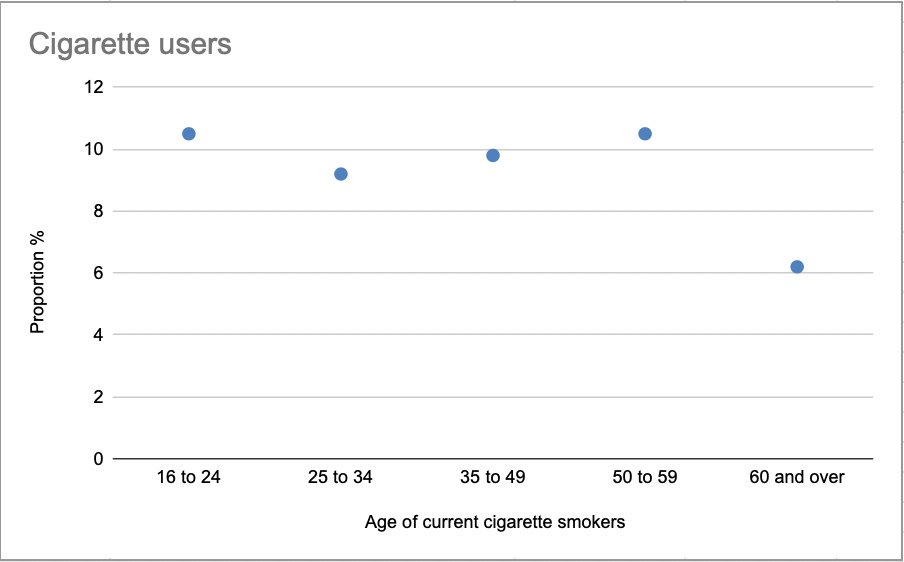
Percentage of adults who smoke cigarettes, by age, Great Britain, 2025
ONS Table 1.
Data from the Office for National Statistics, visualised by me in Google Sheets
Note: Statistics don’t establish that vaping has caused smoking rates to change
Among 25-34 year olds, the estimated current vaping rate of 16.4% compared to a cigarette smoking rate of 9.2%, 7.2 percentage points difference. This kind of difference isn’t consistent amongst every age group, with those aged 60 and over, 6.2% currently smoke cigarettes, 4.6% using e-cigarettes. These differences raise the question about the relationship between smoking and vaping among adults, with the NHS identifying potential advantages to vaping such as cost, control over nicotine strength and a reduced exposure to chemicals. Although, the ONS figures cannot establish whether these factors explain the differences between smoking and vaping rates.
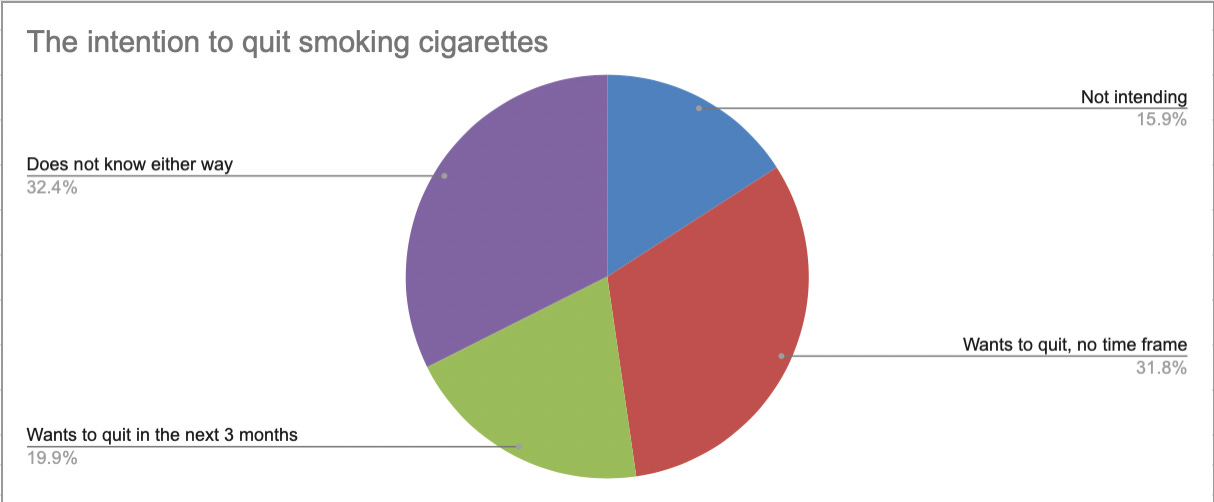
Further ONS figures from 2025 have shown that 31.8% of current cigarette smokers want to quit without a specific timeframe, and an extra 32.4% remain uncertain whether they want to quit at all.
Percentage of adult’s intention to quit smoking, Great Britain, 2025
ONS Table 6.
Data from the Office for National Statistics, visualised by me in Google Sheets
However, these figures do not reveal whether smokers are considering e-cigarettes as a substitute instead highlighting the potential intentions surrounding quitting cigarettes. This adds further context of the role vaping can play in smoking cessation and using vaping as a tool, a perspective distinct from concerns about young people starting nicotine.
The figures detail a more complicated picture of the vaping habits held in Britain than the attention surrounding younger users. Whilst concerns about addictions to nicotine amongst teenagers and young adults remain crucial, the use of e-cigarettes extends across generations according to ONS data.
The distinction doesn’t just lie between who is vaping, but how it’s interpreted. For young people with little experience smoking, e-cigarettes offer a risk of health issues and nicotine dependence. However for adult smokers, they present a less harmful alternative to cigarettes.
Britain’s vaping debate cannot be reduced to one generation, the statistics do not dismiss concerns about teenage vaping but rather using ONS figures to see the wider picture of e-cigarette usage across age groups. Comprehending Britain’s relationship with vaping means understanding risks of nicotine uptake but also the benefits for existing smokers.
Sources
ASH (2024). Use of e-cigarettes among young people in Great Britain. [online] ASH. Available at: https://ash.org.uk/resources/view/use-of-e-cigarettes-among-young-people-in-great-britain [Accessed 8 Nov. 2026].
Balogun, B. (2024). Youth vaping in England. [online] House of Commons Library. Available at: https://commonslibrary.parliament.uk/research-briefings/cbp-9932/ [Accessed 8 Nov. 2026].
Gloucestershire, N. (2022). Young people and vaping : NHS Gloucestershire ICB. [online] Nhsglos.nhs.uk. Available at: https://www.nhsglos.nhs.uk/your-health-services/healthy-communities/vaping/ [Accessed 8 Nov. 2026].