



(Image by Daniel Guerra Unsplash)
Recline back, crunch on your popcorn, engulf yourself in the wondrous adventure of being transported into an entirely new world. Cinema is an experience. It allows us to see the newest workings of some of the most creative people on the planet. An entertainment form that tickles every imagination.
So what is the reality of the current state of cinema?
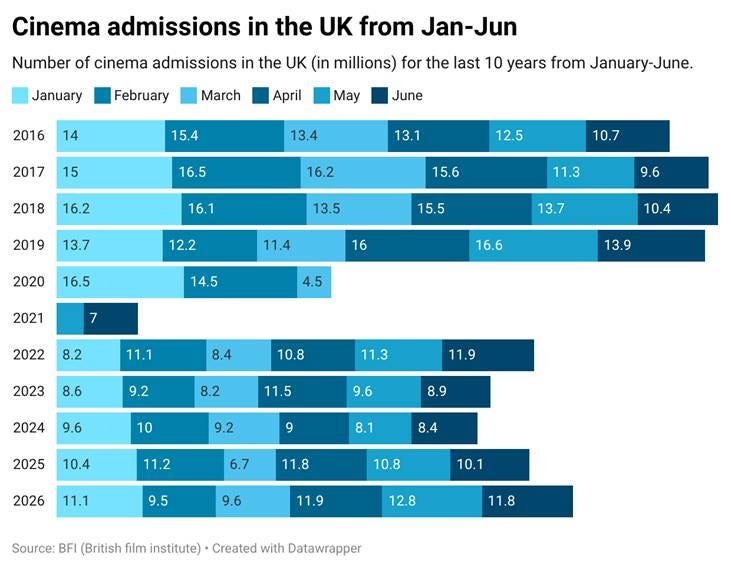
On face value, the 2020’s demonstrates a drastic fall off from the second half of the 2010’s.
2018 saw the greatest number of admissions between January and June in the last 10 years displaying a total of 85.4 million admissions in the UK. That is almost 25% higher than the total admissions for 2026, which has been the highest number since the pandemic, but it may not be as dire as it seems on first glance.
In 2026, for the first six months of the year there has been 66.7 million cinema admission in the UK, which is over 6 times the number of admissions in 2020.
Not only this but the first six months of 2025 and 2026 both demonstrate a steady increase in admission numbers, 2025 shows an over 12% increase on 2024 and 2026 admission numbers have grown another 9% on 2025. However, the yearly admissions in 2025 still fell by 3 million compared to 2024.
Cinema may appear to have begun its COVID 19 bounce back but there is still a way to go before it reaches admission figures it saw before 2020. Prior to COVID, cinema admission maintained stable numbers, with no inclination that they would decline until March 2020. Cinema was never on the descent but was abruptly impacted by the outbreak of the Coronavirus.
The pandemic had startling, immediate impacts for the creative industries, and film felt the full extent of lockdown.
Looking back at the data, if you examine the period immediately prior to lockdown in January, February and March it clearly shows the initial, detrimental damage as both months at the start of the year display a continuation of admission numbers of the previous years, but the implementation of a lockdown led to cinema closure and the plummeting of admission numbers.
Now what does this mean, it signifies that the art of cinema was never dying and since the temporary closure of cinemas, the industry now faces a different challenge. The repercussions of COVID are endless and its unpredictable carnage has left not only monumental damage on so much but has brought out a completely different approach to the digital world.
This is the issue cinema has to be weary of overcoming, it cannot hope to simply reach its admission levels of the late 2010s, it has to adapt to different times.
Technological advancements have meant people can experience similar visual and sound quality at home, that was previously only available at cinemas. The rise of streaming platforms allows an array of films and watching capabilities at the click of a button and from the comfort of their own sofa.
Cinemas have to adapt and how they are doing this may be seen in the specific cinema admission numbers.
While examining 3 different cinema companies, Vue, Cineworld and Everyman, it may reveal what the future of cinema might look like.
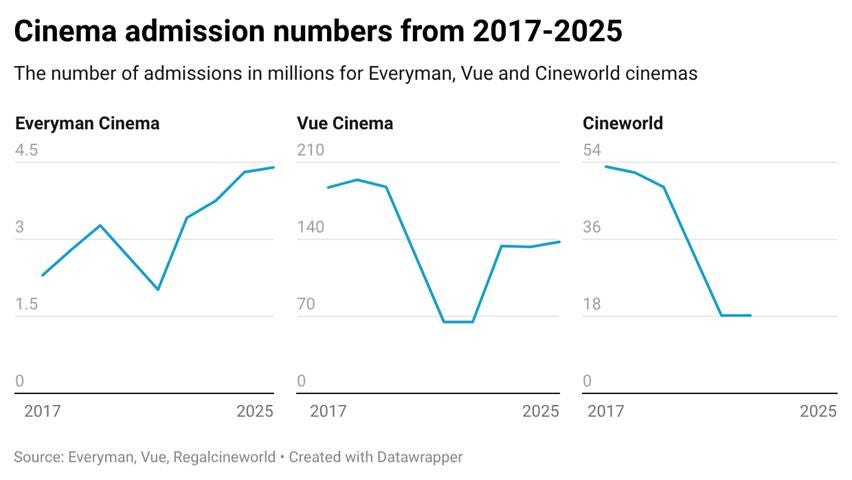
Everyman has continued to grow since 2017, excluding 2021, averaging a 26.8% increase year on year up until 2025, Vue cinema has increased by 3.5% in 2025 compared to 2024 but up until then was still short of its success prior to the Coronavirus.
Although there is only data available up to 2021, data released by regal entertainment in regards to Cineworld shows that admissions were in decline even before the pandemic.
This reflects that cinemas cannot afford to rely on its traditional attraction, they must now provide an experience that gets audiences out of their homes and into the cinema and the success of Everyman may just prove this very point.
The seat service, luxury warmth and differing atmosphere and a multitude of choices from their bars provide viewers a luxury experience.
Vue and Cineworld both now stress the differing options they offer to audiences with selections of differing viewer experiences whether in differing dimensions, Imax, reclining chairs all moving towards a different experience and one that you will not find at home.
That is the future of cinema in order to reach the admission numbers cinema saw before the coronavirus the experience must be enough to drag audiences out their homes to encounter the beauty of the shared cinema experience.
So what have we established.
Cinema is recovering gradually after Covid and although the overall admission numbers seem to be stagnating, delving in deeper to the admissions numbers between January and June we can see 2026 may be breathing new life into these numbers.
Despite positive signs, there are still hurdles to overcome, so how does the industry approach this?
Enhanced experience.
Viewers have to truly provide an unforgettable viewing experience that differs from when you switch the television on at home.
All things considered maybe Cinema was never dead, it is simply in the process of recovery, with cinema offering a refreshed experience we may see cinema reach great heights once more.