


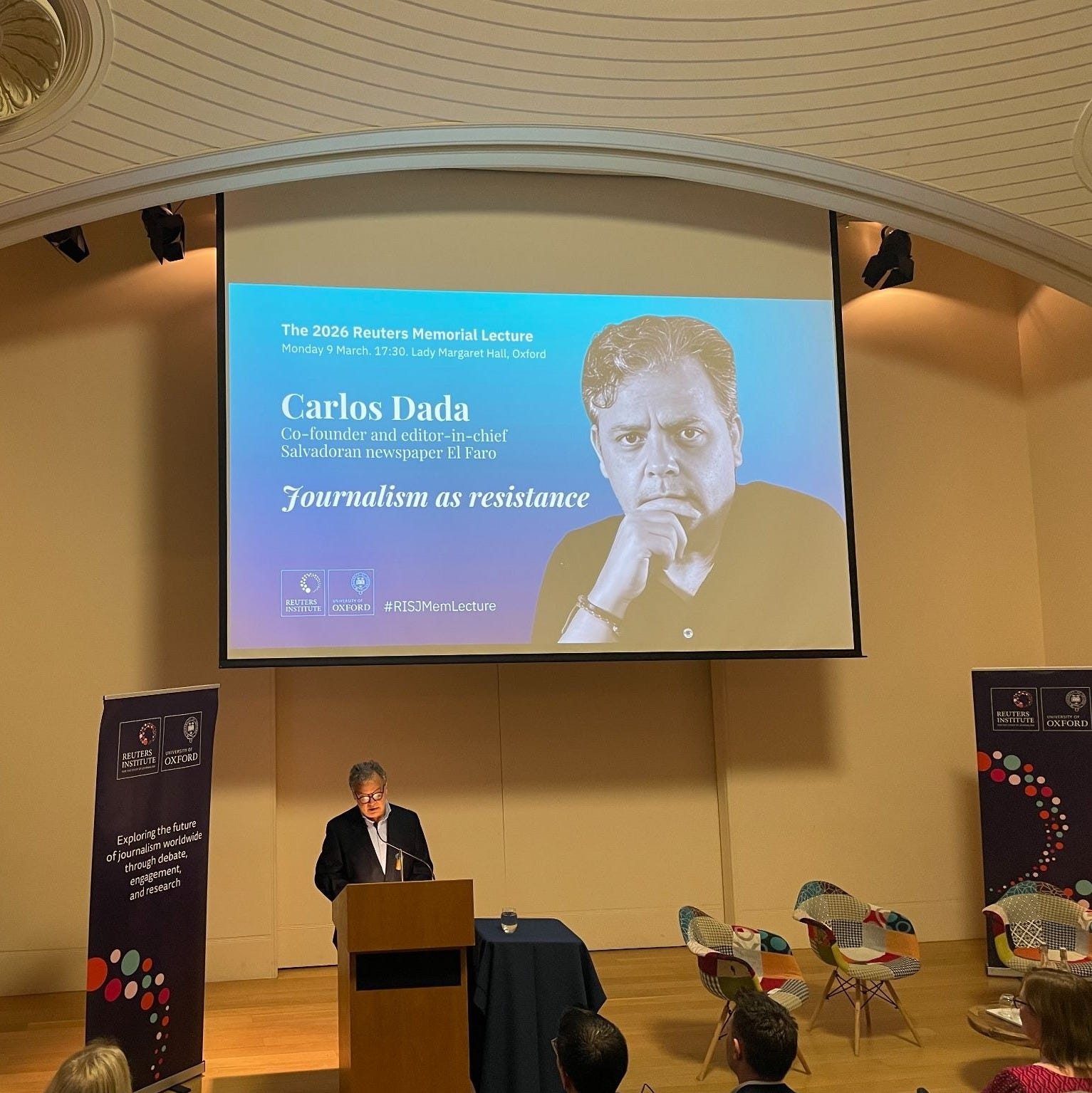
‘Visceral and viral’ is how Carlos Dada describes the populist leader of his country El Salvador – Nayib Bukele. For many of us, El Salvador has only appeared on our news cycle with news of MS-13 gang members in prison with shaved heads and tattoos on their torsos, and deportation of Venezuelans to El Salvador by the Trump administration since last year.
However, what’s happening in this Central American country reflects larger complex issues in many countries – populist leaders, human rights violations, troll farming on social media, spying software – and the seismic challenges these present to journalism and journalists.
‘Ideologies are just a vehicle,’ says Dada in a riveting and thought provoking lecture on Journalism as Resistance, at the 2026 Reuters Memorial Lecture at the University of Oxford on 9 March.
Populism and Othering – ‘It’s Always Language’
Using his country’s President Bukele as an example, Dada explains how cleverly populism works its way in creating a narrative and a monologue. Populist leaders determine the people’s needs and aspirations and create an enemy for them to blame. It could be immigrants in one country, or drug gang members in another.
‘Discourses that remained hidden or on the margins for decades have now become mainstream, encouraged and embraced by political leaders. The language sounds somewhat familiar. The hate speech, the calls to nationalism, the construction of the other, the racist language, the tribal language, the populist language.’
Dada calls the current times ‘techno populism.’ Referring to the strategies adopted by Bukele, he explains how ‘he and his team had spent years understanding social media and building what we call troll farms . . . Bukele’s propagandists knew how to use technology in their favour and deliver the message directly to those new voters . . . He ran his campaign mostly on Twitter, Facebook and TikTok, promising to do away with our corrupt political establishment.’
The ‘enemy’ could also be journalist in this discourse. Repeatedly targeted by legal threats, corruption accusation, and intimidation, El Faro’s legal registration has been been moved to Costa Rica. Dada describes El Faro as an ‘outlet of exiles for exiles.’
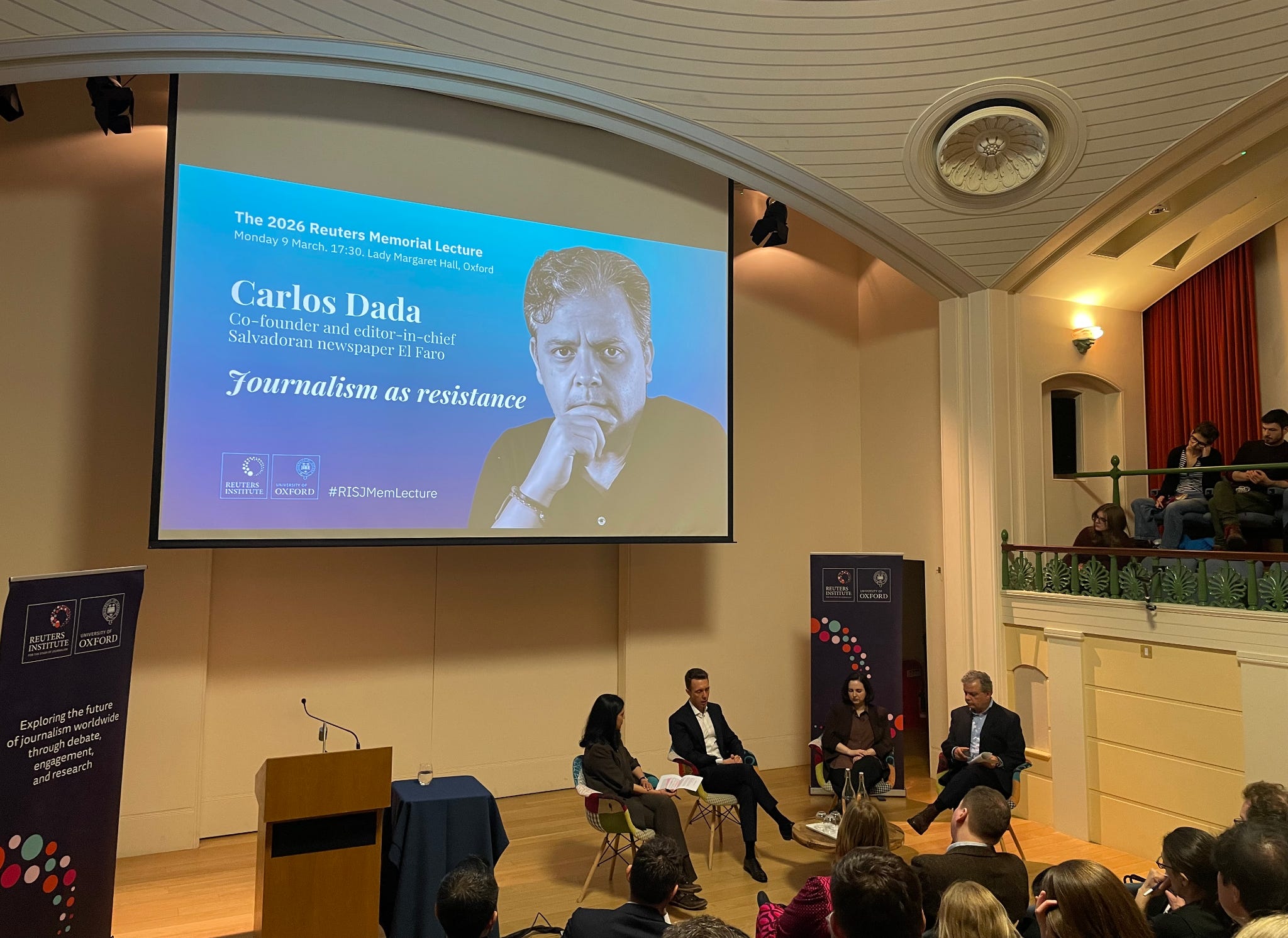
In a panel discussion following the lecture, Noa Landau, deputy editor-in-chief of Haaretz, Israel’s oldest daily, points out that in populist regimes, the line between the elite and suppressed minorities has been increasingly blurred.
‘Who is the elite and who is suppressed when the same elite has been in power for decades?’ she wonders in the case of Israel, where Benjamin Netanyahu has been in power for many years, and can definitely count on certain friendly media, and his own media outlets for favourable coverage.
The Elephant in the Room – Technology
By the end of the 2021–22 year, El Faro’s 30-plus employees had been hacked for a year and a half by the Israeli spyware Pegasus. El Faro was not alone in this. More than 180 editors, investigative journalists were reported to be the target or possible targets of Pegasus software hacking (as reported by Guardian). It’s not a coincidence that many of these journalists belong to countries with populist leaders at the helm of affairs.
Threats to journalists now are greater and faster than ever due to technology. It aids the spread of dangerous discourses at a rapid pace and cannot be challenged, cautions Dada.
Reuters global managing editor Nick Tattersall, also responsible for safety and security of journalists at Reuters, insists on ‘practising cyber hygiene’ to protect journalists emotionally and legally against attacks. Very often, he cautions, that online intimidation and harassment against journalists could turn into physical threat. Emotional preparedness and resilience of journalists has taken on more importance now in many countries where Reuters is present. Large sized organisations like Reuters are well resourced with an editorial safety team, which provide its journalists the cushion and wings to do bold and ambitious reporting.
‘Our job is not to attract people to this side or that side, it is to report accurately’ – Carlos Dada
‘No surprises journalism,’ is how Reuters defines it, checking facts and getting news from all sides ‘through the front door.’ Nick points out that Reuters, which is new to the subscription based model, saw a surge of traffic on their website and subscriptions during key moments of news and politics in the last few months. He cites Trump tariffs and events of the last few days with the US and Israel led Iran war, as events when audiences have turned to Reuters for a more ‘neutral’ fact checked analysis, rather than opinion pieces of other media outlets.
Today more than ever we need to be rigorous, as credibility can be lost in a few seconds, says Dada.
Noa shares that fact checking can take time in certain cases, but in these fast moving times, people have already made up their minds before facts are verified and delivered to them by verified channels.
Is There a Conflict Between Media and Journalism?
‘How we get our information, or as it’s called content now, is through our phone, which becomes a completely individual activity. Communities are made inside our phones with people that share our shared prejudices, rather than debate and dialogue,’ says Dada.
‘We want to invest our resources investigating power, not standing next to power. But power is draining resources from us, and very effectively.’ Dada insists in El Faro, they of course want to reach more people, but they can’t turn into content producers. He laments on the current trend where traditional allies of journalism are turning to content churning.
‘We don’t have the luxury of being tired of news,’ says Noah on the news fatigue challenge in the Middle East region.
She shares that today news organisations are not competing with another news outlet, they are competing with something else, which might create a positive atmosphere for people.
‘It will be over.’
Dada concludes on an optimistic note with the hope that people will turn to credible journalism when they will be tired of dictators and disenchanted with the populist regimes and their hollow promises.
‘We can be the draft and archivist for another generation,’ adds Noa hopefully.