


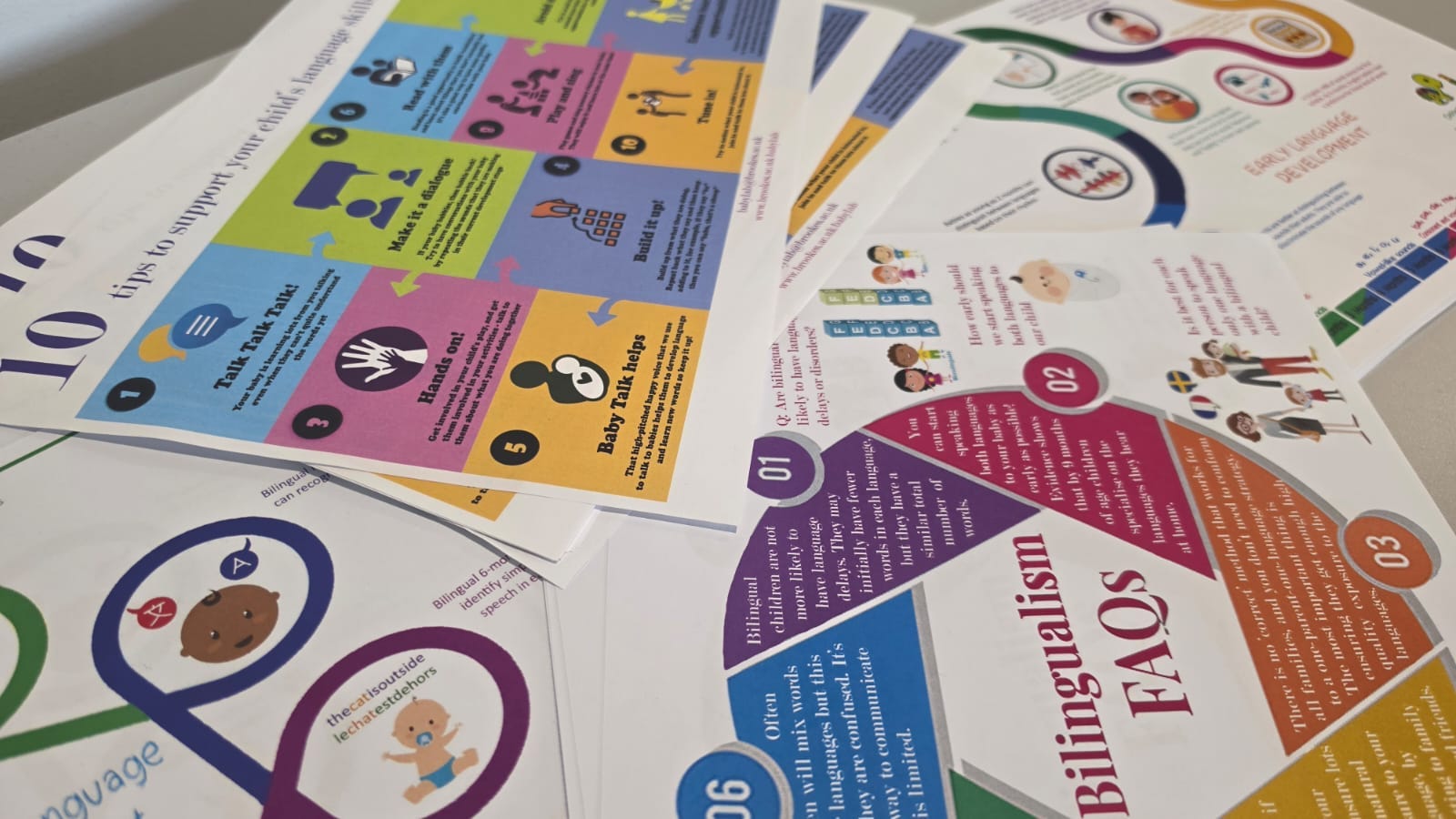
On the fourth floor of the Sinclair Building at Oxford Brookes, inside a spacious classroom, toys are scattered across the floor, mothers with their babies, and Dr Nayeli Gonzalez-Gomez, the conference organiser.
For the Baby Week’s 10 years - this annual event that celebrates “maternity, health and early years services” - a talk was held about babies and languages. A meeting between researchers and families, deemed very useful by the participants.
Rhiannon, a young mother, said : “I found it very interesting, I understand better how to dialogue with my 10-month-old daughter.”
Based on studies carried out on babies, precious information about their ability to learn was given.
With the help of techniques such as the measurement of their heart rate, the use of electroencephalography - placing electrodes along the scalp to measure the activity of the brain - or even the observation of eye movement ; it is known that, by five months, babies can already comprehend the words and that, few months later, they can produce themselves those words in an appropriated context.
However reaching this point required a great deal of work, starting from the very beginning: “At around 28 weeks of gestation, the auditory system is already functional, which means that babies in the womb can already perceive sound”, states Dr Gonzalez-Gomez.
An aptitude to understand and reproduce perfectly that we have lost over time, our brain being calibrated in such a way that it is difficult to change. Dr Gonzalez-Gomez regrets : “As a Mexican woman, I speak very well in English but, despite my efforts, I would never be able to correct my pronunciation”.
On the other hand, babies are like a blank sheet of paper. Without any notion of grammar, they manage to master a language with an average of 150 words in their vocabulary by the age of 14 months.
And this is possible thanks to general linguistic capacities, namely : prosody (rhythm and intonation), phonetic (the sounds) and phonotactic (the rules about how sounds can be combined together). Thus, they are able to distinguish between different linguistic tones, identify repetitions in sentences, or even recognise which types of words are allowed in a language.
No small task, but one that can be made easier. Dr Nayeli Gonzalez-Gomez offered a lot of tips to the mothers to accompany their children in the best way possible. Among them : “baby-talk” (an exaggerated way of speaking with high intonations) , play, sing or simply embrace every opportunity to talk to the baby. Rhiannon exclaims : “I thought baby-talk wasn’t good for babies, I am happy to learn it is not true !”.
Methods that can be done for different languages at the same time. Dr Gonzalez-Gomez confirms: “there is no proof that teaching several languages to a baby will confuse them”.
A fact that all the polyglot moms present in the rooms have themselves already been able to notice. Anna, a mother originally from Poland whose spouse is Romanian, says: “It is mindblowing how natural it is for my daughters to switch languages”.
It is all a question of exposure that has to be done as early as possible, because “by the end of the first year, the brain of the baby will specialize on their own language”, clarifies Dr Gonzalez-Gomez. It doesn’t mean that older babies cannot learn a new language.
Margaux, mother of two kids, one of whom is four years old, is now introducing Arabic at home : “I have also signed my four-year-old up for some classes”.
An objective that requires greater effort, but is undoubtedly made easier by the fact that the child already speaks French, Italian and English fluently. His brain is more flexible than a monolingual. Moreover, “I think that if the child realises that their language skills allow them to communicate with others, they will feel a great sense of pride and do everything they can to develop those skills further” tells Margaux.
Dr Nayeli Gonzalez-Gomez continues : “I am very happy to hear from all of you because now, I know I have to do a follow-up for bilinguals ! That is why those conferences are important : they are a good opportunity to check which aspects of our research we need to explore further”.