


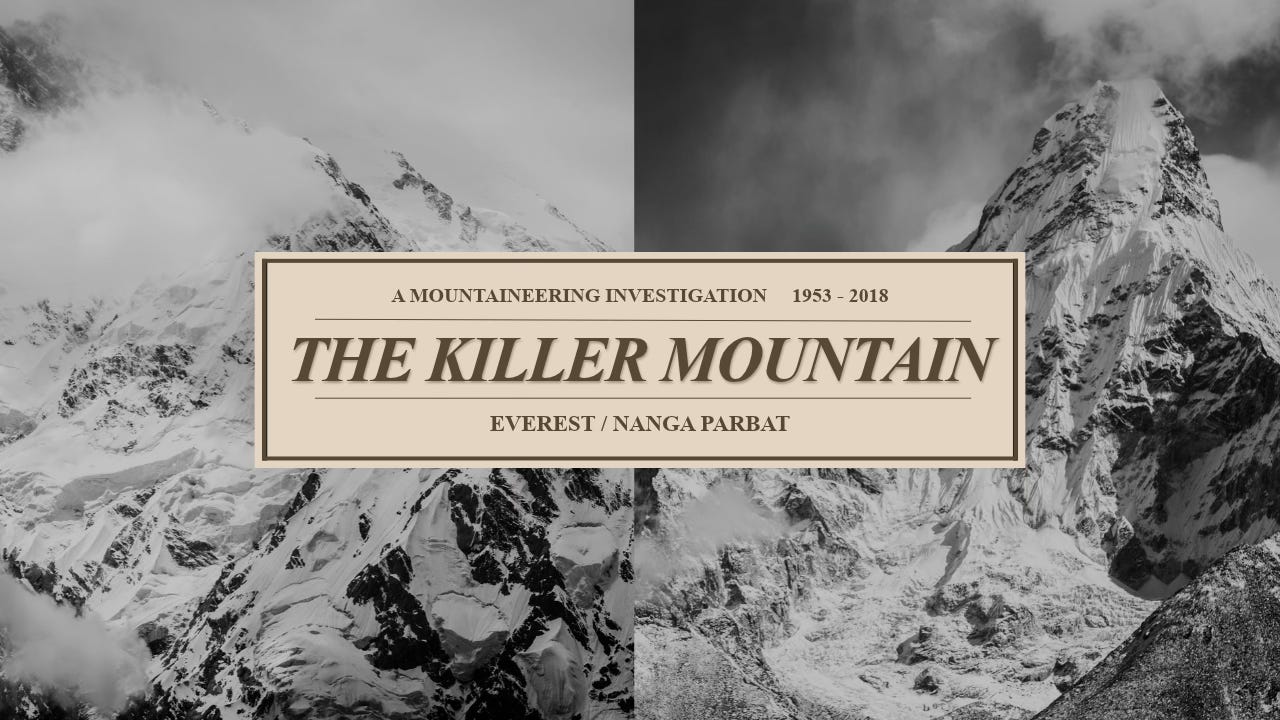
At seven o’clock on the evening of 3 July 1953, Austrian mountaineer Hermann Buhl stood alone on the summit of Nanga Parbat, Pakistan. At 8,126 metres above sea level, it was already rather late in the day to be standing anywhere, particularly with an entire mountain still to descend.
Buhl had reached the summit without supplementary oxygen. His only food for the climb was dried fruit and nougat, most of his provisions having been left with a companion who never made it to the top. He planted his ice axe at the summit and began his journey down, with no food or water left, eventually spending the night standing against a rock, waiting for daylight. By the time he made it back to base camp, three days after setting out, he was exhausted and suffering from frostbite. This was the first successful ascent of Nanga Parbat. Seven previous expeditions had failed, and 31 people had died trying.
Just over a month earlier, Edmund Hillary and Tenzing Norgay had reached the summit of Mount Everest, standing at 8,848m, between Nepal and Tibet. Both mountains had finally been climbed in the same year, but their reputations were headed in rather different directions.
Everest became a household name, even among people whose mountaineering experience extends no further than the odd steep hill. Nanga Parbat, the world’s ninth-highest peak, acquired a less reassuring title: the Killer Mountain. Although Everest has accumulated considerably more fatalities, a closer look at the numbers suggests that the less famous of the two has a particularly grim climbing history.
So which one is the deadliest?
An analysis of mountaineering records between 1953 and 2018 found 280 deaths on Everest, compared with 52 on Nanga Parbat.
On numbers alone, Everest appears the obvious winner of a competition nobody wants to win, but those fatalities occurred against very different levels of climbing activity.
Over the same period, Everest recorded 9,165 successful ascents, compared with just 375 on Nanga Parbat. This works out to approximately 3.06 deaths for every 100 successful ascents on Everest, against 13.87 on Nanga Parbat.
The distinction matters; these figures are not a climber’s probability of dying. Someone who abandons an expedition halfway does not appear in the summit total, whether they return safely or never reach the foot of the mountain. Some climbers also conquer summits more than once. To calculate an accurate mortality rate, we would need comparable records of everyone who attempted both mountains, including those who never reached the top.
Still, the difference is enormous, and it raises a rather obvious question: what has made Nanga Parbat such an unforgiving mountain?
A MOUNTAIN WITH A HISTORY
Nanga Parbat had been claiming lives long before anyone reached its summit.
Avalanches, falls, exposure and disappearances are common denominators in Nanga Parbat’s fatality records. The mountain’s steep faces and unpredictable weather have contributed to its reputation, although the exact circumstances of many older deaths remain unknown.
In 1895, British mountaineer Albert Mummery disappeared while attempting the peak alongside two Gurkha1 soldiers, Raghobir Thapa and Goman Singh. The three men were never seen again.
The following decades were a theatre for several ambitious German expeditions, some of which carried political meaning far beyond mountaineering. Success was however not guaranteed. In July 1934, ten people died during a German-led expedition, caught in severe weather. Three years later, an avalanche destroyed a camp, killing another 16 people. This helped paint Nanga Parbat as Germany’s Schicksalsberg, or ‘Mountain of Destiny’, and the deaths became part of its nationalist propaganda. It has been said that the disaster ‘for sheer protracted agony, has no parallel in climbing annals’. Among the 31 people who died before Buhl’s successful ascent were 17 porters.
The historical figures also reveal how much the relationship between fatalities and successful ascents has changed: during the 1980s, Everest actually recorded a higher deaths-to-summits ratio than Nanga Parbat: 33.3 deaths per 100 successful ascents, compared with 27.6.
By the 1990s, the figures were almost identical, at approximately seven to eight deaths per 100 summits on both mountains. The following decade marked a turn; between 2000 and 2009, Everest’s ratio had fallen to 1.5, while Nanga Parbat stood at 4.9.
These comparisons need some caution, especially in earlier decades when relatively few people reached either summit. A handful of fatalities can make a considerable difference to a statistic when based on a small number of ascents.
Both mountains have undergone major transformation since the first expeditions of the twentieth century. Advances in equipment, weather forecasting, supplementary oxygen have transformed high-altitude mountaineering, and commercial expeditions kept growing.
Nanga Parbat, however, has never attracted anything approaching Everest’s number of successful climbers.
Whether these differences explain the changing fatality figures is harder to establish, as the data shows what happened, but rarely why.
WHEN THE NUMBERS BECOME MISLEADING
There is also a rather uncomfortable problem when deciding what counts as a mountain death.
On the night of the 23rd of June 2013, armed militants attacked Nanga Parbat’s base camp, killing 11 people, including a Pakistani guide. The victims were not killed by an avalanche, a fall, the effects of altitude… They were murdered. All 11 deaths still appear in the mountain’s fatality records.
Including them in our calculations here is factually correct, but treating them as evidence of the dangers posed by the mountain itself is another matter.
When these deaths are excluded, Nanga Parbat’s figure for 1953-2018 falls from 13.9 to 10.9 deaths per 100 successful ascents. This is still more than three times Everest’s equivalent ratio, but it makes an important difference to the historical comparison.
It also shows us how easily statistics can become misleading when they are separated from the circumstances behind them. The same problem happens when counting fatalities without considering the people behind the numbers: mountaineering records include expedition members and workers, whose exposure to danger can differ. The deaths of those preparing routes and carrying equipment are just as real as those of climbers hoping to stand at the top.
Even seemingly straightforward causes of death can hide complicated circumstances. An avalanche might be recorded as the immediate cause, while the climber’s route, decisions, equipment and weather conditions might have all contributed to the outcome. There isn’t a single figure capable of accounting for all of that.
Maybe this is the trouble with trying to identify the world’s deadliest mountain: a death toll tells us how many people never came home, a summit count tells us how many made it to the top, but what happened to everyone in between is a lot harder to fit into a spreadsheet.
1 - Soldiers native to South Asia, primarily from Nepal and parts of North India