



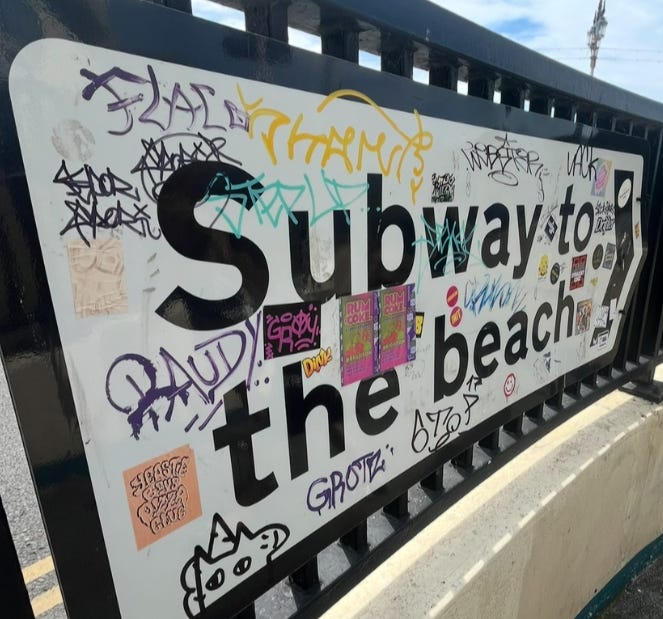
Brighton: the seaside city where you can unwind and have a pint in the sun (or, more realistically, on a drizzly grey day). Brighton is widely recognised as gay-friendly, with deep roots in liberalism and artistic freedom. But is there real data to back up this inclusivity?
Brighton Pavilion tops this chart with just under 12%, but how did it earn this reputation? In this article, I’ll be comparing constituencies across the UK, focusing on the highest and lowest percentages, and examining why the reported percentages are so different.
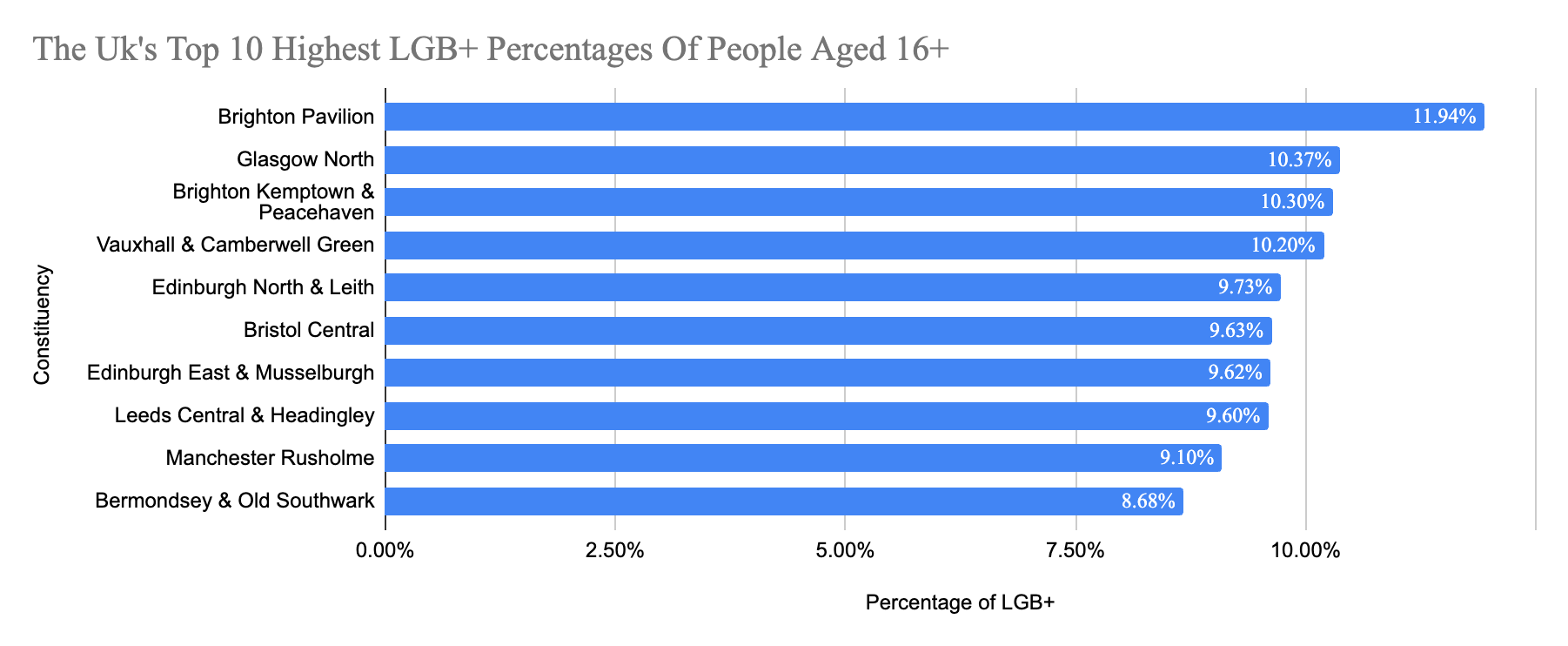
This data was published by the House of Commons Library in March 2026 and was collected in England, Wales, and Northern Ireland in 2021, and in Scotland in 2022. It asked UK residents aged 16+ about their sexual orientation, with the categories ‘Straight/Heterosexual’, ‘Gay or Lesbian ’, ‘Bisexual’, and ‘Other Sexual Orientations’. All graphs in this article were created directly from the dataset.
The top three constituencies with the highest percentages are Brighton Pavilion with 11.94%, Glasgow North with 10.37%, and Brighton Kemptown and Peacehaven with 10.3%. These percentages are exceptionally high compared with the lowest constituency, Mid Ulster, which has only 1.08%. In context, just under 120 in every 1000 people who live in Brighton Pavilion are LGB+, while just over 11 in every 1000 people who live in Mid Ulster are LGB+.
The data does have limitations - responses were voluntary, and for all constituencies, a percentage of people didn’t answer. For example, 9.17% of Brighton Pavilion’s residents didn’t respond, meaning the percentage of LGB+ individuals may not have been fully captured. Similarly, 7.4% of Mid Ulster’s population didn’t answer the sexual orientation questions, which could potentially change the findings of the data.
With the top three LGB+ constituencies being two-thirds Brighton (Brighton Pavilion and Brighton Kemptown & Peacehaven sandwiching Glasgow North), it’s no secret that Brighton is the ‘gay capital’ of the UK.
Royal Collection Trust explains that Brighton quickly gained popularity when George IV visited in 1783, when he attempted to tackle his gout with Dr Richard Russell’s seawater medical treatment. He decided he wanted to stay, and had the Royal Pavilion built. The Pavilion became a place for entertainment, and a crowd were attracted to Brighton, with a multitude of famous faces beginning to appear in the seaside town - Brighton and Hove Museum claim Oscar Wilde, Anne Lister (dubbed the first modern lesbian, often known as Gentleman Jack), and Harriet Elphinstone-Dick were among them. By the 1930s, Brighton had become openly known as a gay location - people could relax and let their hair down, which attracted the LGB+ youth of not-so-far London. Six years after male homosexuality was decriminalised, Sussex Gay Liberation Front organised the first Pride March in 1973 - and from 1991, Pride had reached Brighton.
In modern-day Brighton, the city is filled with LGBTQ+ communities - physically and online. Brighton is dotted with LGBTQ+ bars, cafes, clubs, and community spots, with a growing community, perhaps due to LGBTQ+ individuals migrating from other UK constituencies where they may not feel accepted.
Brighton being top of the list isn’t surprising - but some of the other top LGB+ percentages could be.
The sixth highest percentage is Bristol Central, recording 9.63% of the constituency to be LGB+, and with over 40,000 people attending the main Pride Festival, Bristol is the fifth largest Pride in the UK.
I spoke to Brookes student Amara Baker, who is part of the LGBTQ+ community and was raised in Bristol. She discussed how accepted she feels, and how Pride has made her feel even more of a part of the community.
Amara explains that Bristol Pride is a huge event, as well as discussing Airbus, whose engineering and aircraft design centre is in Bristol, and have an LGBT+ employee resource group within their company and promote zero-tolerance for homophobia.
Amara says, ‘While homophobia is still prevalent within Bristol, I can say I’ve had fewer encounters there than I’ve had in other places across the country. It’s somewhere you feel safe and respected, especially when showing public displays of affection as an LGBTQ+ couple.’
Brighton’s rainbow reputation is acknowledged across the UK - but what about the lowest percentage LGB+ populated constituencies?
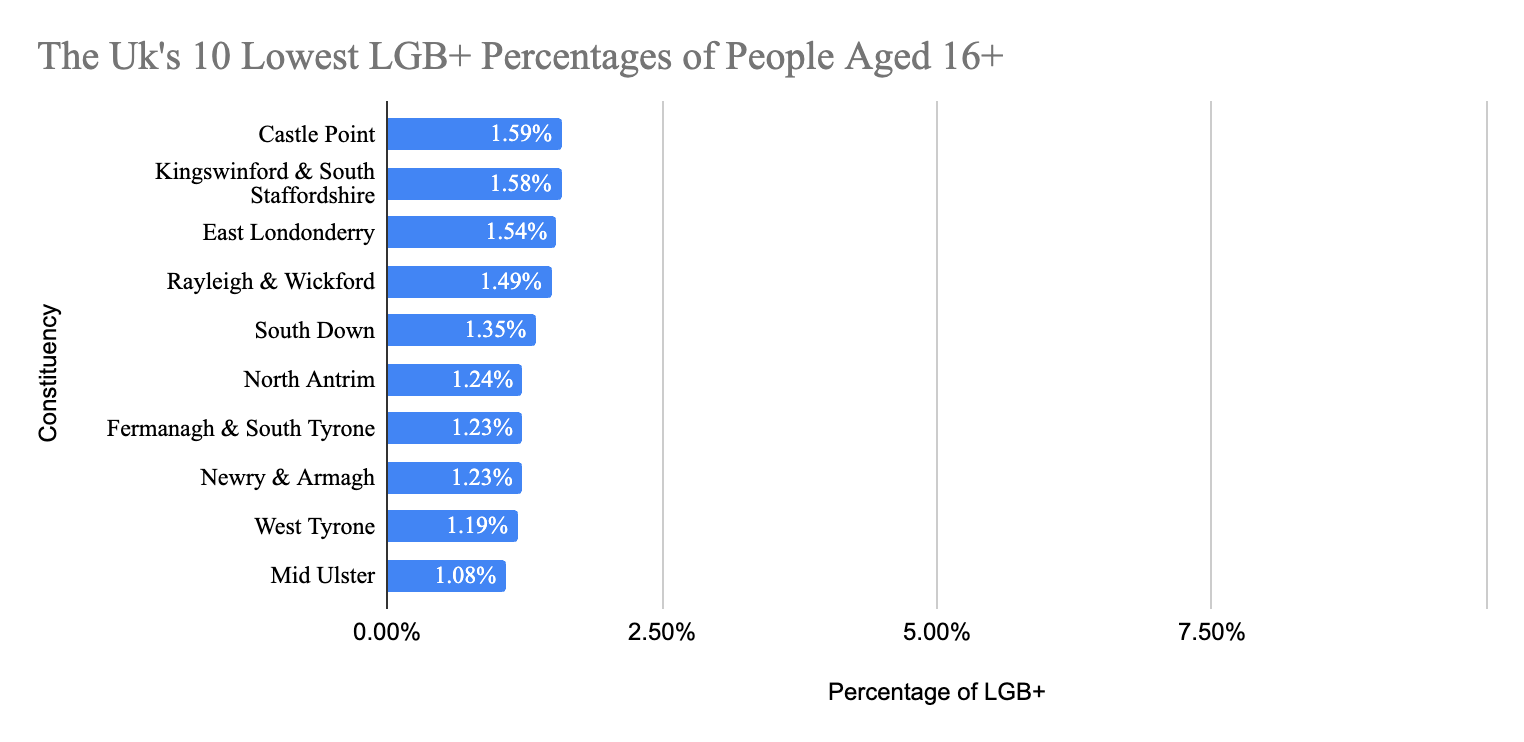
Northern Ireland’s Mid Ulster constituency statistically has the lowest LGB+ population, with 1.08% being LGB+. Interestingly, seven of the lowest ten percentages are in Northern Ireland, two are in Essex, and one is in Dudley. Mid Ulster is rural and saturated with Northern Irish history, and many LGB+ individuals may enjoy living in more urban areas, like Belfast, which has a 3.7% LGB+ population - and therefore may migrate from Mid Ulster, causing their percentage to lower.
For historical context, legislation on same-sex marriage in Northern Ireland was passed in 2020 - seven years after England and Wales. Data from Agriland exploring the needs of gay people in Northern Ireland found that 43% of gay people’s decision to move out of a rural Northern Irish constituency was at least partly because of their sexual orientation.
According to Derry Now, ‘The Mid Ulster district recorded the second highest rise in homophobic incidents (+17) and the highest rise in homophobic crimes (+21) in 2021-2022.’ In an article written by Ireland Live, the health and wellbeing officer for Mid Ulster Pride says that the entirety of Northern Ireland needs to do more for the LGBTQ+ community overall. LGB+ individuals may not feel as safe in Mid Ulster due to its rise in homophobic crimes; however, these statistics could also show that people are reporting crimes more frequently, which could be optimistic in terms of speaking out.
The repeated appearance of Northern Irish constituencies in the lowest percentages of LGB+ populations could be attributed to the religious views of many Northern Irish citizens - a 2021 census published by the Northern Ireland Statistics and Research Agency showed that just under 90% of Northern Ireland were raised either Catholic or Protestant. Most religions have certain views on LGBTQ+ identity; according to the Human Rights Campaign, the Catholic and Protestant Churches don't say homosexuality is sinful, but can have traditional, negative views. According to a 2004 survey published by Northern Ireland Life and Times, in 1998, 67% of Protestant respondents and 50% of Catholic respondents said that same-sex relations were always wrong. This data is nearly three decades old, but it could provide context for Northern Ireland’s religious attitudes towards LGB+ people.
Essex constituencies take two of the lowest percentage spots on the census - Castle Point with 1.59% and Rayleigh & Wickford with 1.49%. With London’s thriving and diverse population, LGB+ individuals in Essex may rather move to nearby London where they feel accepted. According to Essex Pride organiser Gary Ormes, Essex being so close to London means more LGBTQ+ individuals move there, where there is ‘much more of a thriving, multicultural community.’
The census shows that Brighton Pavilion and Mid Ulster differ by 10.86 percentage points. The data can’t explain why a constituency ranked where it did, but it does outline the facts. The data may offer reasons about where LGB+ individuals feel comfortable living, and how people are willing to identify themselves, but a high LGB+ percentage in a constituency doesn’t mean that it’s inclusive, and a low percentage doesn’t mean it’s homophobic. Are smaller constituencies doomed to lack inclusivity, or is it that people search for big, bustling cities and don’t give them a chance?