


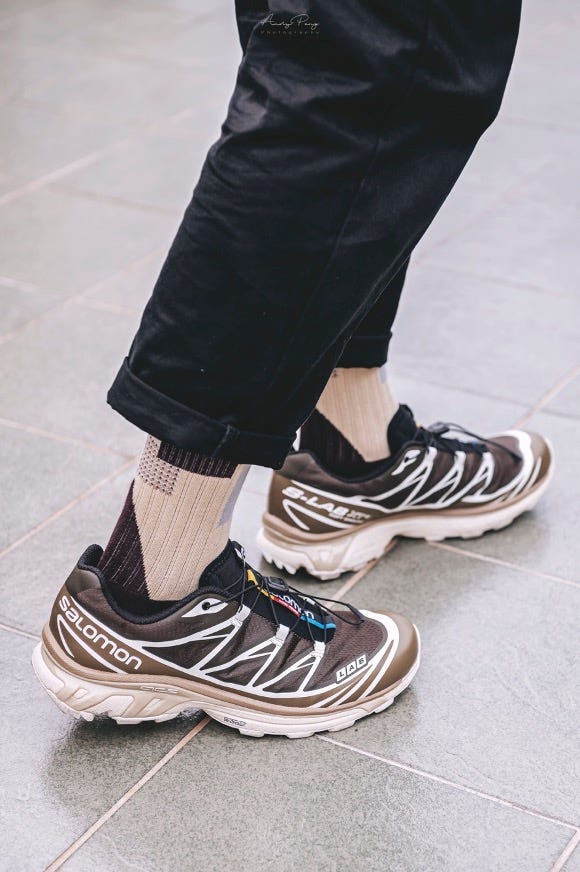
It’s an autumn afternoon on the Central Line. The underground train you’re sat on comes slowly to a halt at Notting Hill Gate, the brakes gently squealing. The doors slide open and off get those wearing Bathing Ape hoodies and overly ripped jeans. On walk those wearing technical Patagonia fleeces and a plethora of brightly coloured Arc’teryx Beta jackets, all being unzipped following a recent rain shower. You notice how nylon begins to sit where denim used to, but someone notices you staring. You look straight back at your own feet, but you live in London in 2026, so you’re wearing a pair of Salomon XT6’s, as well as everyone else on the train.
Gorpcore is (or was) the fashion trend around wearing traditionally technical, functional outdoor clothing in juxtaposing settings, trading the Alps for Aldgate East. I bet you whatever’s in your wallet that you can’t guess where the word ‘Gorp’ actually originates from. Gore-Tex? Great outdoors? Nope. It was coined originally by American writer Jason Chen in 2017, taking its name from trail snacks usually stored in the pockets and eaten by those wearing technical clothing – ‘Good Ol’ Raisins and Peanuts’, or ‘Gorp’ for short. So, if you’d like to send your wallet contents to our offices that would be greatly appreciated.
Gorpcore has always been present, despite its recognition in 2017. Cities like New York, Copenhagen, Tokyo, as well as London, had begun to see increases in outdoor clothing becoming more of a regular staple. More exposure came from celebrities like Frank Ocean unintentionally becoming the Gorpcore poster boy at Paris Fashion Week in 2019.
Ocean rocked up sporting a Mammut Eigorjoch puffer and Diemme hiking boots, topped off with an Arc’teryx Toque beanie. This casually sent the fashion world into a frenzy, remarking upon the outfits blend of comfort yet readiness for any eventuality.
Lockdown proved to be a rapid accelerator for Gorpcore as well. Remember all those walks and bike rides you were going on whilst big Boris was telling us to stay home? And remember the sheer amount of time you spent on TikTok? Well both of those factors married together quite nicely.
Outerwear became more essential, and TikTok ‘Fit Checks’ and ‘OOTD’ (Outfit of the Day) trends became more frequent on our For You Pages. Gorpcore started to become more of a trendy choice.
“I found out about Gorp from Mimi Moocher, inspired from her travelling fits. The fact it also stands for Good Ol’ Raisins and Peanuts as well. I never knew that”
When the world finally started getting back to normal, it was evident that Gorpcore was here to stay. People were purchasing technical outerwear without intention of utilising any of the features listed on the website. Brands responded, increasing availability worldwide. However, as the cultural value of certain products rose, so did their financial value. An Arc’teryx shell jacket used to set you back around £300. Nowadays if someone sold one for that price, you’d assume it to be a fake, with new examples being listed currently at over £600.
London has transcended the ‘trendy’ phase of Gorpcore now. In reality, it has actually just become the norm. I challenge anyone spend more than ten minutes in the capital without seeing a vintage The North Face fleece of any description.
Vi, a nineteen-year-old second year art student at UAL, tells us about her discovery of Gorpcore, and how she incorporates it into her everyday life:
“Honestly, my go to pub look is just layering – a corny graphic tee underneath a Columbia shell jacket is all I need.
“I’m also a fan of these baggy Nike ACG trousers I found on Depop, with a pair of Oxblood chunky loafers poking out.
“I found out about Gorp from Mimi Moocher, inspired from her travelling fits. The fact it also stands for Good Ol’ Raisins and Peanuts as well. I never knew that”
London has become a natural home for Gorpcore, and when you break it down, it’s not hard to see why. The city demands constant movement; vast, overcomplicated stations, busy streets, the inevitability of the Lime Bike. It’s a city that, at times, can require the vast range of different technologies offered by leading brands.
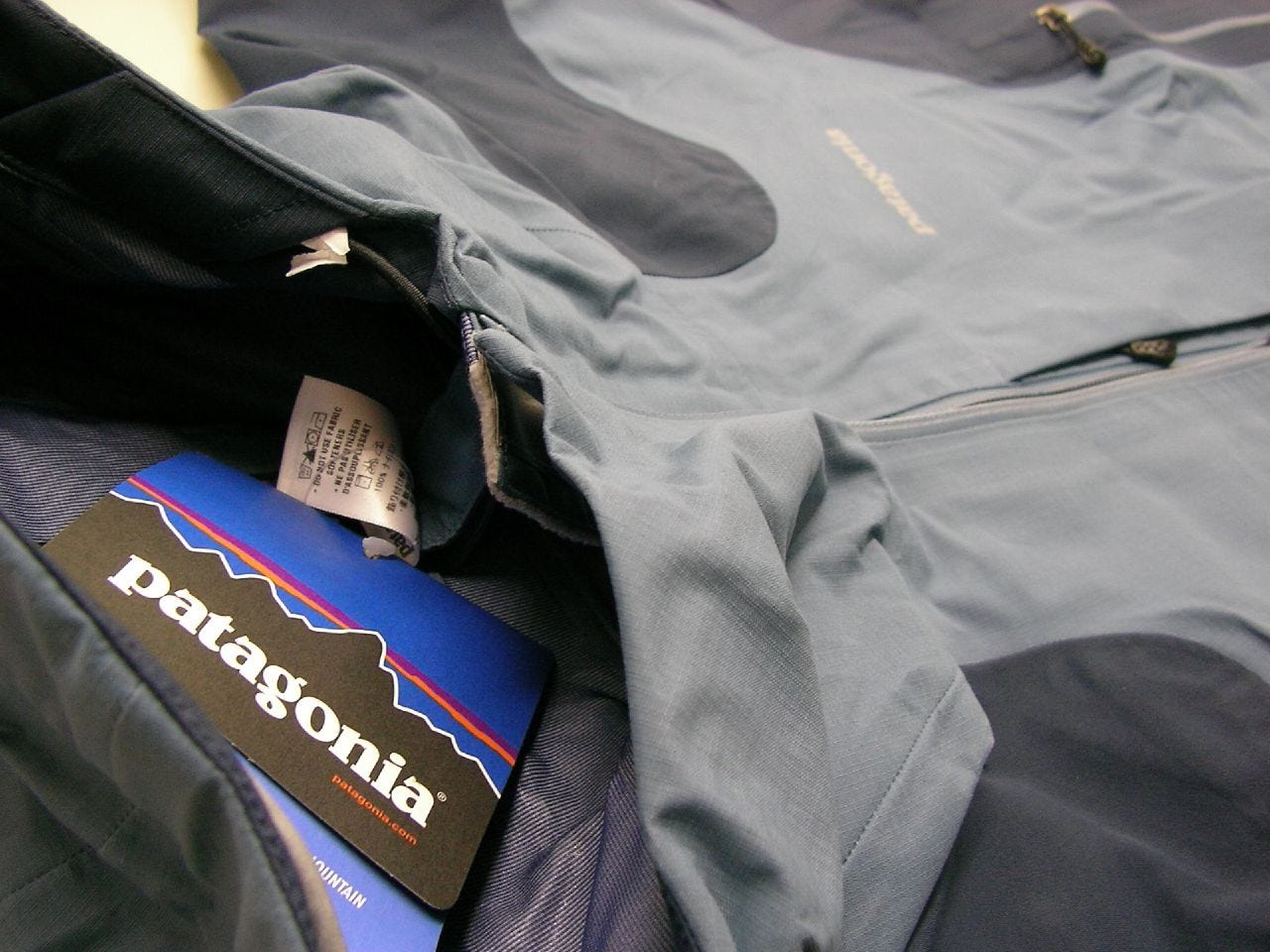
Salomon’s AC Muscle midsole foam comes into its own when walking thousands of steps across town, and Patagonia’s R1 Air breathability is vital on a humid summer’s day in the city.
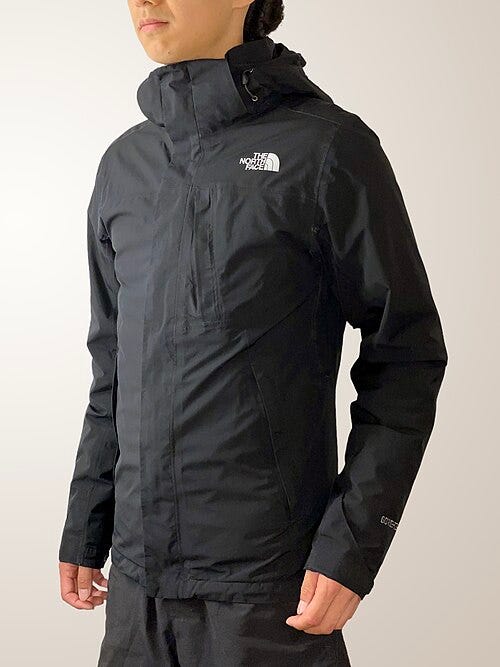
However, the most important weapon in a London Gorpcore wearers arsenal is the shell jacket, and the best of those utilise Gore-Tex technology. For those that have never visited the UK, or maybe just those that live under pretty massive rocks, you need to know that Britain is wet. Very, very rainy indeed.
“Honestly, my go to pub look is just layering – a corny graphic tee underneath a Columbia shell jacket is all I need.”
For those living in Blighty, Gore-Tex is essential; an ultra-thin membrane developed in the sixties, designed to always keep the wearer dry and protected from the wind, all in a garment that doesn’t compromise on breathability.
The Gore-Tex label is still seen as the ‘gold standard’ waterproof standard in the outdoors world, and ironically finds itself very much at home hanging on the back of a pub chair in Soho. Londoners usually prefer the technology in Arc’teryx Beta form, or maybe in The North Face GTX Mountain Jacket, sometimes even in their Salomon trail shoes. But the shell jacket is always the centrepiece of any Gorpcore outfit, especially to Londoners that are just nipping into the office or jumping on a Lime bike for a drink later. The shell is their natural defence against the city’s unique climate of, well, rain.
To someone visiting London for the day, they may assume everyone around them wearing identical outfits; a waterproof jacket rolled at the waist, a pair of technical, baggy trousers (or loose fit jeans), and some sort of Salomon trail shoe of choice. They may, however, be oblivious to the subtle differences between products, from one Gorper to the next. For example, they may not realise the sheer difference in price from trail shoe to a regular Adidas Samba. Or the nuances between different types of Arc’teryx jacket.
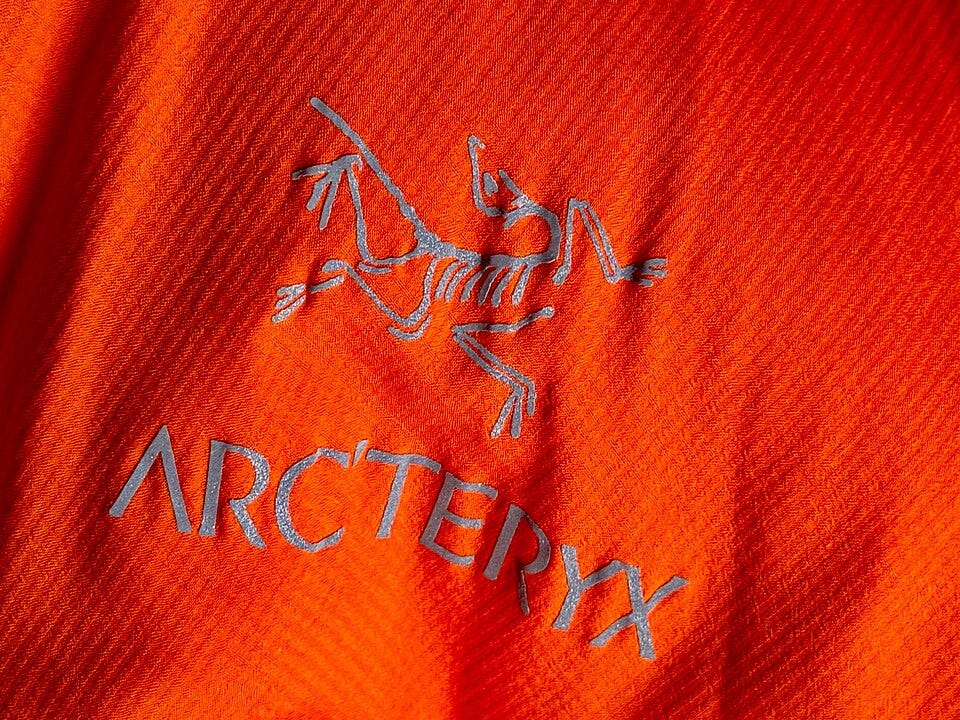
As I hope you are aware at this stage, Arc’teryx jackets are expensive. Like, really expensive. That’s why second-hand marketplaces are crawling with fakes at a fraction of the price. If you were to go directly to the website and order one, however, you could be looking at an £800 bill. Even the humble beanie, a staple of Gorpcore, could set you back as much as £60.
With the immense financial value also comes the weight of cultural value when wearing an Arc’teryx Alpha SV jacket; other Gorpcore wearers in their The North Face shells and Patagonia fleeces would know exactly what they were seeing, and the price paid by the wearer.
Value is often reflected through recognition, not communication when it comes to Gorpcore. The subtle hierarchies are layered just like their technologies, with a vast scale of values between items.
Now, truth be told, I have probably used the term Gorpcore far more than it’s really been used in the past year or so. That’s because it isn’t really a conventional ‘trend’ anymore. It moved into Londoners lives over eight years ago, and has settled in very nicely indeed. The technical jackets and chunky trail shoes that once signalled the beginning of a new movement are now looked upon as ‘normal’. In fact, they are not even looked upon, they just blend into everyday London life.
Miles and Millie move through the city without distinction; no one looks twice as they sift through long queues for the tube. Those attuned to Gorpcore will understand and respect their outfits, as they remain invisible to others. Gorpcore has outgrown definitions. People once took to the streets in technical clothing to stand out, and in 2026, people do the same just to blend in. It absorbed into the rhythms of the city, the weather, the transport, the ‘rat race’ that tens of thousands find themselves in every day. In London, Gorpcore hasn’t disappeared – it has simply become the everyday uniform.