



Lonely in a crowded room
It is true that you can be alone without feeling lonely. Being alone is a physical state of being by yourself, residing in moments of solitude can be healthy. It allows us to recharge and find a moment of peace in the chaos of day-to-day life.
Loneliness, however, is an emotional experience characterised by sadness and a lack of meaningful connection. It’s not defined by how many people are around you, but by whether you feel seen and understood. It is the feeling that arises when there is a mismatch between the relationships we have, and those that we need.
Yet official statistics reveal a more complicated picture of wellbeing in Great Britain since 2020. While levels of low happiness have declined, loneliness has proved more difficult to shake.
Lonely often, always or some of the time
How often do you feel lonely?
We live in an era of constant digital communication. Yet, in 2026, 38% of people aged 16-29 in Great Britain reported feeling lonely often, always, or some of the time. Among those aged 70 and over, the figure was 17% - less than half of the proportion reported by the youngest age group.

[Loneliness by age group, September 2026 (ONS)]
Loneliness is widely perceived as a problem of later life. People tend to overestimate loneliness among older people and underestimate it among young adults. However, the data reveals a different story, suggesting that concerns about loneliness should extend across generations.
Living in the shadow of the pandemic
The COVID-19 pandemic may feel like a distant memory now, but in 2020 we were all forced to confront loneliness in a new way.
Research suggests that young adults were particularly affected by loneliness during the pandemic, as lockdown restrictions coincided with significant life transitions, including leaving education, entering the workforce, and settling into adulthood.
National lockdowns and social distancing restrictions left many people socially isolated and forced us to confront loneliness in a way we had not experienced before. With this in mind, you might expect loneliness to have been at its highest in 2020.
However, the figures suggest that loneliness did not simply disappear when restrictions were lifted. In fact, reported loneliness increased in the years that followed. In 2020 the average proportion of people reporting loneliness was 23.85%. By 2024, this figure peaked at 26.17%, before falling to 24.67% in 2026.
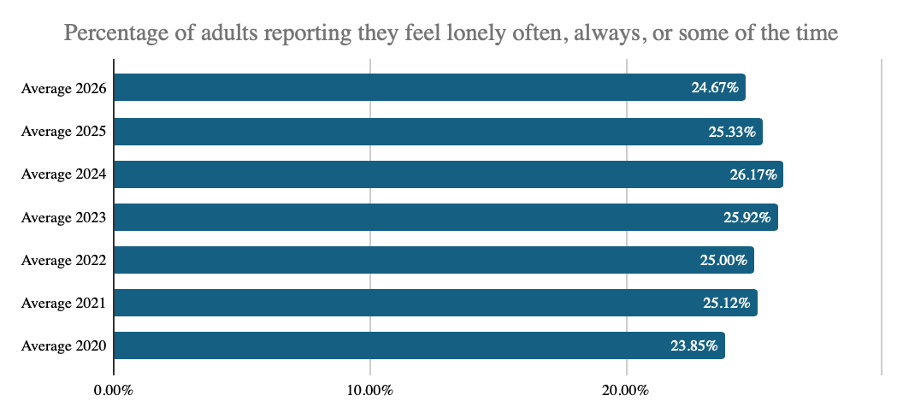
[Average percentage of people reporting loneliness, 2020–2026 (ONS)]
It’s not all doom and gloom, though. The data shows that since the COVID-19 pandemic levels of low happiness have dropped. In 2020, 13.05% of people reported low levels of happiness. By 2026, that figure had fallen to 11.89%.
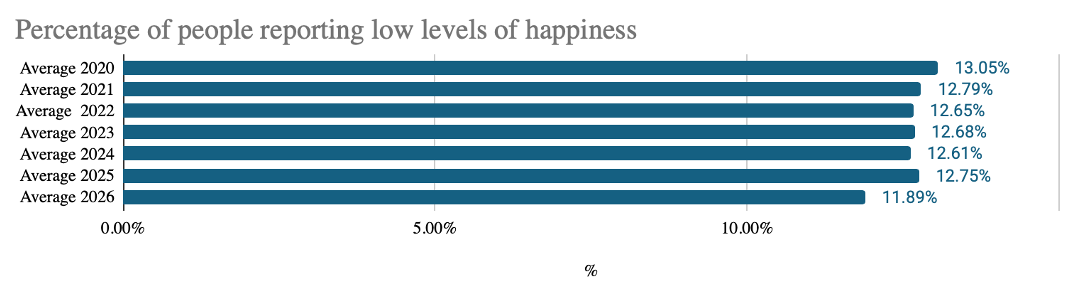
[Percentage of people reporting low happiness, March 2020–September 2026 (ONS)]
So why are certain aspects of the nation’s wellbeing, such as happiness, steadily improving, while levels of loneliness are seeing no significant decline?
Beyond the numbers: The circumstances behind loneliness
There is no single root cause of loneliness. It goes much deeper than simply lacking meaningful connections. It turns out that socioeconomic factors in England also play an important role in our wellbeing.
What do the figures tell us?
Work status - People not in work (8.4%) are more likely to experience chronic loneliness than those who are (4.8%).
Level of deprivation - People who live in more deprived areas are at a higher risk of experiencing chronic loneliness (9.3%).
Living status - People who do not live with a partner are more likely to be lonely. Those who are widowed, separated, or divorced are 3.5 times more likely to experience chronic loneliness. And people who had never been married are 2.5 times more likely to experience chronic loneliness than those who were living with a partner.
Health - People with a long-term health condition or disability are 2.9 times more likely to experience chronic loneliness than those with no such condition or disability.
Household income - Descriptive analysis revealed that people in the highest income quintile were less likely to experience loneliness than people in all other income groups.
Taken together, these figures suggest that loneliness must not simply be understood as a failure to maintain social relationships. We often hear the argument that we are the most connected generation, thanks to social media. So why do so many of us still feel lonely and disconnected?
It is not necessarily about how many people we know. Employment, financial circumstances, health, and living arrangements all shape people’s opportunities for connection. Ultimately, it is about the circumstances that determine how accessible meaningful relationships are in the first place.
A question of wellbeing: Do you even understand me?
Perhaps the most surprising finding is that happiness and loneliness do not necessarily move together. We have more ways than ever to communicate, yet that does not guarantee the kind of meaningful connection that makes you feel seen. A message, a notification, or a room full of people cannot replace the feeling of being understood.
Our wellbeing is shaped by the lives we are able to lead. If we are serious about tackling loneliness, we need to look beyond individual interactions or relationships and pay closer attention to the wider social and economic circumstances that shape them.
Perhaps the question is not whether we are more connected than ever, but whether those connections are fulfilling our needs. If the figures reveal anything, it is that becoming happier does not necessarily mean becoming less lonely.