


On 25 February 2025, the Prime Minister, Keir Starmer, announced that the UK would raise its defence spending to 2.6% of gross domestic product (GDP) in 2027.
This increased investment in defence will come at the cost of reducing aid spending from 0.5% of gross national income (GNI) to 0.3% in 2027.
The UK contributes to international aid through the Official Development Assistance (ODA) to promote the economic development and welfare of developing countries. It is bound by International Development (Official Development Assistance Target) Act 2016 to spend 0.7% of GNI on aid.
Between 2013 to 2020, the UK has met this target each year.
Not meeting this target requires an explanation by the government to Parliament, and meeting one of the three reasons — 1) economic circumstances, such as a fall in GDP (which was the case for UK aid reduction from 0.7% to 0.5% of GNI in 2021 due to the impact of pandemic on the UK’s economy); 2) fiscal circumstances and the effects on taxation, public spending and public borrowing and; 3) circumstances arising outside the UK.
Neither of the above three circumstances exist currently, which would warrant a drastic reduction of ODA.
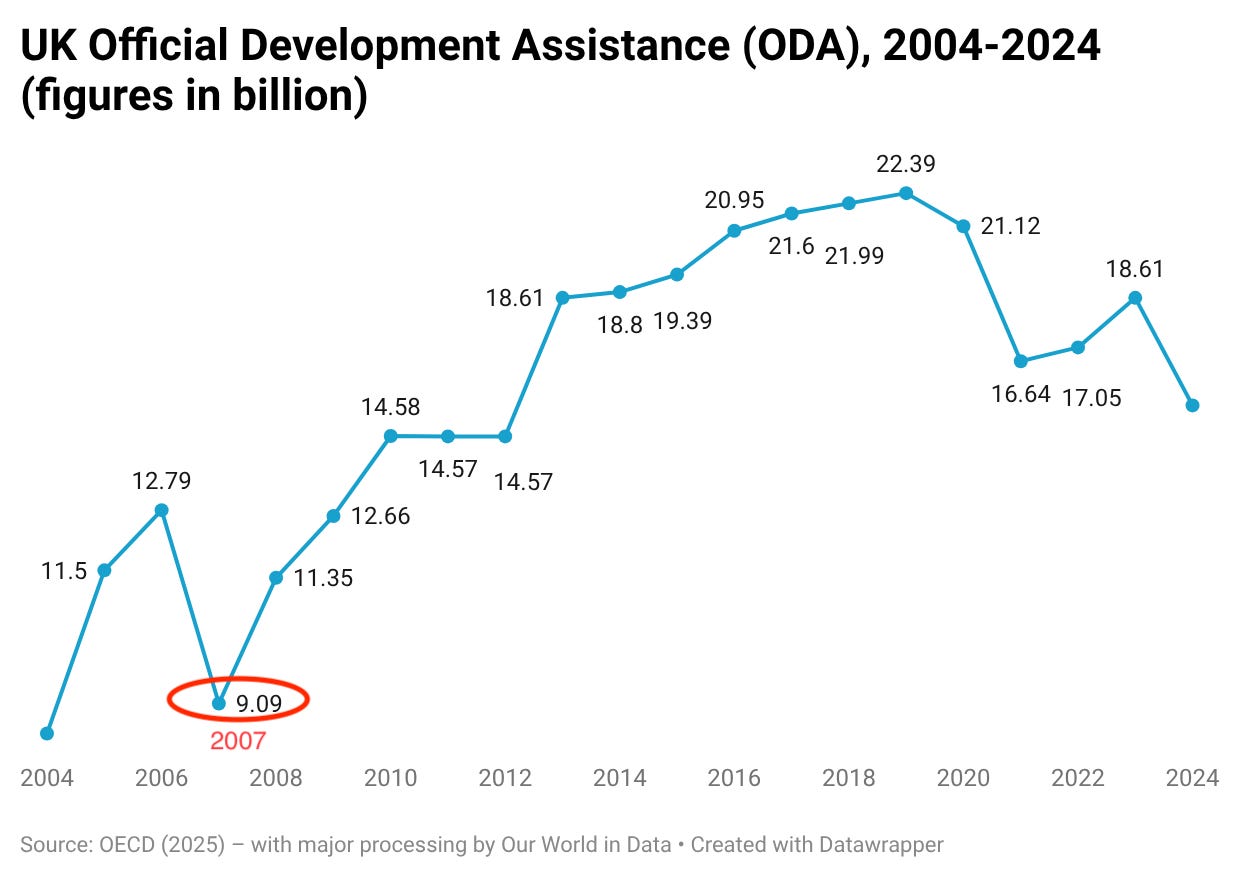
Reducing the aid budget to 0.3% would mean next year’s aid budget would be £ 9.2 billion.
This amount would be the UK’s lowest ODA contribution in 20 years. The last time the UK’s aid contribution was around the £9 billion mark, was in 2007 — when the UK was in the midst of Iraq and Afghanistan wars.
Post- Brexit identity crisis for the United Kingdom?
‘It’s the strategic position the UK has ended up in post-Brexit. Britain is now awkwardly positioned between the US and Europe — neither fully European nor fully aligned with the Anglo-sphere. That creates strategic insecurity’, says Prof. Glen O’Hara, Professor of Modern and Contemporary History at the Oxford Brookes University, and author of New Labour, New Britain? How the Blair Governments Reshaped the Country.
‘One way the British state tries to compensate is through defence spending and defence relationships, particularly with France. Defence becomes a way to remain relevant and connected.’
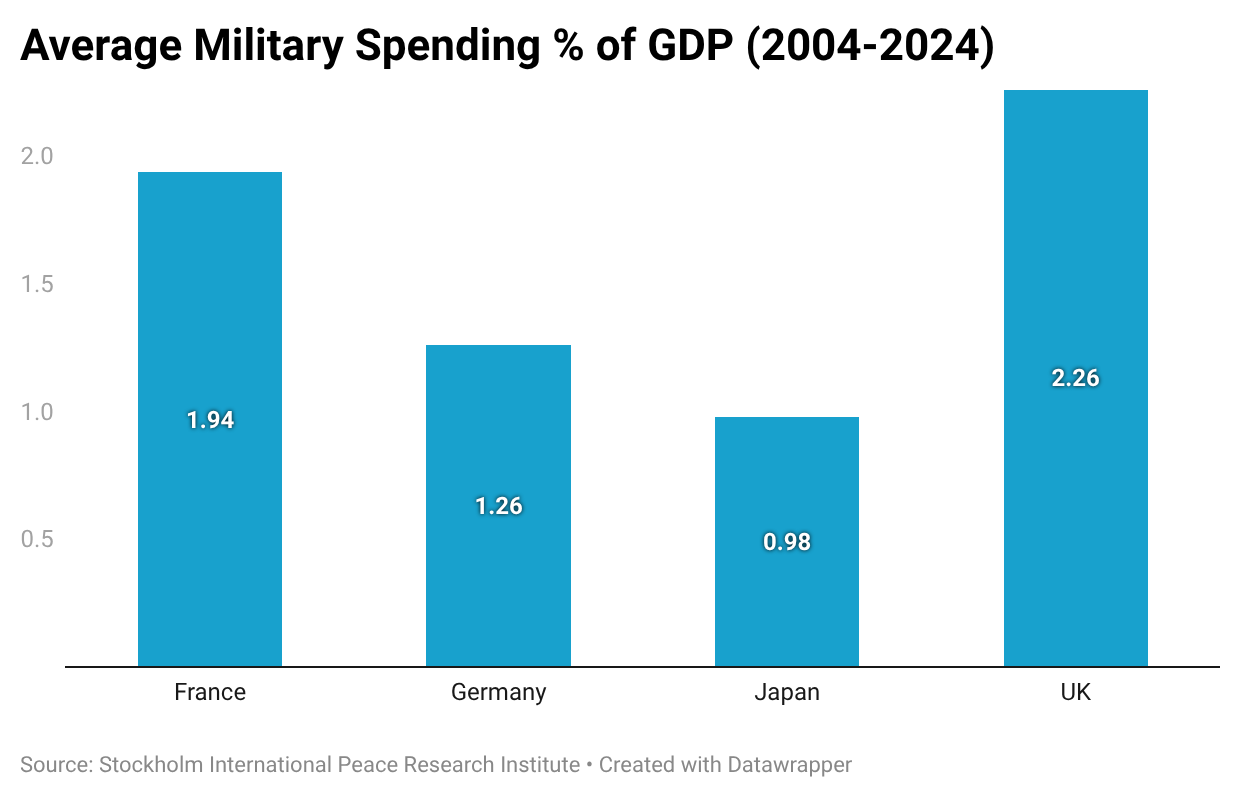
Despite France’s strategic importance as an actor in the defence sphere, its military spending remains much lower than the UK, at 1.94 % of its GDP.
The UK’s average military spending is already more than its comparable GDP counterparts — France, Germany and Japan.
In the last two decades (2004-2024), the UK spent an average of 2.26 as a percentage of its GDP on military. This is much higher than 0.98 % of Japan (Japan’s constitution limits it to 1% of GDP spending on defence), 1.26 % of Germany, and 1.94% of France.
Ironically, in these two decades, UK’s involvement in full scale military wars has largely reduced, as its troops withdrew from Afghanistan and Iraq, and limited military involvements in Syria, Libya, and Yemen.
The public confidence in PM Starmer’s decision to not involve the UK in the USA and Israel’s attacks on Iran have also been high. Polling data from IPSOS in the UK, conducted between 3-7 April 2026, reveals:
65% Britons favour using diplomacy with the US, Israel, Iran, and other countries to try to de-escalate the situation.
An overwhelming 64% reject sending British troops to the Middle East to support the US and Israel in military action against Iran.
Efficiency, not deficiency
‘Britain is terrible at buying military equipment on time and on budget’, says O’Hara. ‘Large projects — armoured vehicles, nuclear submarines, aircraft carriers — massively overrun costs. The nuclear programme alone absorbs billions. So a lot of defence spending isn’t about expanded capability, but inefficiency.’
Dr. Samuel Perlo-Freeman from the Campaign Against Arms Trade (CAAT) in a quote provided over email says, ‘The Ministry of Defence (MoD) wastes vast amounts of money on nuclear weapons that can never be used, do nothing to increase security, and involve the threat of horrific crimes against humanity.
‘A lot of other spending is wasted on expensive prestige projects that give huge profits to arms companies, while running over time and budget, and often failing to deliver the capabilities promised, which in any case are often ill-suited to real security needs. If there are genuine needs for military capabilities that would contribute to UK and European security, they should come from this vast wastage of current military spending, rather than from international aid or other areas of spending.’
O’Hara believes there are domestic political and economic benefits for any government in the UK to increase defence spending, ‘Defence exports can be framed as re-industrialisation and job creation, especially in regions Labour wants to win politically.’
ADS, the defence sector’s trade body, claims it has added £15 billion worth of value to the UK economy, provided direct employment to 181,500 people, and £13.7 billion to exports.
‘Aid is soft power, but it’s harder to sell.’ — Prof. Glen O’Hara, Professor of Modern and Contemporary History at the Oxford Brookes University
‘The public vastly overestimates how much Britain spends on aid. They assume it’s far higher than it actually is’, says O’Hara.
‘Charities are also expected to be altruistic and non-professional. When voters see salaries, offices, and logistics operations, they feel uncomfortable — even though professionalisation is essential for effectiveness.
‘Voters also focus strongly on domestic problems. When they believe money is being siphoned off abroad, resentment builds — even when aid is in the UK’s strategic interest.’
Development Engagement Tracker (DEL), which tracks public engagement with overseas aid and global issues, in a survey by YouGov of 1500 GB adults, revealed less than half of the public (45%) support keeping or increasing aid spending levels.
Arms industry lobbying and revolving door

In contrast to charities, ‘arms companies are expected to be morally compromised. Nobody is shocked by the opacity there’ — Prof. Glen O’Hara
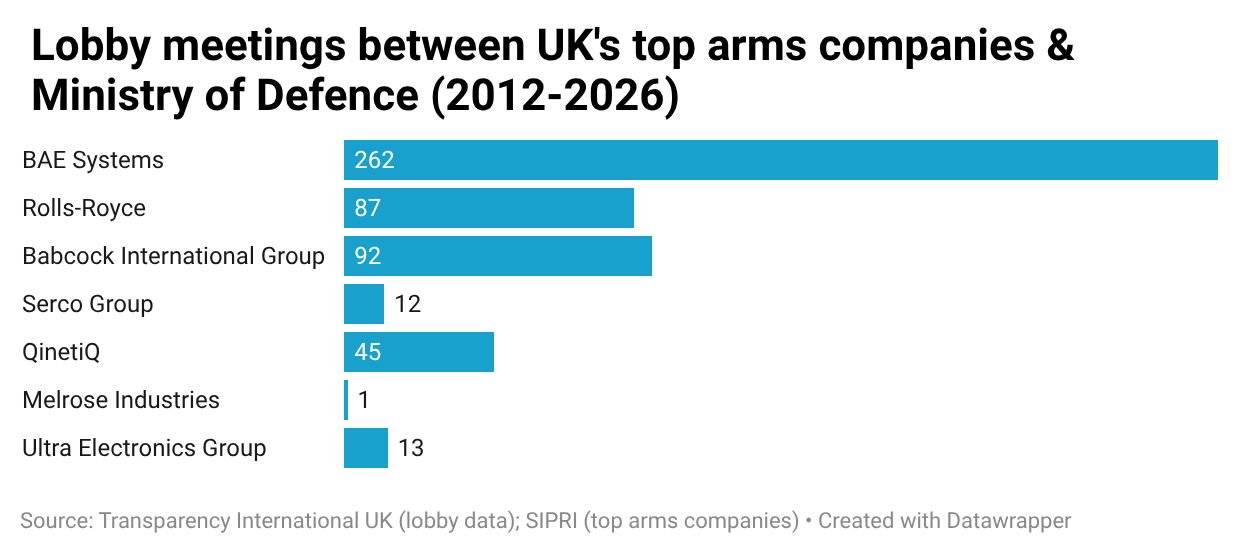
Seven arms producing and military services companies from the UK are in the top 100 in the world (SIPRI 2024). Transparency International’s open access tool (access here), which collates data on ministers’ meetings with external organisations, shows these seven companies commanded 22% of all lobby meetings with the Ministry of Defence (MoD).
And a single defence company BAE Systems (sometimes along with other firms) had 262 meetings with the MoD since 2012.
‘The UK arms industry exercises grossly excessive influence on UK government policy, in relation to both military spending, arms procurement, and arms exports’, says Dr. Freeman. He attributes this to an ‘unparalleled level of access afforded to the industry by government, through a constant stream of high-level meetings and a plethora of government-industry forums, supported by the revolving door between top levels of government, especially the MoD, and the arms industry.’
During the press release of Dr. Freeman’s 2024 report— From revolving door to open-plan office: the ever-closer union between the UK government and the arms industry (available here), he said ‘This is a broken system. No industry should have this level of influence over government, especially one that deals in death and destruction.
‘This level of influence is profoundly undemocratic and means that shareholder profits are protected at all costs – even if this means complicity in appalling war crimes.’
Declassified UK has also reported that several British Conservative party MP’s who rejected a parliamentary motion calling for a ceasefire in Gaza have owned BAE shares.
In a recent report, Prospect uncovered the gross misuse of revolving door policy and conflicts of interest between ex MoD staff and defence firms in the UK. Prospect identified more than 120 applications by former senior military officers, civil servants and politicians to take paid positions with firms either directly holding MoD contracts or bidding for them, or operating within the wider defence sector.
Prevention better than cure
International Development Committee Chair, Sarah Champion, said the aid cuts are ‘deeply shortsighted’ and ‘our finances should be spent on preventing [conflict], not the deadly consequences’.
A recent study in the Lancet has found that aid cuts by the US, the UK, and other western countries, are likely to cause 22.4 million excess deaths by 2030 (See here). Dr. Freeman of CAAT says while the share of this accounted for by the UK is not clear, but is likely to run into millions of excess deaths. There is no conceivable security benefit from the increased military spending that could outweigh this horrific impact.
According to the Institute for Fiscal Studies (IFS) the fiscal consequences of the government’s plans and ambitions for defence spending include reduced spending on other areas (for now aid). The second is to increase tax revenues to fund the increased spending. The third option is to borrow.
Chancellor Rachel Reeves in recent interviews to the press has clearly said she does not favour tax hikes or higher borrowing to pay for increases in defence spending.
Borrowing for a permanent increase in defence spending is unlikely to be sustainable, and would be hard to justify on the grounds that defence spending will boost long-term economic growth.
The fiscal impact of returning to 0.7% of GDP for aid is small relative to the defence budget, making it a feasible reallocation.
More importantly, it would keep the United Kingdom on the right side of history —preventing poverty, conflicts, and distress migration.