


With Summer Fashion Weeks being right around the corner where inspiration is the number one thing collections are born out of, Leigh Bowery needs to be re-introduced. Even if you think you haven’t heard of him, you’ve definitely seen the force of his works in designs made by Alexander McQueen, John Galliano, Rick Owens, Martin Margiela, and many more.
Leigh Bowery still rules the fashion world in one way or another. Being everything from a performance artist to a fashion designer and a club promoter, Bowery did not only leave a one-of-a-kind mark on 80s fashion, but also on the fashion world of the 2000s. He redefined what fashion meant by crossing all possible boundaries and experimenting with such creativity that it ‘challenged the norms of aesthetics, sexuality and gender,’ according to Tate Modern.
His persona shone through every piece of artistry that he created or was a part of, whether that be in nightclubs, galleries, on stage in theatres, or even on television. More than 30 years after his death, Bowery is still talked about, just as loudly as he was expressing himself.
The one, the only – the outrageous Leigh Bowery!
Growing up in Australia in a conservative community, Bowery had it in him from an early age to provoke and shock people. Body distortion became a recurring ethos in his works later in life, but this is actually something he had to face from a young age as he grew really quickly and was already six feet tall by the age of 12.
Bowery, by nature, also experimented with public embarrassment as he discovered that this is something he can weaponise. Instead of being embarrassed, he purposely put himself in situations that would, by the public, be seen as humiliating. But, this is where he thrived.
However extreme Bowery’s designs were, they all screamed freedom and self-expression, which is what today’s designers are also trying to do. Michael Clark’s ‘Yes Manifesto’ perfectly concludes Bowery’s view on not only fashion, but life itself as well, so even though this Manifesto is not about him, it also completely is.
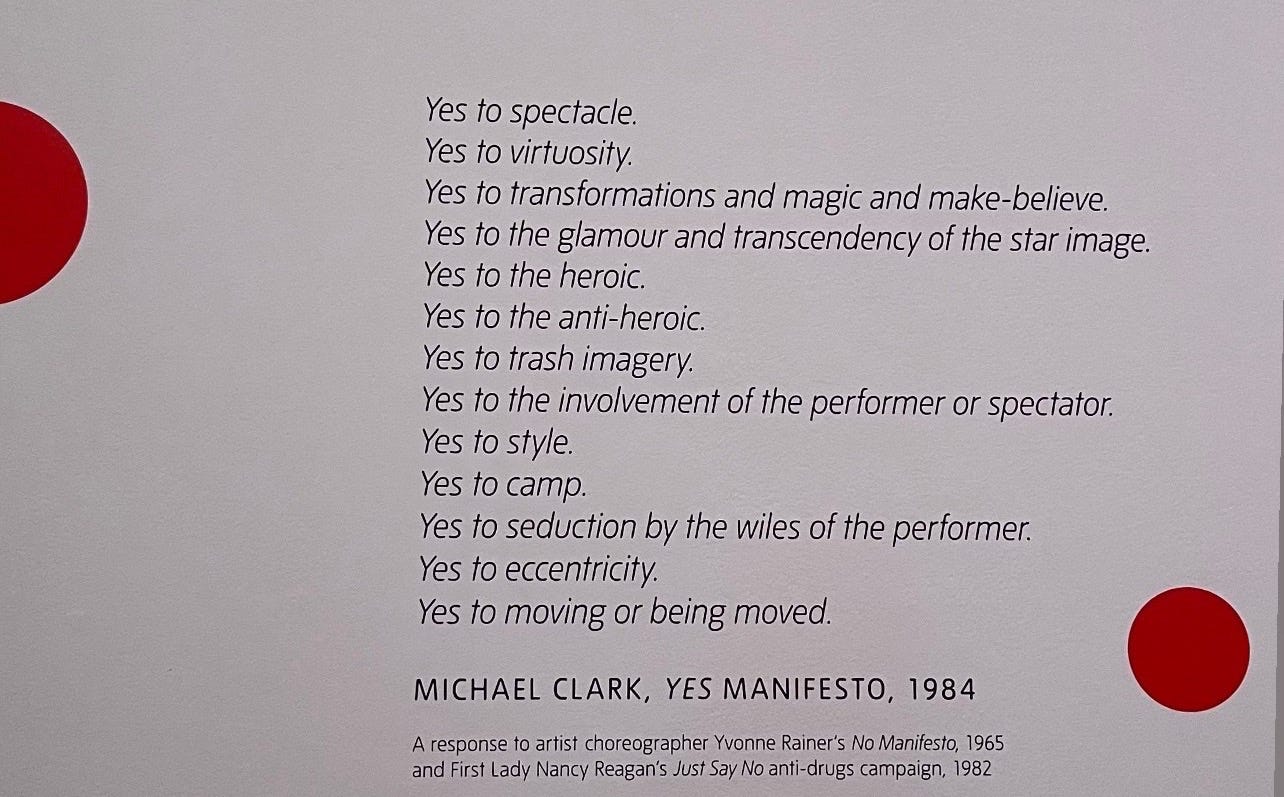
Being inspired by the one and only Vivienne Westwood, Bowery also influenced many designer masterminds of the upcoming generations.
‘Leigh Bowery was part of that force, that force of freedom. It’s that force of delirious depravity, cheerful depravity. I talk about that because I feel like those are the values I need to support because the world can be so harshly condemning and judgmental, and that’s never going away,’ said Rick Owens in an interview with AnOther Magazine. Rick Owens has also famously been influenced by Bowery, recreating the human backpack part of his SS16 collection based on Bowery “giving birth” to Nicole Bateman.
The unconventional yet dramatic Alexander McQueen
Alexander McQueen, being a showstopper in a rather different sense than Leigh Bowery, found himself in the world of fashion through strange expression.
‘Beauty can come from the strangest of places, even the most disgusting of places’ – Alexander McQueen, The Times
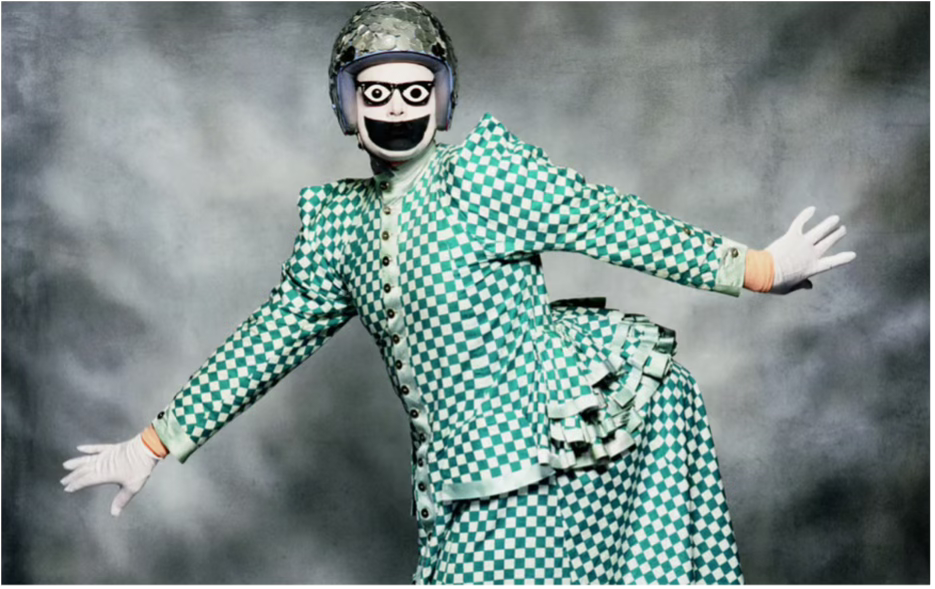
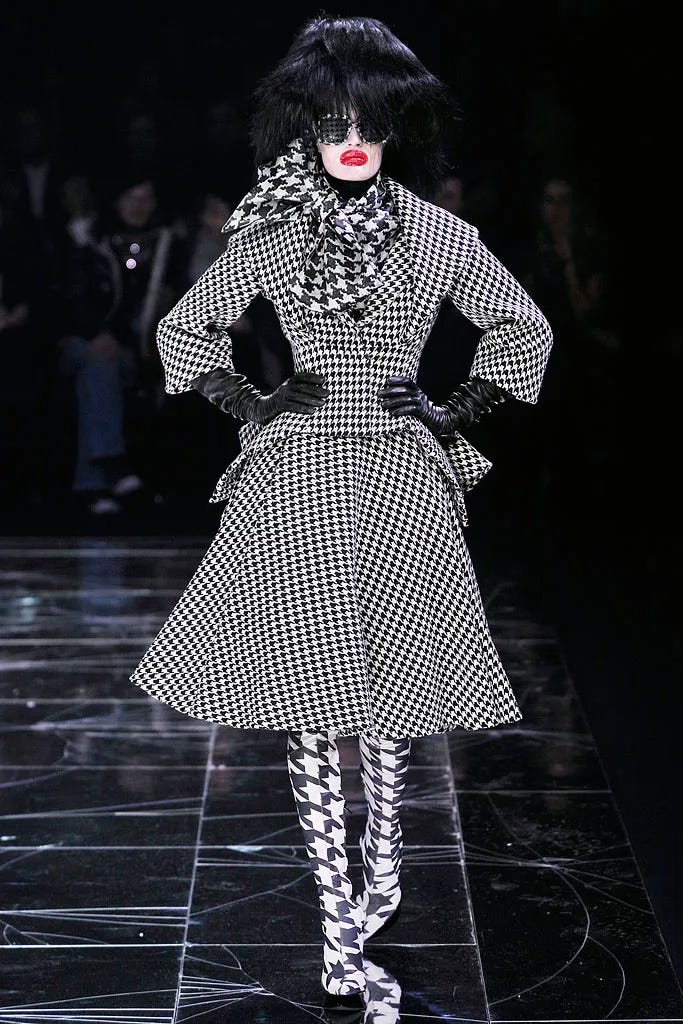
Before Bowery’s death, Alexander McQueen actually attended his last performance in 1994 which foreshadows the influence he will have on McQueen, especially in his Horns of Plenty AW09 Collection which was his last Autumn/Winter show before his death.
Alexander McQueen, being the most influential designer of his generation, inspired many, but was also inspired by many. Similarly to Bowery, he incorporated distortion into his designs in many ways, whether that be facial or bodily.
As Sally Gray has perfectly stated in her review of the Savage Beauty exhibition: ‘In Alexander McQueen’s approximately two decades in fashion, he stunned, shocked, delighted, amazed, and often emotionally overwhelmed the fashion world.’ Just like Bowery.
In this collection, McQueen played around with extensive, almost ridiculous over-lining of lips, which could even be referred to as clownish. But it worked. Not only did he draw the attention to the face, but also to the mix-matched use of prints with the pairing of skirts and jackets, which further create a sense of deformity.
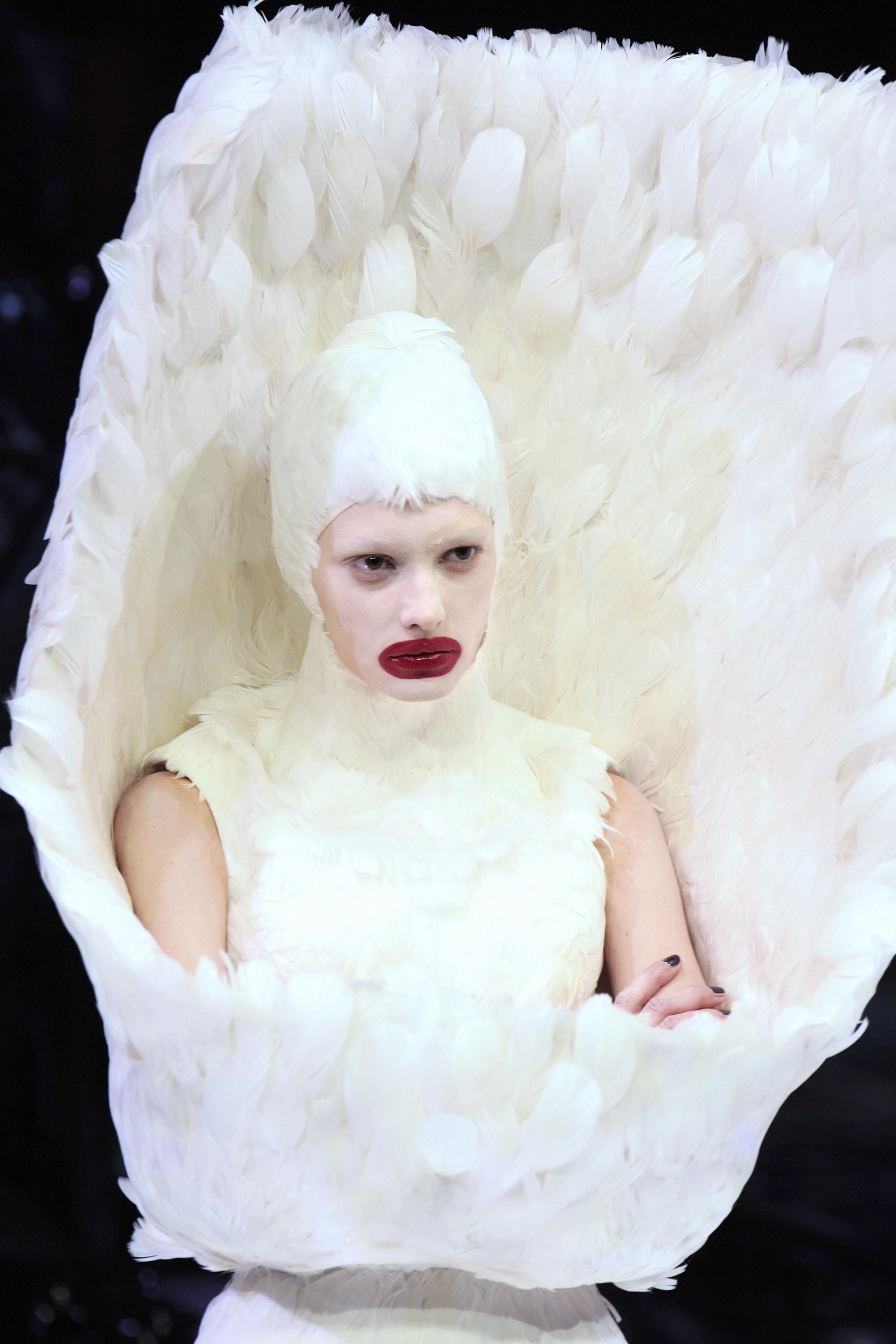
McQueen, similarly to Bowery, amalgamated the bizarre and the fascinating, creating a work of art. The models walked down the runway with painted porcelain-like white skin with the contrast of the heavily overdrawn red lips.
In an interview with Penny Martin for SHOWstudio, McQueen said, ‘it’s good to leave the audience in bewilderment,’ which he definitely did.
When it comes to McQueen’s works, it is all about influence on influence. While taking inspiration from Bowery, historical eras also made either subtle or explicit appearances in his shows, like Flemish, more specifically Hans Memling or the van Eyck brothers, and so did the gothic era.
It can definitely be said that Leigh Bowery and Alexander McQueen were completely different when it comes to their lives and journeys throughout art, yet somehow, they were connected by fashion, culture, and history.
Martin Margiela – The mystery man behind the haute couture mask
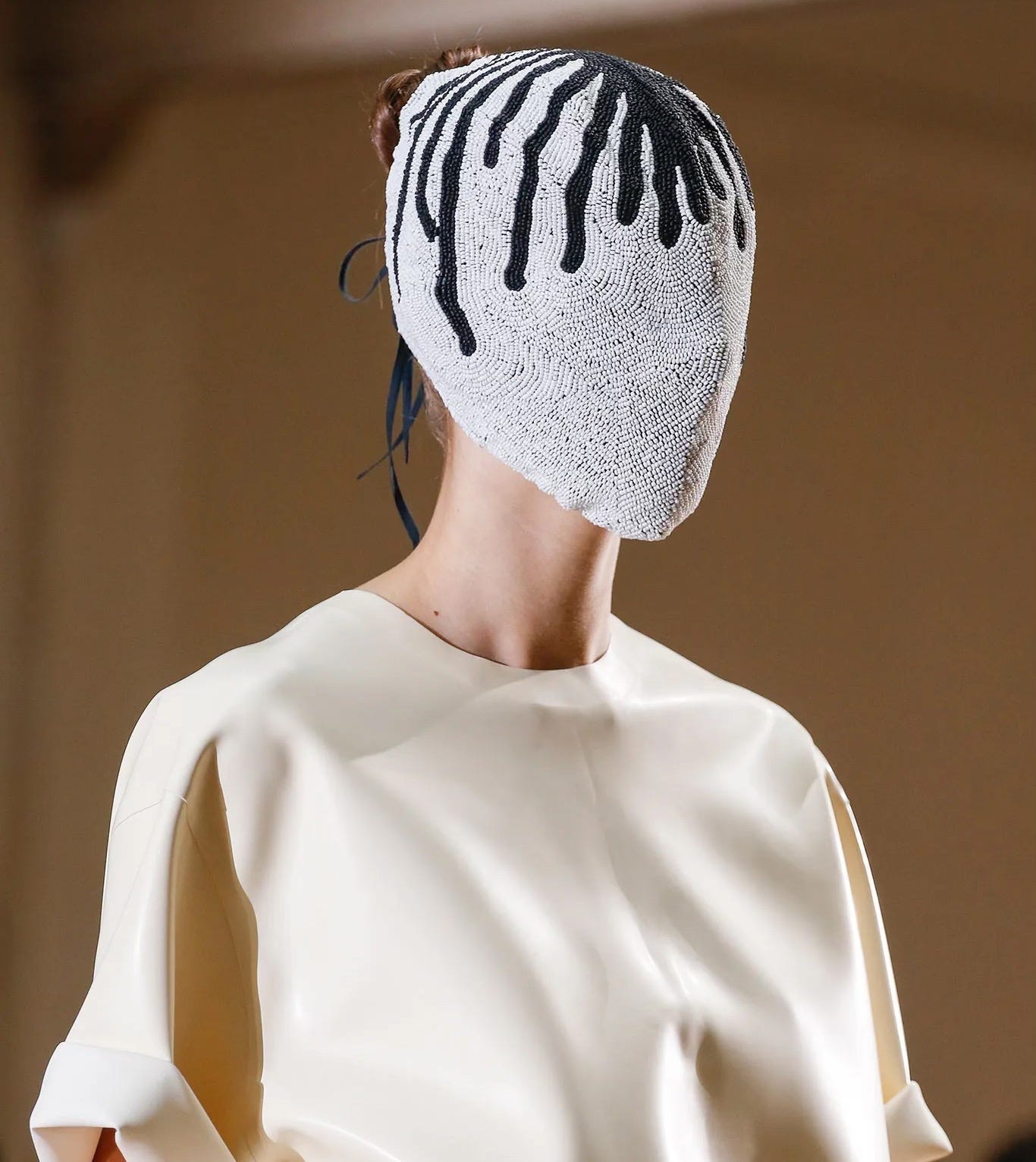
Martin Margiela, in nature being the complete opposite of Bowery, could be described as ‘the most mysterious fashion designer ever,’ as James Anderson wrote in his article in i-D. As mentioned, the complete opposite. Bowery, even if he tried, could not have been a mystery to the world.
Margiela went against traditional beauty standards when it came to his shows; he would intentionally cast models who were a little bit ‘diverse and unconventional-looking,’ added Anderson.
At his Fall Artisanal 2013 Couture Show however, the models’ features could not even be seen. From the haute couture flower face mask, through the iconic latex jeans and T-shirt look, to Bowery’s inked dripping egghead look-alike, this collection had everything and more in it.
The theme is reoccurring – fetishism appears in almost all of these pieces, with a lot of specific examples being a nod to Bowery’s works.
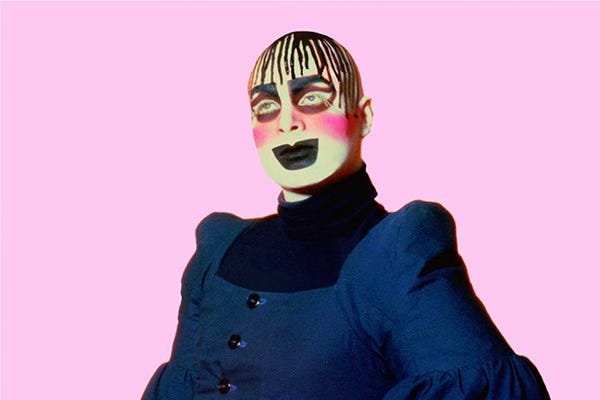
‘Masks have long formed a signature part of the Margiela brand, an extension of the incognito nature of the design house’s notoriously private founder,’ said Daisy Woodward in AnOther Magazine.
As Margiela never took part in interviews, and whenever he was asked questions it was him with his team who answered – only via e-mail – the fashion industry started rumours. ‘The daftest rumour was that he didn’t really exist at all!’ wrote James Anderson in i-D.
While Bowery was finding himself in the process of expressing himself and experimenting with masks and covering his face, Margiela did the same in a completely different sense.
For him, the masks were in relation to his personal views on privacy and anonymity, but during his shows it also became about the anonymity of the models as well. In this sense, he was overstepping conventional fashion boundaries, just like Bowery.
If you really think about it, it was never just about fashion, it was about everything else that surrounds it. Culture, history, art, freedom, and lastly, self-expression. This is why Leigh Bowery still sparks up conversations and inspires other designers. Though Leigh Bowery, Alexander McQueen, and Martin Margiela all had fashion in common, they also brought different aspects of their lives to their works.
By all of them being different, they created different collections, yet they had many similarities as at the end of the day this is what fashion is about. Inspiration.
If you take away one thing from this article, let it be this: Do not be afraid to inspire, and do not be afraid to be inspired.