


The existence of a “pink tax” has been discussed for years, with critics arguing that products marketed towards women often carry higher prices than very similar products marketed towards men. Businesses that support gender-based pricing argue that the differences in marketing, branding and product development contribute to variations of price. Critics, however, argue that many products marketed towards women serve the same purpose as men’s equivalents despite often costing more.
After an Intrum 2024 study that revealed women spend an average of 64% of their income on essentials, compared with 53% for men, Jim Appleby (Intrum UK Managing Director) said:
“The financial crisis has exacerbated gender inequalities when it comes to money. Women are spending less of their income on luxuries and ‘nice to have’ items than their male counterparts.”
To investigate whether those differences still exist in major UK retailers, a dataset of 40 health and beauty products was collected from Boots, Superdrug, Tesco, ASDA and Morrisons. Unit prices were calculated and compared across four categories: facewash, deodorant, bodywash and shaving gel. Using unit prices allowed products of different sizes to be compared on a like-for-like basis. Prices were converted to cost per 100ml before category averages were compared.
The data analysis revealed that pricing differences were not consistent across all product categories… While women’s products were more expensive in most categories, others produced the opposite result. This suggests that this universal “pink tax” may be more complicated than it appears.
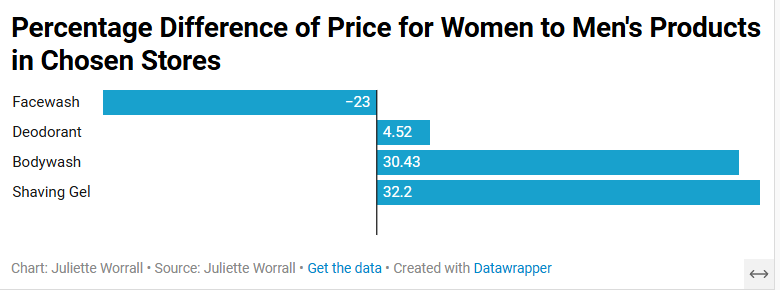
The most significant differences were found in body wash and shaving gel products. Across the sample, women’s body wash products cost an average of 30.4% more per 100ml than comparable products marketed towards men. Women’s shaving gel carried an even larger difference, costing 32.2% more on average.
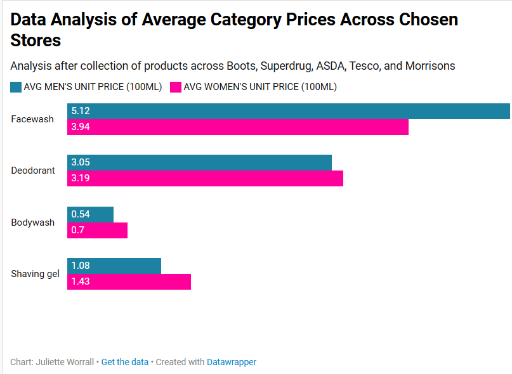
These findings clearly aligns with the global concerns raised by campaigners who argue that products marketed towards women are often sold at a higher price despite performing the same function as men’s alternatives. However, this trend did not continue across every category.
In facewash products, a contrasting pattern emerged. Women’s facewash products were found to be 23% cheaper on average than men’s products when compared using unit prices. This was the largest reverse price difference observed in the dataset and challenges the idea that products marketed towards women are always more expensive. Deodorant showed the smallest price gap, where women’s deodorants cost 4.5% more on average than men’s equivalent products.
According to Plan UK, the pink tax refers to the ‘the higher prices often charged for products and services marketed to women and girls compared to similar items aimed at men and boys.’ While not an official tax, ‘this form of price discrimination increases everyday costs for women’. Plan UK highlights that pink tax exists because of gendered marketing and unequal power in the economy, presenting women’s products as more specialised and attractive.
While the body wash, shaving gel and deodorant categories appeared to support these concerns, the results from the facewash category suggests the issue is more complex than a universal price premium.
Globally, businesses and stores have claimed to improve their gendered pricing differences between men and women. For example, in 2016, Boots responded to pressure over ‘sexist pricing’, by changing their cost of razors and eye cream. In a statement on their website, Boots said it had never operated a pricing system that discriminated against women “so we were surprised and disappointed to see recent examples in the press that did not reflect our own standards”.
Researchers have debated whether the pink tax remains a widespread issue in modern retail. In a 2023 study on gender-based pricing in consumer packaged goods, Moshary and colleagues described the pink tax as a ‘second-degree price discrimination phenomenon’, and that ‘gender segmentation is ubiquitous, as more than 80% of products sold are gendered’.
The findings from this investigation partially support these concerns. Three of the four product categories analysed showed higher prices for products marketed towards women. However, the significant difference found within the facewash category suggests pricing strategies may vary between products.
Recent research by Wishart, Poo, Baxter and Lau (2023) argues that increasing consumer awareness may challenge traditional gendered pricing practices. The researchers suggest that younger consumers, particularly Generation Z, who are ‘known for their progressive views on gender’, are increasingly favouring ‘gender-neutral products and fairer pricing strategies, which could ultimately dismantle the Pink Tax and promote economic equality’, rejecting traditional gender stereotypes in marketing.
This shift may offer one explanation for the mixed results found in this investigation. While some products continue to display noticeable gender price differences, others appear far less divided along gendered lines than previous studies have suggested.
The results of this analysis found no simple answer to the growing pink tax debate. Women’s body wash, shaving gel and deodorant products were all more expensive than men’s equivalents, but facewash products showed the opposite trend. Rather than revealing a universal premium applied to all products marketed towards women, the findings suggest that gender pricing varies significantly between categories. While concerns about the pink tax remain valid in many areas of the health and beauty market, the evidence from this sample indicates that the issue may be more complex than consumers often assume.