


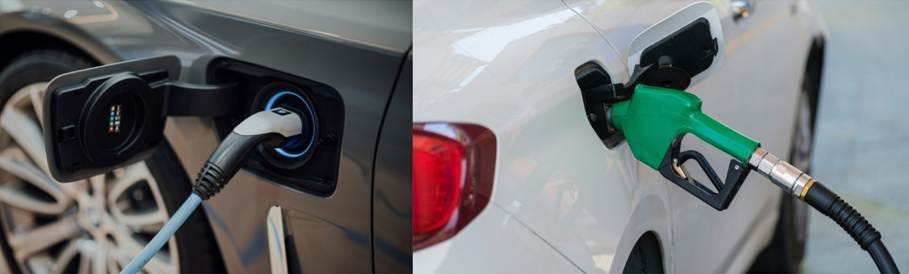
When the COVID-19 pandemic struck in 2020, UK new car registrations fell by 29% to 1.63 million, according to Motoring Research. Yet, more than 108,000 new electric cars were registered on UK roads that year, giving them a 6.6% share of the new car market.
By 2025, new car registrations reached 2.02 million, with almost half a million new electric cars joining the road, nearly one in four cars sold, according to data from the Society of Motor Manufacturers & Traders (SMMT).
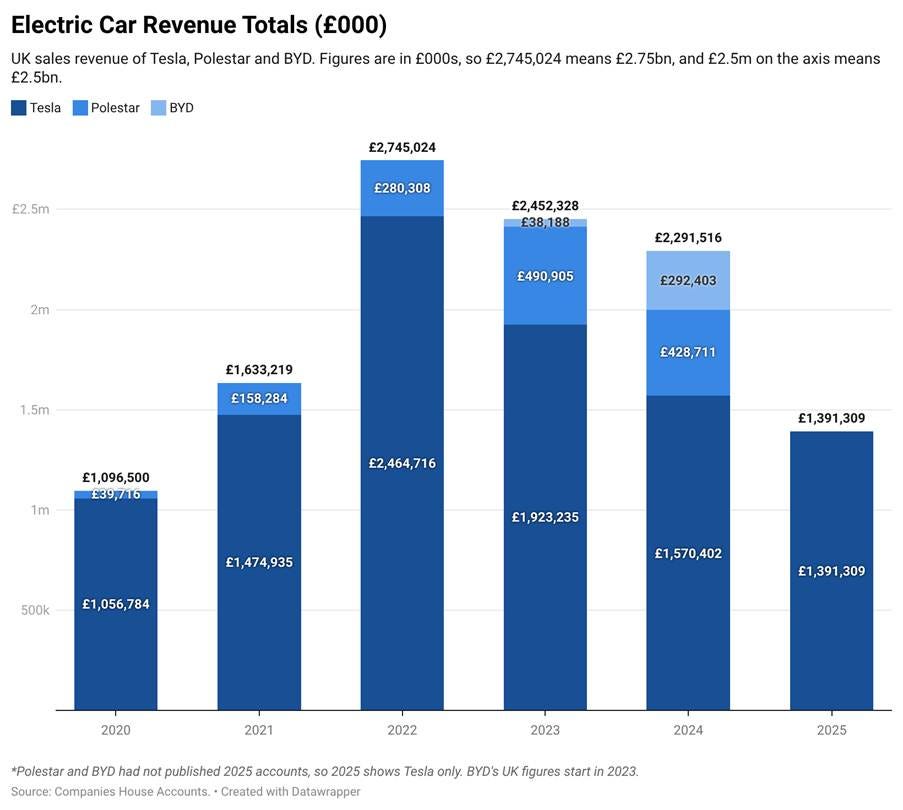
Companies House financial accounts for three electric brands, Tesla, Polestar and BYD, show that their combined UK annual revenues between 2020 and 2024 have more than doubled from £1.10bn to £2.29bn, despite peaking at £2.75bn in 2022. Over the same time period, revenue at three brands which sell mainly internal combustion engine (ICE) cars – Mercedes-Benz, Ford and Mazda only grew by 49%
The rapid growth has been seen through new electric car brands such as BYD, which, in March 2023, started selling passenger cars in the UK market, had a total of 9,271 cars sold in the first quarter of 2025, which surpassed the total sales volume of cars sold in 2024 (8,787 units), according to BYD UK news. Reflecting on the surge in sales, a BYD sales manager who wished to remain anonymous said, ‘BYD has experienced significant growth in the UK because of increasing demand for the electric car market. We expect to see this trend to continue through expansion of our electric car range and more customers switching over to electric vehicles.
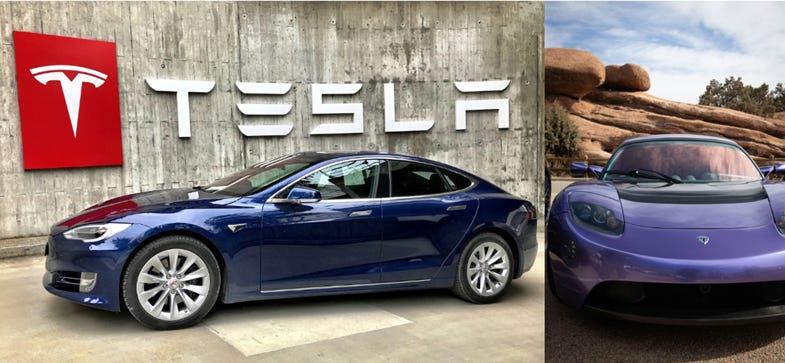
Competitors such as Polestar entered the UK market in 2020, and its revenue grew from £39.7m to £428.7m in 2024 with models such as the Polestar 2 and Polestar 3. BYD’s revenue, which first appears in the figures in 2023, went from £38.2m to £292.4m in a single year, and by the end of 2024 both brands had brought in £721m in revenue, 31% of the trio’s final figure.
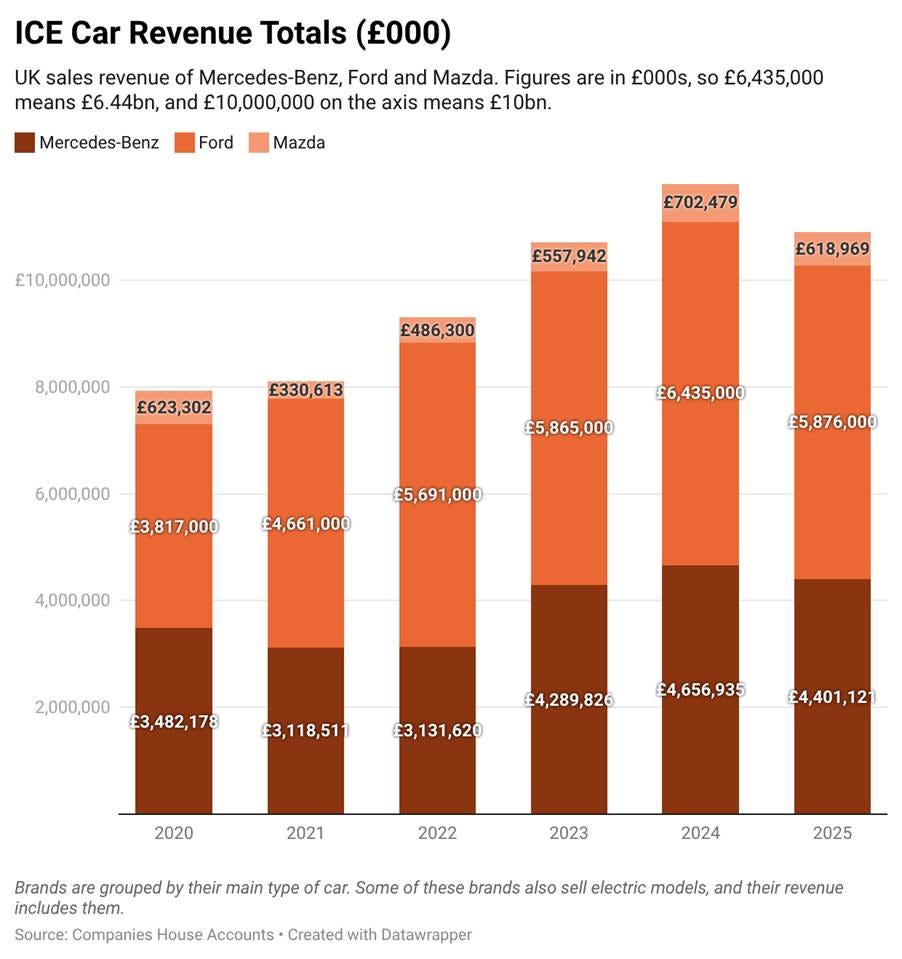
ICE brands such as Mercedes-Benz, Ford and Mazda earned around five times as much as the electric trio (£11.8bn against £2.3bn). Their accounts do not separate electric and combustion sales, and all three did sell electric and hybrid models, but across the market, three in four new cars sold in 2025 were not electric. Their annual revenues also fluctuated between 2020 and 2025, with Ford’s annual revenue rising 54% from £3.82bn to £5.88bn, Mercedes-Benz’s by 26% from £3.48bn to £4.40bn, whilst Mazda’s fell by only 0.7%, from £623.3m to £619.0m.
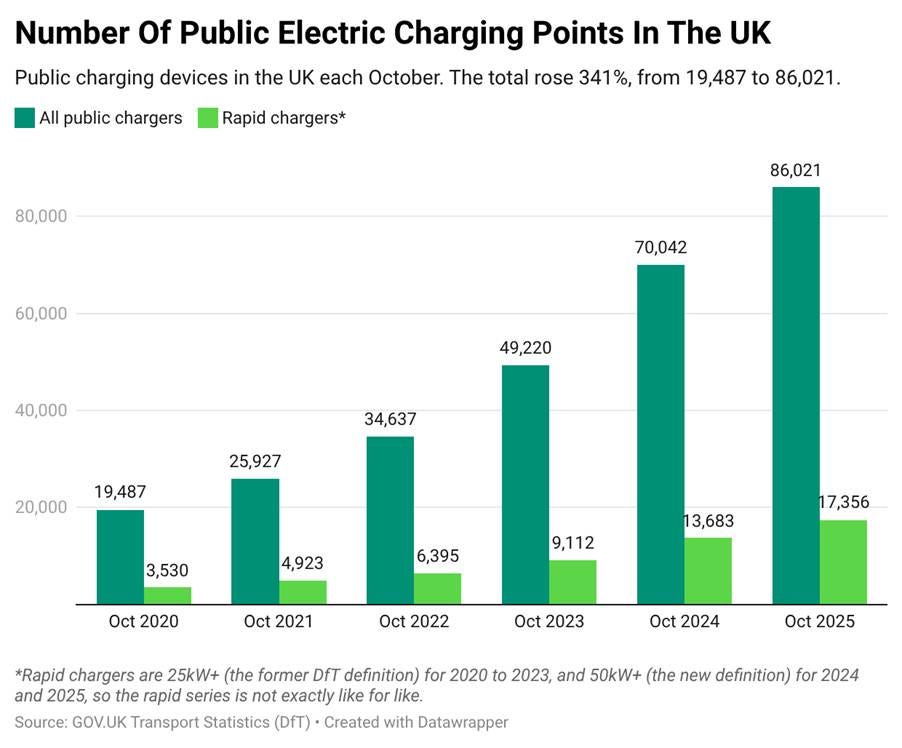
The charging network has also grown alongside the number of electric cars on the road to meet demand. Government transport statistics show the number of public electric car charging points in the UK grew from 19,487 in October 2020 to 86,021 in October 2025, with more than four times as many.
The largest jump was in 2024, when 20,822 charging points were added. Rapid chargers, which reduce charging times, have grown too, but their share in the network hasn’t changed significantly, from 18.1% in 2020 to 20.2% in 2025. In October 2023, the government changed the way rapid chargers are counted from 25kW and above to 50kW and above, so the comparison is not exactly like-for-like. Growth peaked in 2024 when 20,822 charging points were added, starting to eliminate the electric car’s weak spot of long waiting times for the car to charge. Vicky Read, chief executive for ChargeUK, the charging industry’s trade body, said the sector was “investing billions of private capital into high-quality charging”. She added: “The vast majority of EV drivers use the public networks and an increasing number will be wholly reliant on them.”
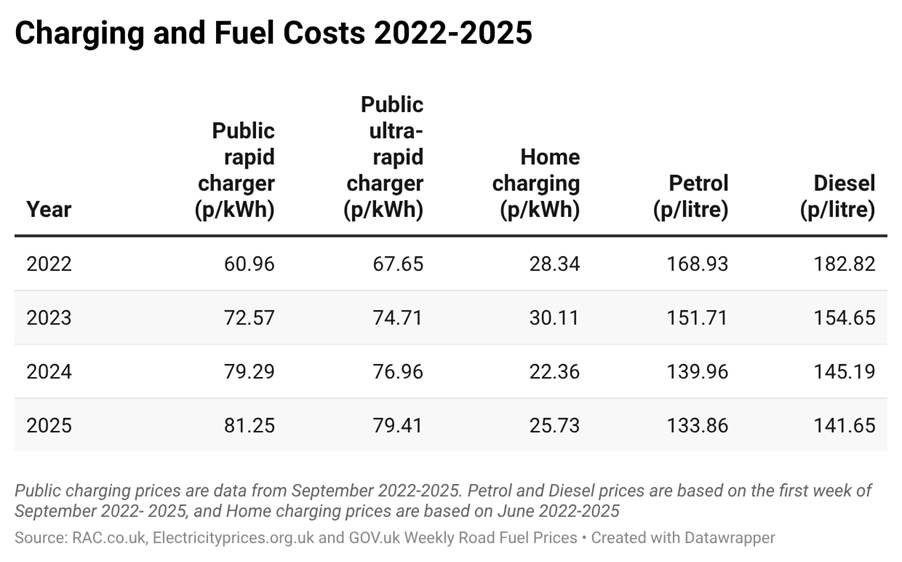
A bigger network raises the question of what it costs to use compared with filling up with petrol or diesel. RAC figures show that September prices between 2022 and 2025, the cost of a kilowatt hour (kWh) at a public rapid charger rose by 33% from 60.96p to 81.25p while ultra-rapid charging rose by 17% from 67.65p to 79.41p. Over the same time period, petrol prices fell by 21% from 168.93p to 133.86p a litre, with diesel reducing in price by 22.5% from 182.82p to 141.65p, according to government weekly fuel price data.
Converted into cost per mile, in September 2022 a public rapid charger cost 17p a mile whereas petrol cost slightly more at 17.9p. By September 2025, rapid charging cost 22.6p a mile, roughly 60% more than petrol’s 14.2p, assuming an electric car covers 3.59 miles per kWh and a petrol car does 42.8mpg based on HMRC figures.
Substantial savings come from charging at home. Ofgem’s price cap for July to September 2025 was 25.73p per kWh, which works out at just 7.2p a mile. At September 2025 prices, an average car doing 9,935 miles a year, the estimated average price for an electric car charging at home is £712 a year, whereas petrol costs £1,413 and diesel costs £1,290.
But, in recent times, an article written by ChargeUK, the charging industry’s trade body, in April 2026 has claimed public charging is now cheaper on average than petrol and diesel. The analysis has revealed that drivers who charge their cars at the average cost of 54p per kWh can expect to pay 15p per mile compared to petrol’s 17p and diesel’s 17.5p, due to the petrol/diesel prices being heavily influenced by global factors outside of the UK government’s control.
That advantage may run out soon, though, as from April 2028, electric cars will pay 3p per mile under the pay-per-mile tax announced in the 2025 Autumn Budget, suggesting that those relying on public chargers may pay more than fuel users when the tax takes effect.
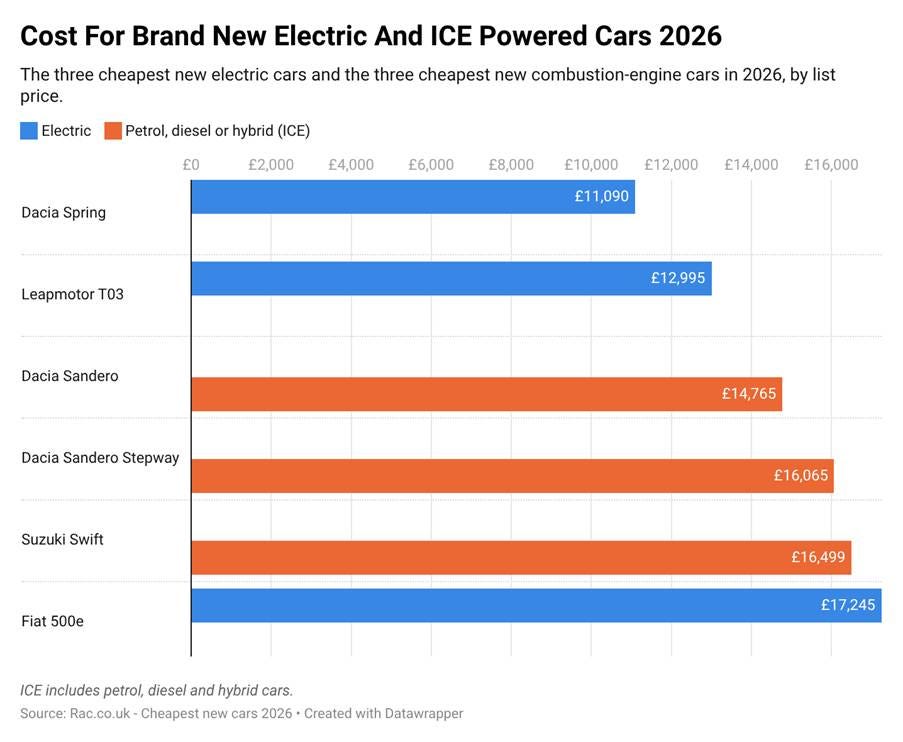
The price of entry for electric cars has also significantly decreased. The three cheapest new electric cars for sale, the Dacia Spring (£11,090), Leapmotor T03 (£12,995) and Fiat 500e (£17,245), cost £13,777 on average. That is around £2000 less than the three cheapest ICE-Powered cars, the Dacia Sandero (£14,765), Dacia Sandero Stepway (£16,065) and Suzuki Swift (£16,499), which average to £15,776. Only the Fiat 500e narrowly costs more than its petrol rivals. Across the whole market, the average new electric car costs £42,620, slightly less than the average new ICE car at £43.405.
Buyers are also getting financial support from the government through the Electric Car Grant, which takes up to £3,750 off eligible electric cars priced at £37,000 or less. Cars built with the lowest manufacturing emissions qualify for the £3,750 (Band 1), whilst others receive £1,500 (Band 2 ). The grant, which opened on 16 July 2025, will run until 31 March 2030 as an incentive for car buyers to turn to the electric market.
So is the combustion engine running out of road? Not yet. Combustion brands still dominate the balance sheet, and most new cars sold still have an engine. But with electric revenue more than doubling between 2020 and 2025, the charging network more than quadrupling and the cheapest electric cars undercutting their ICE competitors, the road ahead for combustion is getting shorter.