



“Every moment in school counts and days missed add up quickly. Evidence shows that pupils who have good attendance enjoy better wellbeing and school performance than those who don’t,” says the Department for Education.
Consider a family of 4 with 2 school-aged children planning a week’s holiday to Spain in summer 2026. A Jet2holidays package to the Playamojacar Aquapark Hotel costs £4072 during the first week of the school holidays, but only £2744 in the penultimate week of term - a saving of £1328 for dates just 2 weeks apart. For many families, the school holiday price is simply unaffordable, leaving term-time travel as the only realistic option. But is the risk worth it?
State schools in England already receive 13 weeks of holiday per academic year, yet term-time absences remain common. Holiday companies and airlines significantly increase prices during school holidays, often adding thousands of pounds, which explains why some parents take the chance.
In August 2024, the Department for Education in the UK changed the cost of the fines for unauthorised term-times absences, increasing the fine for the first time since 2012.
The new rules and changes are as follows …
· A fine must be considered if a child misses 10 or more sessions (a session counts as either a morning or afternoon during the school day), which is equivalent to 5 school days, for unauthorised reasons, within a 10-week period.
· The fine per parent per child has increased from £60 to £80 if paid within 21 days, so if a family of 2 children at school and 2 parents went on holiday during the school term and the children were out of school for 5 days unauthorised, the family would be fined £80×4= £320.
· If the fine is paid after this 3-week window but within 28 days, it is increased to £160 per parent per child.
· If a parent receives a second fine for the same child within any 3-year period, the fine would be charged at a higher rate of £160 if paid within 21 days.
· Under the new legislation, fines for parents are capped at 2 fines within any 3-year period, therefore once the limit is reached other action like a parenting order or prosecution will be considered.
· The changes introduce national consistency, replacing the previous system where fines were set and enforced differently by local authorities.
· Revenue from the fines is used to cover administration and attendance support, with any extra money returned to the government.
Over the last 4 years particularly, there has been a significant increase in the number of fines, with the most recent data from the 2023/24 academic year revealing 487,344 fines were given out for unauthorised absences in England, which is a 22.2% increase from the previous academic year. The data for the 2024/25 academic year is due to be released in January 2026, so we will more than likely expect another increase, as a result of the trends seen below and the stricter government guidelines.
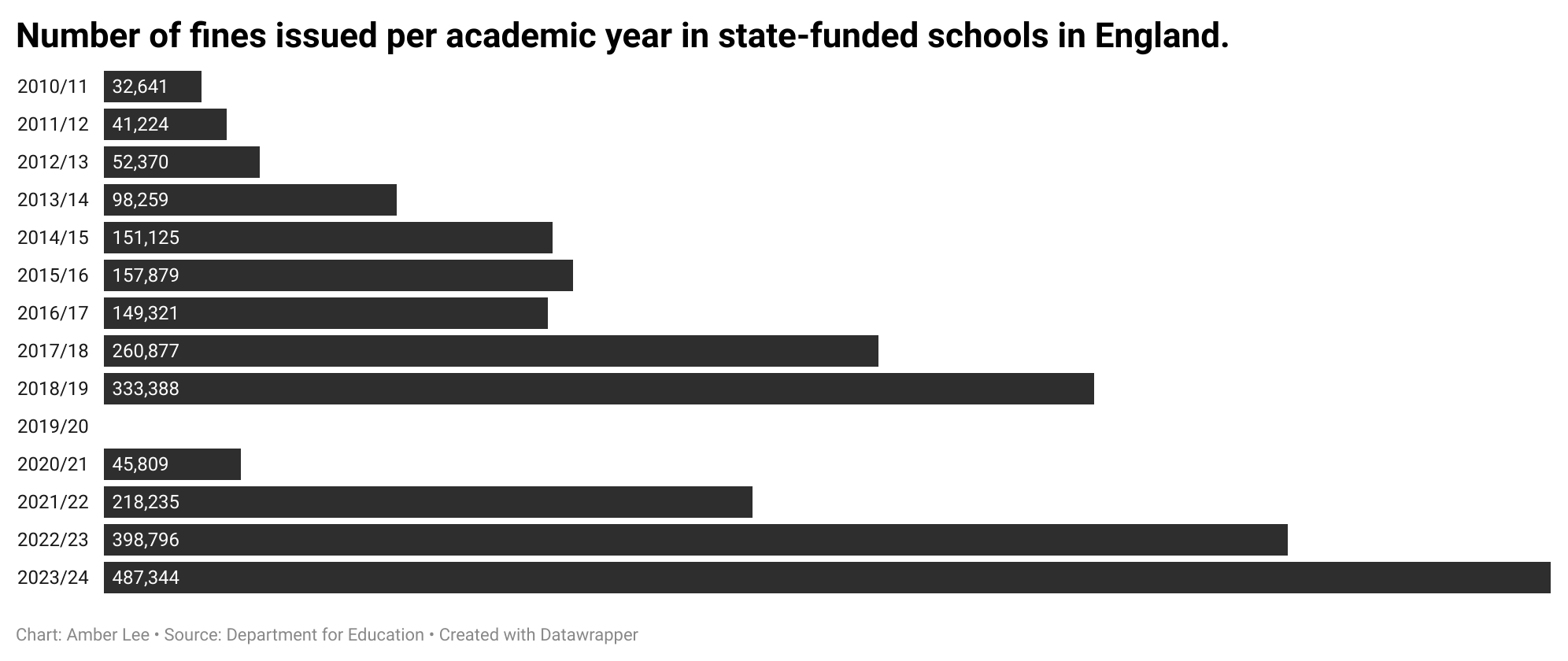
The data for the academic year 2019/20, as seen above, is absent due to the additional burdens faced by local authorities during the pandemic; a decision was made not to run the data collection for that year. There were also fewer fines than previous years in 2020/21 and 2021/22. This was the result of children not being in school full time in 2020/21 for the whole academic year due to lockdown rules; the Secretary of State for Education disapplying offences for regular attendance for the first 2 months of 2021; as well as rules surrounding restrictions to travel and overall caution, meaning people were less likely to go on holiday or go as frequently as they would have pre-pandemic.
With the number of fines being issued per academic year increasing, it poses the question as to whether this deterrent is successful.
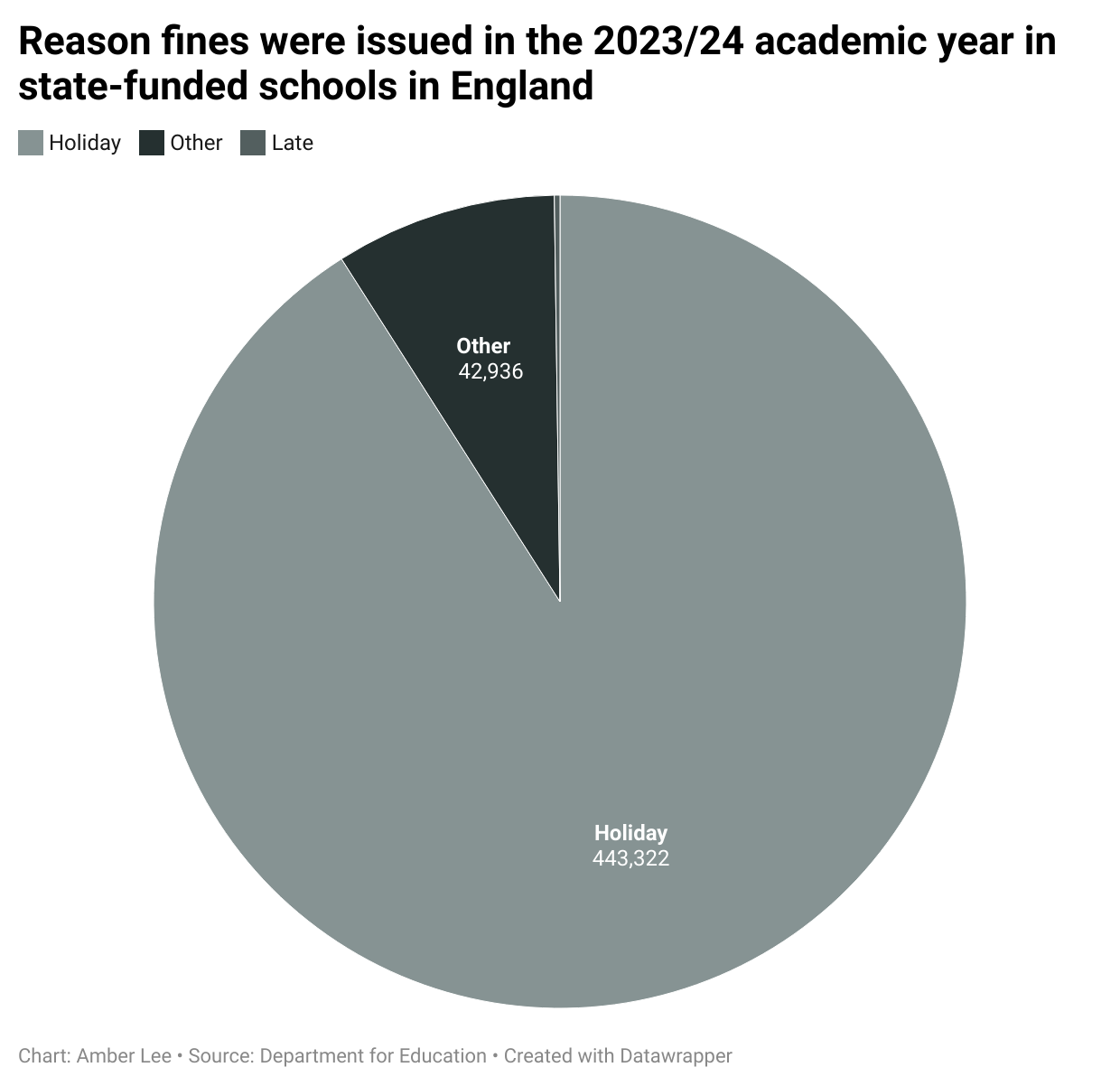
In the 2023/24 academic year, 90.97% of fines issued were for unauthorised holidays, highlighted below in the pie chart. Reasons classed within ‘Other’, accounted for 8.81% of the fines issued, such as a child missing school for their birthday. 1086 fines were issued because of children being late to school, making up 0.22% of the reasons. Fines are issued for persistent lateness usually after 10 unauthorised late arrivals to a session within a rolling 10-week period. The cost of the fines follows the same guidelines regardless of the reason.
Many parents argue that it is still cheaper for them to pay the fine and go on holiday, than it would have been to go away during the school holiday. For the family of 4 mentioned previously, for them to go away in the penultimate week of term with their 2 children missing 5 days of school, under the new legislation, they would be fined £320 if paid within 21 days. Meaning they would still be saving £1008.
School parent, Nicky Howells, expressed that “holidays are so incredibly expensive during the school holidays, I don’t blame parents for occasionally taking their children out during the school term. Holidays allow for precious family time or allow families to enjoy a celebration for example, a wedding or special family event. It can also offer new experiences such as foods, cultures and languages, if going abroad. I would happily take a fine to be able to have a holiday that we may otherwise have not been able to afford to do in term time”.
Some may argue that the fines need to be increased even more, so that it does counteract the savings, for the fines to be a deterrent. So, for now, whilst the fines are not likely to be more than the saving on the holiday, should parents make the most of it?
Speaking to a teacher of nearly 30 years, who works at an infant school, I asked her if she’d noticed the increase in children being taken out of school to go on holiday, she said she has noticed an increase but commented it has always been an issue. She stressed the lack of concern parents feel for their children missing school saying, “We often hear from parents taking children out of school that, ‘it’s the last week of term, they’re not doing real work, just playing so they won’t be missing anything’. In fact, those activities and experiences are crucial for the development and education of the whole child. They contribute to social development, communication, empathy and so much more.”
I also asked her about the impact it has on teachers and children at school. She said, “What parents don’t appear to realise, is the impact it has on the other children in the class. Teachers and teaching assistants have to spend time with them individually ‘catching up’ up with work and activities they have missed whilst away on their ‘cultural experience holiday’; this means those staff are then taken away from supporting the children that need them most, i.e. children with SEND or other vulnerable children.”
She expressed her concern about the lies parents say to avoid the risk of financial repercussions. “What I find the most unacceptable, is the way that parents clearly lie to school about why their children are absent. They tell us their children are poorly, have a stomach bug or a high temperature, to try and avoid paying a fine or having ‘unauthorised absence’ marks on their record. We as teachers then worry about those children, especially if they’re off school for an extended period assuming they must be really unwell. In contrast, there are occasions when it’s obvious children are on holiday and not ill; they do tell us about their holidays! I fear a generation of children is growing up believing it’s fine to lie to those in authority because they have witnessed it happening so freely by their parents.”
So is it really worth it? For the family of 4 who are wanting to book a holiday to Spain, if they were to book during the school holidays, they wouldn’t be able to afford it, so couldn’t go on holiday. It poses the question, what do you value more, a holiday or education? But as the Department for Education noted, “It’s not just children who fail to attend school who miss out, but those around them too”.