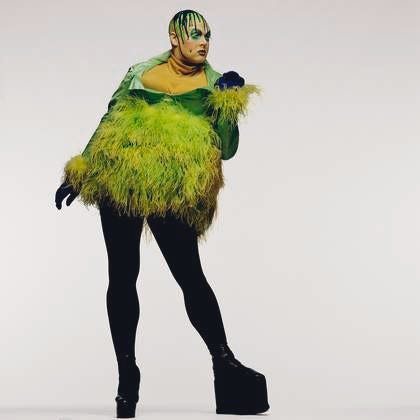
On the 27th of February 2024 The Tate modern opened the Leigh Bowery expedition displaying some of Leighs legendary looks. A stranger to Leigh myself I really had no idea what to expect from the exhibition and was immediately shocked at the outrageous, peculiar nature of the clothes he had created. The exhibition was immersive allowing you to watch Leigh on the screen, view his clothes and see some of his onstage performances. However, what struck me most was that at the end of the exhibition I left with that same sense of confusion, who really was Leigh Bowery? Whilst of course you could pin him down as a performance artist, designer, Club owner or even gay Icon I felt he was so much more than this. Upon deeper research, Leigh Bowery was a person who challenged societal norms and pushed boundaries through his outlandish performances and often flamboyant clothes. Bowery’s defiance against the conservatism rooted in the early 1980’s and 1990’s society inspired people’s courage today in tackling repressive powers existing within our own societies.
In 1985 Leigh inaugurated a new club night in disco bar in Leicester Square known as Taboo. The concept behind the club was that nothing could ever be considered taboo and once inside, you were encouraged to embrace experimental ideas rather than be discouraged. Whilst the club only lasted a year, its impact was enormous, and its ideology shines through in our culture today.
The partygoers were 1980’s stars such as Boy George, John Galliano and of course Bowery. The club turned into a community hotspot for those wanting to rebel and experiment with fashion and culture. This ideology is prominent in controversial stars of today such as Charli XCX, who has recently soared to stardom this past year. Charlis’s performances are often extreme, and the theme of illegal substances are prominent in her songs such as her infamous ‘365’ which features the line ‘bumping that’. Her origins in music date back to early London club life where she recalls her first gig at Hackney Wick; “I’d never been to a party like this before. I didn’t know anything about rave culture, or club-kid culture, or gay culture – everything was a first that night.”[1] Charli, who similarly to Leigh is labelled a ‘queer icon’ credits much of her success to her exposure to the LGBTQ community from as young as 14.
Charli even this year sent shock waves through the music industry by releasing her Brat vinyl, which featured ‘white powder’ seemingly resembling a particular illegal substance. Therefore, whilst Chari has never directly credited Bowery, the ideology behind her brand such as her coined ‘brat summer’ where fans come together to unapologetically be themselves is a prominent credit to Bowery whose legacy of outlandish, flamboyant performances lives on 30 years since his death.
After watching ‘Leighs Lounge’[2] a small documentary all about Leigh, narrated by his friends I soon realised the significance of politics in his performances. In 1980’s Britain, it was the decade of Thatcherism. A time of encouraging conservative values, pushing youths to get back to traditional family ideologies rather than outlandish ideas. However, in 1988 Thatcher’s government introduced section 28, which prohibited the ‘promotion of homosexuality’[3]. This legislation caused immense
problems for the LGBTQ community. It was proposed at the height of AIDS/ HIV cases and was heavily aided by the media who were relentlessly pushing stories of men who were dying from AIDS related deaths to feed the attack against Gay or Lesbian people. Around this time, Thatcher delivered a speech; ‘Children who need to be taught to respect traditional moral values are being taught that they have an inalienable right to be gay. […] All of those children are being cheated of a sound start in life – yes, cheated.’[4]
Whilst Leigh never directly spoke out about politics, his close friend Sue Tilley claimed he would do so in an indirect way. An example being, the ‘swash sticker’ which Leigh wore the reverse of to convey its message of peace amongst political unrest happening throughout society. In writing this, I have realised the expression, history repeats itself is astoundingly true. If we turn our attention to American politics where Donald Trump is currently the face of Americas future it is undeniable the uncertain scary times we are currently facing. Within his first four years of office Trump has appointed openly homophobic and Transphobic judges who will hold their positions for life. A 2019 study showed that 36%[5] of Trumps appointees expressed bias or bigotry to queer people. It is in this time of uncertainty that we need to praise and celebrate individuals like Leigh Bowery.
Whilst it’s true that we have come a long way in the development of AIDS and its treatment it’s a shame to see that there are still individuals in power who hold such repressive views. It is in times like this that lives like Leigh Bowery should be celebrated and act as an example of courage to own your individuality. Bowery in all his performances I feel taught us that taking a stand doesn’t equate to being radical its as simple as a putting on a piece of clothing and re designing its meaning.
When considering the influence of Leigh Bowery, it is undeniably present in todays artists. For example, in the melodrama of Ru Pauls drag race, Lady Gaga, Alexander McQueen and Maison Margiela whose crystal hood was directly inspired from one of bowery’s designs and would actually later be worn by Lady Gaga. However, one artist I feel has really drawn inspiration from Bowery is Chapel Roan. Whilst a singer in her own right, she is often seen in maximalist outfits whether it be her infamous transformation into the statue of liberty for the governor’s ball or a medieval ensemble completed with a prosthetic snout at the Grammys after party. The star has often openly praised Ru Pauls drag race and Drag in general for inspiring her looks. Much like Bowery her performances are often to shock and disturb those uncomfortable with her extreme presence. Chapel explains on Jimmy Fallon, the Late-night show “We pull from drag, we pull from horror movies. We pull from burlesque; we pull from theatre. I love looking pretty, and scary, or like pretty and tacky ... or just not pretty! I love that too.” Therefore, Leigh Bowery influence in the world of performance art and fashion today is undeniable and when re-examining Chapels looks the question left to ask is, is Leigh bowery her fairy godmother?
Looking back at Leighs life its hard to imagine what fashion, performance art or even just queer culture in general might of looked like without him in it. Whilst initially I felt frustrated in my inability to understand Leigh and his countless facades I have come to realise perhaps this was Leighs life mission all along. In my research I discovered a quote from Leigh ‘you label me, you negate me.’[6] Therefore, out of respect to Leigh I will refrain from trying to label this truly complex person. Instead, I hope this article gives an insight into the influence Leigh had on society up until his death on the 31st of December 1994. I would deeply encourage you to go and visit Leighs exhibition in the Tate modern which will be running until the end