


On the 17th of November, Trump is visiting the Philippines for the ASEAN Summit for the discussions around Pax Silica with the Philippines.
What is Pax Silica and why does it matter?
Pax Silica is a US-led international initiative aimed at strengthening global supply chains for artificial intelligence and advanced technology. It brings together partner countries to secure access to critical minerals, semiconductors, and advanced manufacturing, reducing reliance on limited suppliers while strengthening technological and economic cooperation.
Pax Silica matters because it highlights how the global race for AI and advanced technology can affect communities around the world. While countries such as the US and UK could benefit from stronger supply chains and access to essential materials, the proposed development in the Philippines raises concerns about the displacement of farmers and Indigenous communities, as well as the impact on local resources. It is important to question whether technological progress is benefiting everyone or leaving the people closest to the development to bear the costs.
The development is proposed to take place in New Clark City, Tarlac, and is estimated to gain between $40 billion and $70 billion in investments, as well as more than 130,000 jobs, stated by the development authority. However, are these proposed jobs accessible to locals? With advanced specialists requiring technological skills, locals may not necessarily benefit from the employment opportunities being promised.
“Maybe for us, the only jobs will be in construction. After that, we won’t even be able to enter the hub because we are not educated people. It’s hard for us to accept that.” - Farmer Mander Matias.
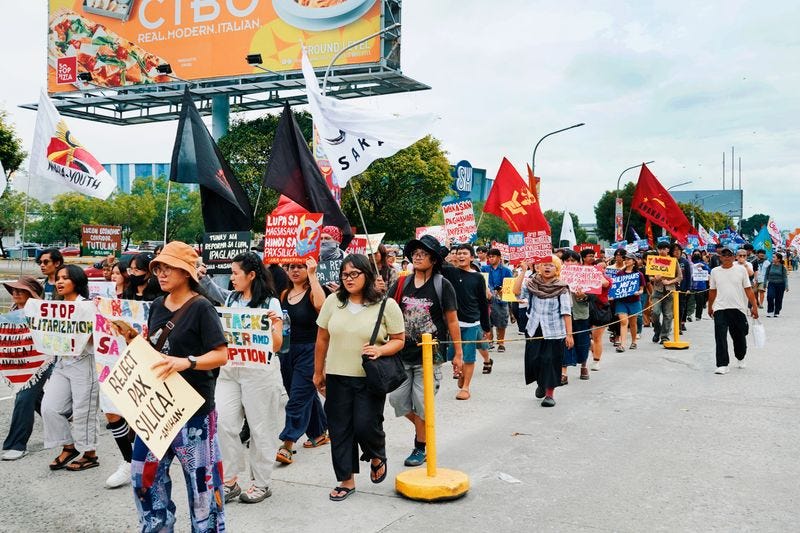
Artists joined hundreds of people from allied organisations at a rally culminating at the project’s intended site. Photo: Noah del Rosario.
The implications of Pax Silica are beyond the Philippines. The UK was among the original countries to sign off on Pax Silica in December 2025. Britain relies on international networks for semiconductor components and critical minerals to use in telecommunications and manufacturing for AI. This means that decisions being made over developments in Southeast Asia have implications for Britain’s future technological security.
The US has strategic interests in the Philippines, as its geographical location strengthens its global technology supply chains, particularly due to the US’s competition with China. China holds a significant position in critical minerals and the manufacturing of technology, creating competitive concerns for the US about relying on limited suppliers. Therefore, by partnering with the Philippines, the diversification of production strengthens supply chains with allied nations. The Philippines’ location in Southeast Asia, its existing semiconductor industries, and access to critical minerals make it an imminent partner for Pax Silica.
Artificial intelligence depends on semiconductors, advanced electronics, energy, and critical minerals, and the Philippines has already established electronics and semiconductor industries, making it a very good location for further manufacturing of AI.
The project sparks concerns about land, water resources, and the future of locals. Channel News Asia reported concerns from local farmer Mander Matias, who questions the lack of information being given to locals.
“They don’t tell us enough about the project,” he told CNA.
The government has deemed that the development is an economic growth opportunity. The debate is about whether economic and technological advancement can be at the expense of those people whose livelihoods depend on the land they want to industrialise.
Pax Silica’s proposals to place AI manufacturing hubs in the Philippines are potentially displacing 20,000 Aeta Indigenous people and 15,000 farmers, while 200 residents cultivating 410 hectares are affected by the proposed development.
The Philippine government argues that the project will bring significant investment and jobs without displacing locals. On the 4th of November, Palace Press Officer Claire Castro said that the facilities would be built within a designated buildable zone, which should prevent people from being affected. She also stated that if displacement did happen, residents would receive relocation assistance and financial support. The BCDA has also said that it plans to use a recycled water system and dedicated power facilities to reduce the effect on community resources.
CNA reported that the proposed manufacturing hub would utilise 60 million to 90 million litres of water daily. Farmers worry that taking water from local sources, such as the river, could affect irrigation and natural supplies.
Opposition to Pax Silica has been loud and clear. On the 13th of November, students from several universities in the Philippines staged a campus-wide walkout protesting the project and Trump’s upcoming visit. Demonstrations happened at Ateneo de Manila and the Polytechnic University of the Philippines, with students raising concerns over environmental destruction, Indigenous land, and the influence of American economic interests.

CoverStory: PHOTO BY BULLIT MARQUEZ
As the Philippines seeks to strengthen its position in the global technology industry, Pax Silica could have implications far beyond Southeast Asia. For Britain, a more diversified supply chain for semiconductors and critical minerals could improve access to the components needed for telecommunications, manufacturing, and artificial intelligence.
However, the initiative also raises questions about the social and environmental costs behind the technology Britain increasingly relies on. With negotiations still ongoing, the challenge is whether countries such as the UK can benefit from greater technological security without overlooking the Filipino communities potentially affected by its development.
Public opposition has also taken shape online. A petition calling for the rejection of Pax Silica gathered hundreds of thousands of signatures, reflecting concerns among Filipinos over the potential impact on Indigenous land, farming livelihoods, and the environment. The Philippine Star reported on 10 August 2026 that farmers and Aeta representatives had launched a petition against Pax Silica, which had gathered nearly 400,000 verified signatures at the time.

screenshot from change.org
Ultimately, if the benefits are global but the consequences are local, who is really benefiting from Pax Silica?