


The 2026 edition of the FIFA World Cup was hosted in North America with matches in cities across the United States, Canada and Mexico. With the tournament taking place in a completely different time zone to the United Kingdom, football fans had to adapt to later kick-off times in order to watch their favourite teams and players. For broadcasters like ITV, the variety in kick-off times affected their viewing figures as many of the matches were scheduled at inconvenient times for a British audience.
Television viewing figures represent the success of a broadcaster and for the 2026 World Cup, ITV was competing for viewership against the BBC who also had rights to broadcast the tournament. Official viewing figures from Barb’s ‘Weekly top 50 shows’ data between 8th June and 19th July 2026 shows how not only kick-off times affected each match’s viewership, but the teams playing and the stage of the tournament also affected who watched the game.
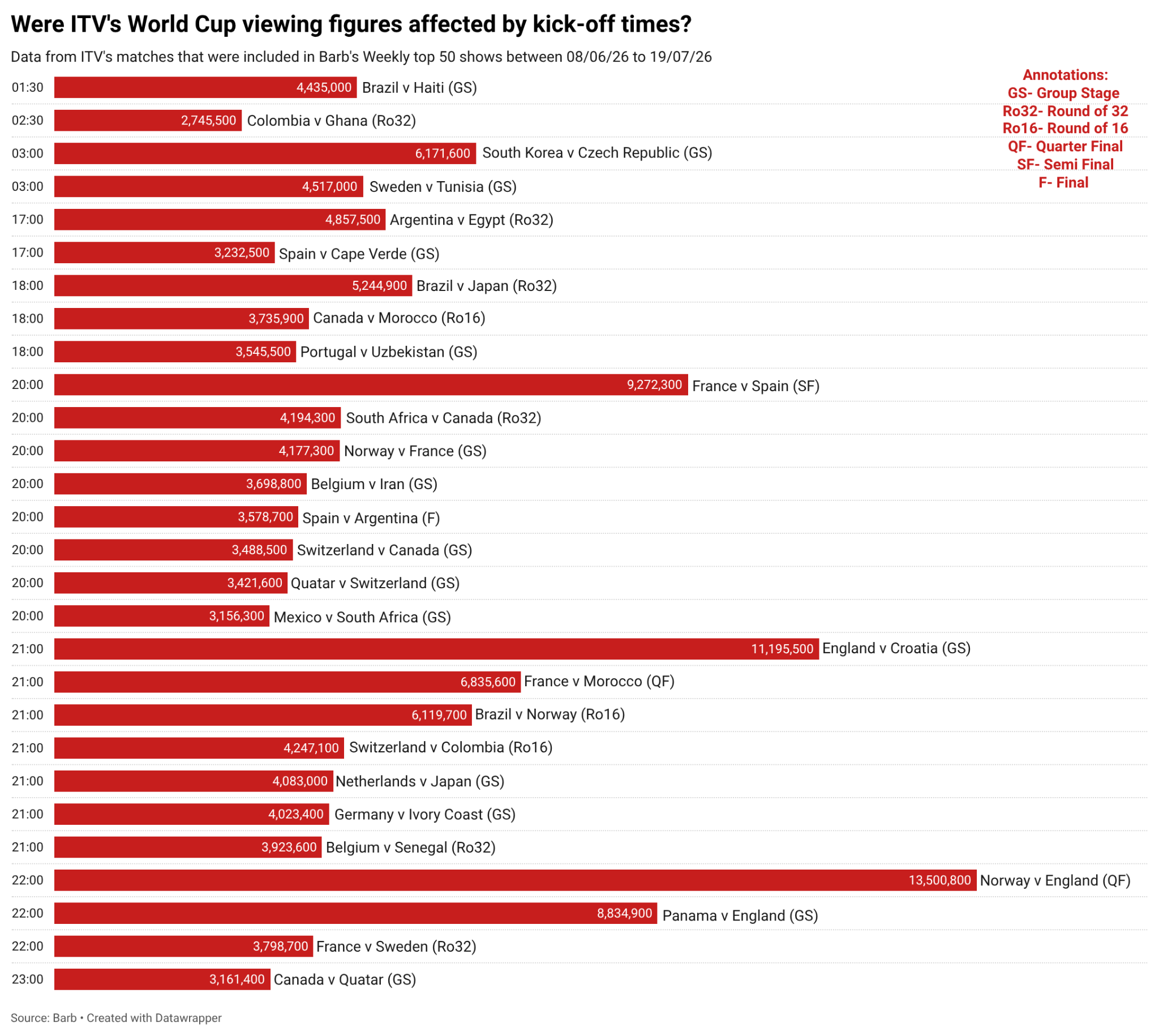
The England games on ITV had only a small variation in kick-off times but it was clear that the difference between an 21:00 kick-off and a 22:00 kick-off impacted viewing figures with over two million more people watching the England v Croatia group stage fixture that kicked-off at 21:00 in comparison to the Panama v England game that kicked off at 22:00. However, later in the tournament, when England faced Norway in the quarter final, the match kicked-off at 22:00 and attracted over four and a half million more viewers than the group stage fixture at the same time. This proves that the importance of the fixture meant that people were more likely to find time to watch the game despite the kick-off time being later than prime time.
A fan of England, Kyan, liked that the matches kicked-off later in the tournament. “I work in the evenings, so, when tournament football usually kicks-off between six and eight o’clock I am never able to watch the matches live. During the tournament this summer, I was able to watch a large majority of the games that were played after nine because I finished work by then. I even got to go to the pub with my friends to support England for some of their games which I never usually get to do during the World Cup. I loved it!”
There was a surprising spike in viewing figures at 03:00 for the group stage fixture between South Korea and Czech Republic. This match was the second of the tournament, so it could be that the build-up and anticipation for the World Cup to begin drove viewing figures for the fixture. Not one of South Korea and Czech Republic’s matches, for the rest of the tournament, had enough viewers to be included in Barb’s Weekly Top 50 shows. This does really show that unfortunately people weren’t watching the match for the teams but just to feel as if they were a part of the World Cup after it had been promoted and advertised for months. Afterall, British viewers really enjoy watching something go wrong and with all the controversy around the United States as a host country prior to the tournament, there was almost guaranteed to be a group of people watching the first game that was hosted in the United States hoping that something would go wrong.
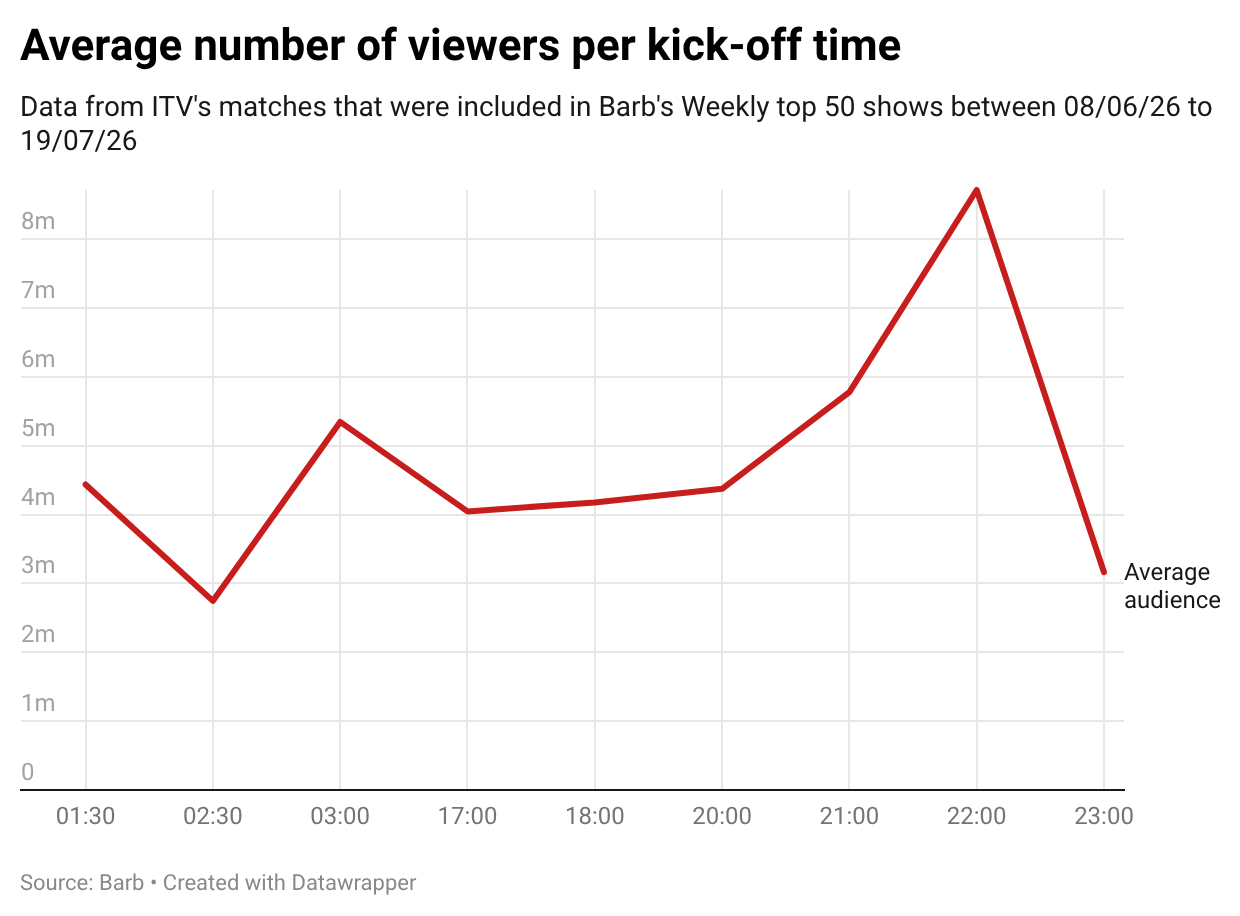
With the kick-off times being later than usual, there was less opportunity for casual viewers to watch the matches because, let’s be honest, no one’s casually awake in the early hours of the morning to watch a football game between nations they don’t support. But, if the game that were scheduled in the early hours of the morning were broadcast at prime time, possibly they could have made for some good background noise in the evening. This casual viewership idea is shown in the viewing figures as matches scheduled between 17:00 and 20:00 all had a similar average number of viewers despite which teams were playing.
One of the matches that surprisingly didn’t attract a large audience on ITV was the final between Spain and Argentina. ITV had to share their broadcasting rights with BBC for the 2026 World Cup and up until the final, the matches were almost evenly spread across both television channels. Both broadcasters had rights to show the final on their channels which meant that the audience was spread across both platforms. It was reported by the Guardian that the BBC had an average audience of 9.2 million viewers, almost three times the amount of viewers the ITV had for their coverage. There are a likely variety of different reasons why the BBC attracted a larger viewership but it wouldn’t be surprising if the British public chose the BBC because of their lack of adverts as that is what sets them apart from other streaming channels. It could be argued that ITV’s business model has failed them in this scenario, but that is a whole separate story in itself.
Ultimately, the kick-off times did affect ITV’s World Cup viewing figures but that wasn’t the sole factor that impacted who was watching the football games. England matches had a predictable spike in viewership along with games that had more significance to the outcome of the tournament, like the quarter or semi-finals. The viewing data produced by Barb reinforces that the prime time was the best time for kick-off to be scheduled as the matches at this time consistently brought in a strong audience despite who was playing in the fixture. Next summer, ITV will face a similar issue with the FIFA Women’s World Cup as it is being hosted in Brazil which is also hours behind the British timezone. Women’s football relies more heavily on the casual viewers that will watch the matches during prime time, so ITV is going to need to plan how they will keep the audiences engaged so they can convince them to come back and watch the matches that will be in the early hours of the morning.