


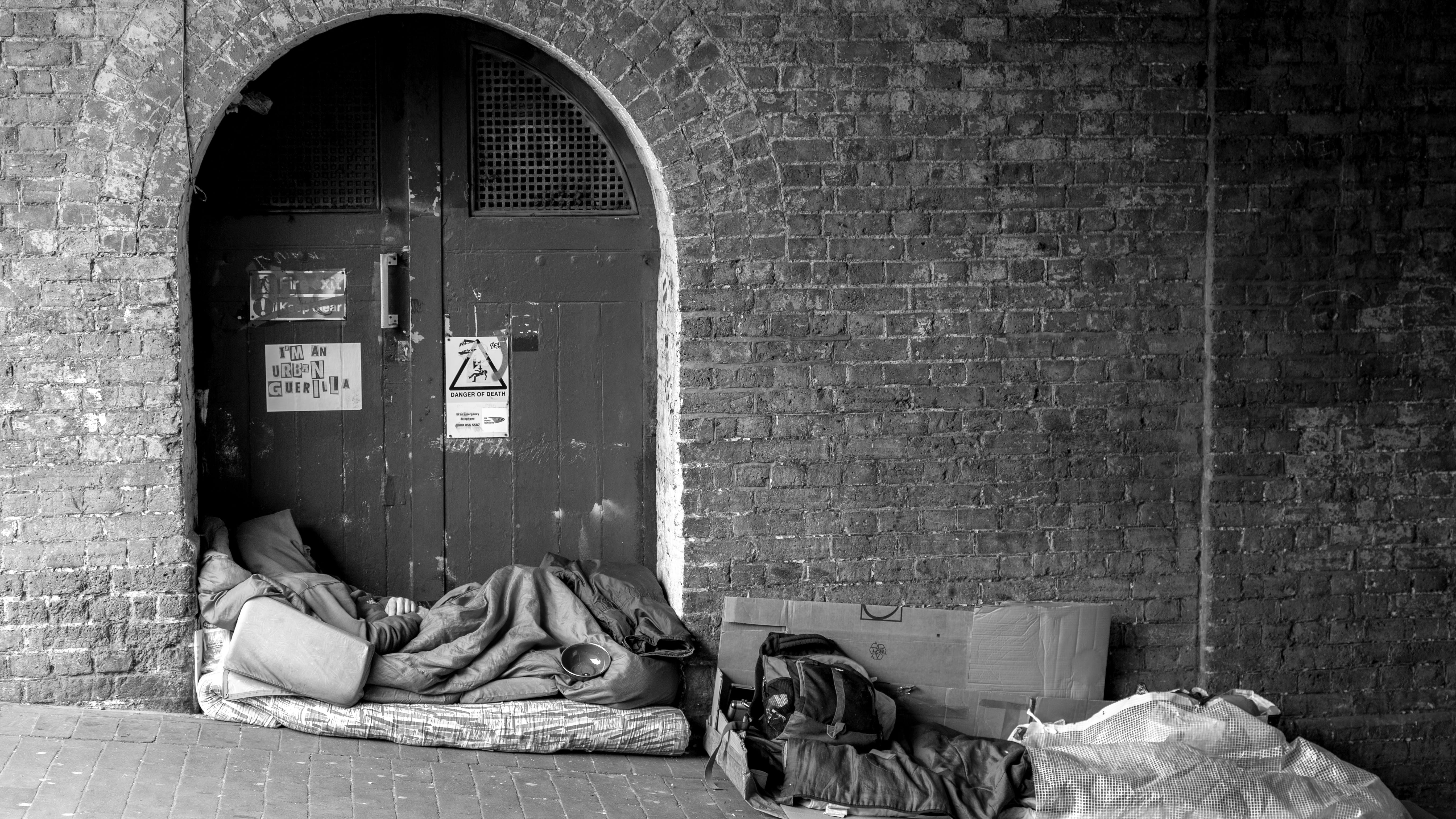
Despite being an ongoing issue, the significant increase in rough sleeping for prison leavers on release has continued to fly under the radar, and hidden resulting problems.
In the year up to March 2025, there was a 311% increase since the year up to March 2019 in prison leavers forced to rough sleep on release, according to data from the Ministry of Justice; 19 times the increase in all prison leavers in the same time period.
This continuing upwards trend, when ignoring data affected by the ‘Everyone In’ scheme (a scheme designed to move all those rough sleeping into accommodation during the COVID-19 pandemic), has now led to rough sleeping becoming the 3rd most common type of accommodation on release for prison leavers.
But what are the reasons behind this increase, and how does being forced to rough sleep affect other aspects of prison leavers’, and everyone’s, lives?
There are many contributing factors to why so many prison leavers have to rough sleep on release, instead of receiving appropriate accommodation. When in custody, most prisoners will lose any benefits they would have previously received, unless their sentence is below 13 weeks, and are unable to reapply for housing benefit whilst still in custody. Whilst prisoners are able to prepare for this process, without essential paperwork from this application it is far more difficult to get accommodation not previously arranged.
In addition to this, a significant lack of social accommodation means there is simply not enough housing to give everyone who needs it. This is an issue Darryn Frost – co-founder of Own Merit, a non-profit organisation with a mission to address the prison-leaver homelessness crisis safely and cost-effectively – is incredibly familiar with.
He explained that in terms of allocating prison leavers housing, “the real issue is structural: responsibility for housing sits with local authorities, not the prison or probation service, so there is a persistent communication gap between the offender manager in custody, the one in the community, and the council expected to allocate.
“Prison leavers are not a ‘priority need’, which puts them at the bottom of a long queue for social housing. The 56-day window for the Duty to Refer [a duty in place for specific public bodies to refer those who are homeless or at risk of homelessness to the local authority] is often missed.”
There have been attempts to aid prison leavers in finding accommodation when it is not provided for them through the Offenders (Day of Release from Detention) Act 2023. The Act ensured prison leavers would not be released on Fridays, to allow them enough time to access housing before services closed for the weekend.
However, this effort is not wholly effective. Mr Frost commented that “stopping Friday releases is a solid idea, however, it hasn’t fixed the underlying issues. Without those basics locked in, the Friday reform is just a better-timed drop-off.”
This problem with securing housing is also not self-contained. Rough sleeping makes re-entering society and rehabilitation considerably harder by causing further problems.
Dr Grace Low, a criminology lecturer at Oxford Brookes University, confirmed this, explaining that “without stable housing, it can then be impossible to sort out other aspects of reintegration, such as obtaining employment.”
It can also lead to reoffending becoming an inevitable cycle for prison leavers, which in turn affects society as a whole. Data from the Ministry of Justice states that 77.5% of adult offenders who rough sleep on release from custody reoffend, the highest rate of reoffending out of any accommodation status.
A prison leaver’s status as homeless can directly lead to them having to return to custody. When prisoners are released from prison on license, license conditions often state where prison leavers must live, and they must hold a suitable, approved address they can be visited at. If they break these conditions, potentially through being homeless, they can be recalled to prison for 56 days, which has recently been increased on 31st March 2026 by the Sentencing Act 2026 from shorter recall times of 14 and 28 days.
Dr Low calls these recalls “particularly disruptive”, stating that through them “people can end up losing their homes, custody of children, and their job, if they had one, while receiving no constructive support within prison to support their desistance [stopping reoffending].”
Issues with reoffending continue to be systemic, as prison-leavers who are already more likely to reoffend, for example those committing lower-level crime, are also more likely to become rough sleepers on release from custody; increasing the likelihood of a reoffending cycle.
68.4% of adult offenders with a sentence less than or equal to 6 months reoffend, and those with the same sentence made up 62.4% of rough sleepers in the year up to March 2025.
As to why so many low-level offenders face street homelessness, Mr Frost explained that “sub-12-month sentences strip any existing tenancy [and] give the Duty to Refer no time to work”, meaning when they are released they have little choice other than rough sleeping.
Lower-level offenders are considered vulnerable before facing homelessness, as Mr Frost said short sentences “are served disproportionately by people with addiction, mental ill-health and care experience.”
Whilst a small number may reoffend specifically to get accommodation and food through prison, “the dominant reason this cohort is over-represented is because lower-level offenders never get any real support to change their behaviour or change their circumstances.” By providing appropriate support, reoffending could decrease for this cohort.
The systemic challenges lower-level offenders face are also demonstrated by prison leavers who committed theft offences being more likely to rough sleep on release from custody, penalising lower-level crimes again.
The seeming inescapability of reoffending increases with theft, with Mr Frost stating that “theft is very often acquisitive offending to feed an addiction, so you have two cycles running at once. Custody interrupts both without breaking either.
“The system effectively manufactures homelessness for this group and then treats their return as a surprise.”
In order to tackle crime as a society, and reduce the £23.6bn cost of reoffending every year, then it is clear that providing housing for prison leavers is a necessary step, with Mr Frost saying accommodation “is the single largest contributor to reducing reoffending.”
Dr Low also affirms the importance of prioritising housing when looking at reoffending as a whole, stating that “it provides a base, for example, to attend treatment programmes or engage with community support. It provides a base to go to and from work.”
Distinguishing living under a roof, compared to having a home, she continued that “somewhere which feels like ‘home’ offers important psychological benefits. For example, a space in which you have control and ownership over and which you can express yourself.”
In order to assist this, instead of the current system of CAS3 (Community Accommodation Service Tier 3) providing 84 nights of temporary accommodation, which Mr Frost says “buys time without buying outcomes”, he suggests “that spend would do far more work if it incentivised private landlords, housing associations and councils to prioritise this cohort, backed by real support: help with evictions, a route for dealing with anti-social behaviour, and indemnity against damage or incidents.
“A tax incentive for private landlords, charities and CICs who take this group on would move the dial further.”
Accessing housing is the problem at the centre of many issues both prison leavers and wider society face, therefore implementing such methods would have an unexpected wide effect. As Mr Frost stated: “Fix housing first and the other interventions actually get a chance to work; skip it and you are pouring resource into a sieve.”