


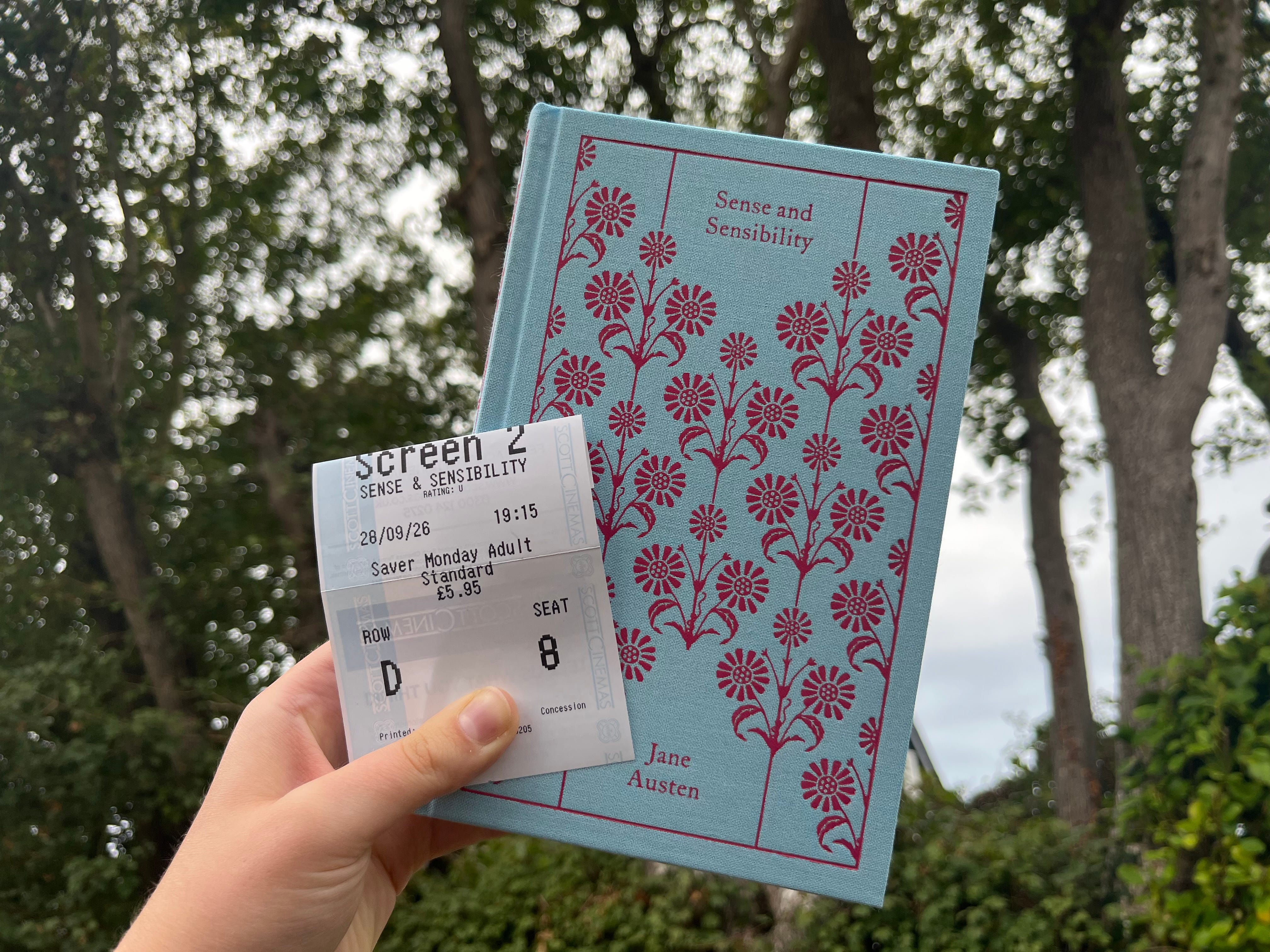
Recently, even the most passionate period-drama fans could be forgiven for becoming slightly overwhelmed by the sheer range of Jane Austen adaptations offered to audiences, and yet Georgia Oakley’s 2026 version of Sense and Sensibility provides a fresh and charming take which absolutely must not be missed. Between balancing moments of quiet reflection and trademark Austen wit, the film successfully absorbs the audience into the romances of regency society.
We are once again welcomed back to Norland Park, the home of Elinor Dashwood (Daisy Edgar Jones) – a considerate young woman who thinks with her head rather than her heart – and her younger sister Marianne (Esmé Creed-Miles) – a free spirit unapologetic about her blind pursuit for passionate love. As they reel from their father’s recent death and the lack of funds it has left them with, the sisters are forced to hand over their family home to their half-brother. In this process Elinor meets Edward Ferrars (George MacKay), the endearingly awkward brother of her sister-in-law. Sabotaged by their own reluctance to prioritise themselves, the two face further problems through the Dashwood’s move to Devon. For Marianne, however, Devon brings both Colonel Brandon (Herbert Nordrum), stoic and serious, and Mr Willoughby (Frank Dillane), charming and boyish.
Any soul brave enough to attempt adapting Austen’s work, in particular one which already has a beloved 1995 version full to the brim of national treasures, treads a fine line between remaining loyal to the source material, whilst also providing a new interpretation to engage and excite the audience. Thankfully, Oakley’s direction and Diana Reid’s screenplay work together to create just this; a witty homage to the characters Austen has created, and a unique depiction of the regency world.
Although there were some occasional issues with pacing, Reid’s screenplay fortunately does not commit the cardinal sin of becoming so preoccupied with ensuring each character is well-spoken and posh enough to fit into the regency period, that any personality distinguishing them from each other is non-existent. Each of Austen’s carefully created characters leap off the page directly onto our screen, retaining the flourishes and flaws which make them so loveable in the first place. The humour in Marianne’s melodramatics of having to greet her extended family and Mrs Jennings’ (Fiona Shaw) endless ramblings are perfectly balanced with tender moments of sisterhood and love in whatever form it takes.
These characters ultimately become truly alive through the actors’ transformative portrayals, allowing us to feel every emotion alongside them. The film boasts a strong main cast, ignoring a few supporting actors who gave weaker performances. The main star of the show, and rightfully so, is Daisy Edgar-Jones’ quiet and considered performance as Elinor Dashwood. She is able to show the depth to Elinor’s internal conflict between the need to keep up her sensible and logical appearance, and her true feelings both through dialogue and her own mannerisms. In a role which could easily become a martyr, Elinor becomes a real person we as an audience feel we know.
Close behind Edgar-Jones are her two most frequent scene partners; Esmé Creed-Miles and George MacKay. Creed-Miles believably portrays Marianne’s naivety fuelled by her lovesick nature and treats her outbursts with the sensitivity they require. MacKay proves himself to be the perfect fit for a period-drama leading man, providing a dynamic performance where Edward’s duty to do the noble thing often interferes with what he truly wants in his life.
Although both sisters experience their own romantic arc, Elinor Dashwood and Edward Ferrars were by far the strongest and most compelling couple within the film. MacKay’s and Edgar-Jones’ performances perfectly complimented each other in showing the complexities of a relationship between two people who consider their own happiness of the least importance. Their struggle with this makes their scenes electric to watch and leaves the viewer invested in how their story will end.
Whilst the depiction of these characters and relationships can be compared to other Austen adaptations, what really made the film stand out from its predecessors is what it didn’t say. A usual sole focus on the busy goings on of regency society and interactions between characters is forced to take a pause through still, establishing shots in this version of the story. Moments of quiet are forced upon the audience, whether that be shots of the Dartmoor landscape or bleak empty estates. Audiences are allowed to sit with certain scenes for longer, and absorb the surrounding setting as a vital part of the storytelling experience.
Every carefully thought-out aspect of 2026’s Sense and Sensibility contributes to the film’s core exploration of how class and societal expectation tries to determine one’s happiness. Despite Elinor and Marianne finding themselves in the early 1800s, the emotional performances and lively script allows each character to be right here with us, and only works to prove how timeless this tale will remain. It would be impossible to please every Austen fan, but consider this Austenite thoroughly impressed.