


The latest figures provided by the Office for National Statistics (ONS) show that the shoplifting offences have risen by 7% in the entire Thames Valley Police force area in 2025, even as the overall recorded crime declined by 1%.
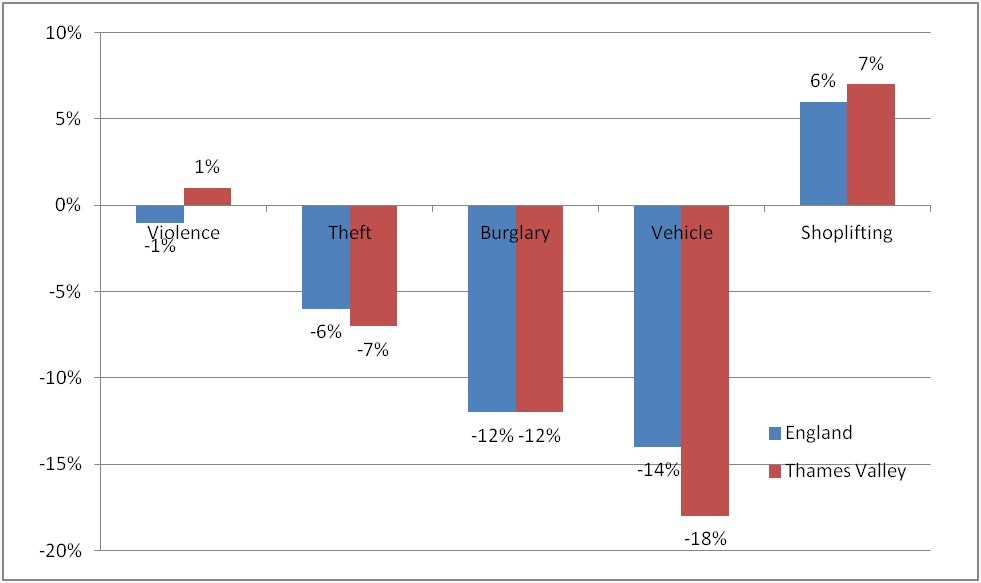
This increase in shoplifting is in dramatic contrast to the overall decline in crime. During the same period, theft declined by 7%, burglary by 12% and vehicle related offences by a substantial 18% in the Thames Valley. Nationally in England, shoplifting rose by 6% while total recorded crime declined by 2%. Violence against the person showed a slight 1% increase locally, compared with a 1% decrease nationally.
As shown in Figure 1, shoplifting is the only major offence category increasing, while other crime types continue to decline.
Figure 1: Percentage change in crime by offence type – England compared with Thames Valley (year ending September 2025)
Source: Office for National Statistics (ONS), Police Recorded Crime Statistics
When adjusted for population size, the Thames Valley continues to be one of the safer police force areas in the country. It recorded approximately 71 offences per 1,000 people in 2025, well below the England average of 88. Violent, theft, burglary and vehicle crime rates were significantly below the national rate. Shoplifting, though, was one of the categories in which Thames Valley and England were nearest to each other, which is an indication that the issue is experienced more evenly across the regions.
The figures tell a story of two trends: positive improvement in general population safety and an infuriating and noticeable increase in retail theft that is becoming a concern to store owners and employees.
In Oxford’s Cowley area, the impact is tangible. Rashid, who runs an Afro-Asian grocery shop serving the diverse Cowley community, says shoplifting has become a daily headache.
“It’s increasing day by day,” he told me. “Due to inflation and high product costs, especially food, people are trying to steal more from shops. Sometimes three or four cases happen in one day. We don’t even report it to the police anymore because it wastes time and we get no compensation. The law is not strict enough.”
Rashid’s frustration is common among small retailers. Many report that the combination of rising living costs and what they perceive as lenient consequences is emboldening thieves. The economic context plays a major role; most of the households are only just recovering the impact of inflation, and retailers experience tightened margins and increased competition from online platforms.
Thames Valley Police and Crime Commissioner Matthew Barber has made tackling shoplifting a clear priority. In a statement issued in August 2025, he emphasised the need for shared social responsibility:
“I believe in social responsibility and in people being engaged in their communities to help keep them safe. People should not turn a blind eye to crime… I have made tackling shoplifting a priority for Thames Valley Police and that has resulted in more criminals being charged, more patrols being visible, easier sharing of evidence from stores, more support for retailers and a focus on the most prolific offenders.”
Barber urged retailers, staff and shoppers to report incidents and, where safe, perform simple actions like alerting staff or taking evidence. He stressed he was not asking people to put themselves in danger by physically confronting offenders.
His comments, however, sparked controversy. Liberal Democrat MPs Joshua Reynolds and Freddie van Mierlo criticised the approach as “irresponsible and dangerous.” Reynolds argued that “expecting the public to do the job for the police is not the way,” while van Mierlo said the public should call the police rather than confront criminals.
The discussion brings up broader issues regarding the societal reaction to retail crime. Meanwhile, the official numbers indicate the positive change. Barber previously highlighted a 98% increase in charges for shoplifting offences in the force area between April and mid-October 2024 (from around 850 to 1,700). He has also pointed to initiatives such as a new Business Crime Team, Operation Purchase for increased visible patrols in retail areas, and better information-sharing platforms for retailers.
Even with this action, a significant number of shopkeepers are still sceptical of the effects on the ground. Others claim that the response times by the police are still too slow and that repeat offenders are hardly deterred. Not all residents in Cowley share the retailers’ sense of rising insecurity. An unnamed local man said everyday life actually feels safer than in previous years:
“Things have become cooler and calmer. There’s less crime going on in our communities recently. You can go out freely at night now. I give big praise to Thames Valley Police — they’ve been very visible and they’re working hard to crack down on crime.”
Oxford Brookes University student Raj, an international student living in the area, echoed a similar personal sense of safety:
“I walk at night a lot of times and I didn’t see any crimes happening. For me it feels safe here. But the types of crimes that concern me most are theft and robbery — especially if someone comes with a knife or tries to scare me to take my things.”
These opposing voices depict how crime patterns are experienced by various groups of people. Frontline retail workers who are the most affected by shoplifting are under daily pressure, and many residents and students are the main beneficiaries of better street security and law enforcement.
Police-recorded crime statistics need to be looked at with a certain degree of caution. The numbers can be affected by changes in recording practices, population readiness to report offences, and enhancement of police systems. The ONS itself notes that not all forces have fully consistent recording standards in recent years. Nevertheless, these figures remain the most comprehensive official measure of crime that comes to the attention of the police.
The consistent increase in shoplifting takes place on a challenging economic background. Retailers are dealing with increased expenses, lower margins and long-term implications of the cost-of-living crisis. On a national scale, the past few years have seen shoplifting at record or nearly record levels, and campaigners are demanding harsher sentencing of habitual offenders and a quicker police response to retail shoplifting.
The problem is especially evident in busy neighbourhood centres in Oxford, and the wider Thames Valley, where there are independent shops alongside larger stores. Local police neighbourhood teams have stepped up efforts in the city centre and Cowley, but retailers say more needs to be done.
As Rashid put it: “The problem is growing every day. Without stronger action, it risks becoming normal.”
Although the general crime rates in the Thames Valley are on the right track, the particular increase in shoplifting incidents indicates the emergence of the strain on the local high street and convenience stores. Bridging the gap between falling overall crime statistics and the lived experience of retailers will likely remain a key challenge for police, politicians and communities in the months ahead.