


All data within this article is from ONS, Sickness absence in the UK Labour market, 2023/24. Unless stated otherwise.
According to NHS England Digital, common mental health conditions and their prevalence has increased among 16- to 64-year-olds from 16.3% in 2000 to 27.8% in 2023/24. This is a 11.5% increase in the space of 13 years and can be due to many varying factors: lifestyle, genetics, trauma, the list can go on.
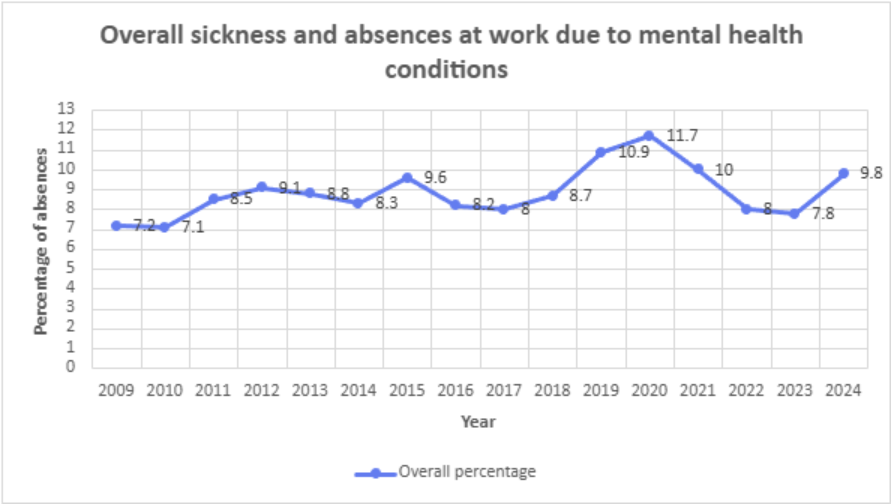
Although this is not a specific date correlation to 2009 and 2024, it can be heavily connected to the sickness and absence from work due to mental health conditions increase of 36.1%. In the graph below you can see that there are a few inconsistencies in the growth but the there is an overall increase between 2009 and 2024.
Created using Excel.
As you can see between 2023 and 2024, there is the steepest increase in absences due to mental health conditions compared to any other year, and as we know from the pattern of increase its going to continue to escalate, which is insufficient and damaging to societies and our economy, revealing why the relevance and impact of mental health conditions should be concentrated on and de-escalated.
The prominence of mental health may have also risen due to the newer acceptance of mental health and companies now having to treat mental health issue the same as physical. Mental health equals health. According to ACAS (Advisory, Conciliation and Arbitration); a UK government funded organisation that concentrates on the rights and problems in the workplace, state that ‘Employers have a duty of care’ including making sure the working environment is safe, protecting staff from discrimination and carrying out risk assessments’ this includes the rule that ‘employers must treat mental health and physical health as equally important.’
The awareness for mental health issues and conditions is more widely accepted and heard of in the later years, therefore leading to more recognition of symptoms and leading to more diagnoses and even self-diagnoses within the country, this will lead to more sickness’ and absences to work because of the laws surrounding mental health and ability to use mental health conditions as a justifiable reason for absences. The mix of the laws and awareness of mental health conditions will produce a necessary rise in absences from work.
External factors will also affect these percentage increases and decreases, such as between 2020 and 2022 – COVID. The coroner virus caused a major lockdown causing an even bigger increase in mental health conditions mixed with jobs being on hold due to be unable to leave your house. These combine together to therefore why we see a sudden rise in 2020 to then have a steep decrease between 2020 and 2022.
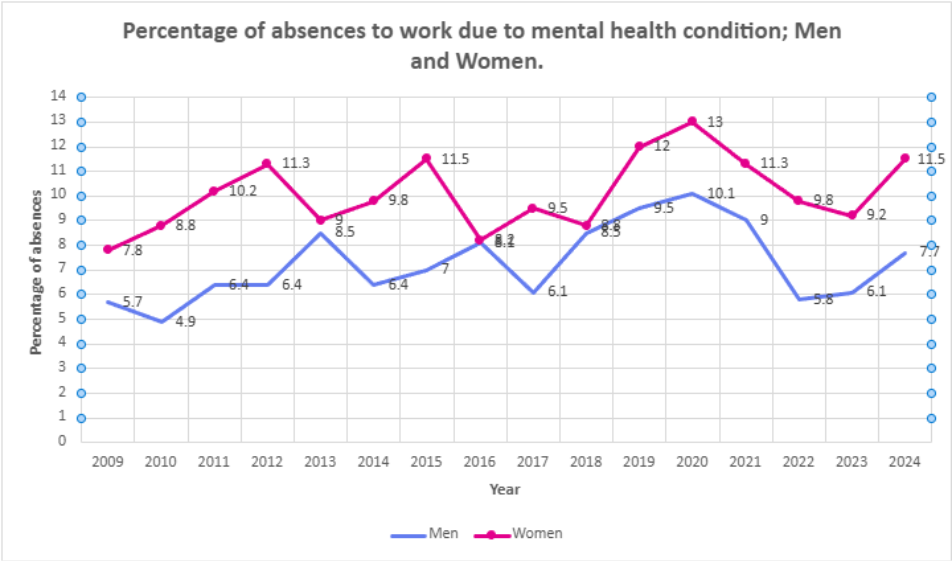
Women and men percentage of absences differ. As reported by NHS England Digital the common mental health conditions increased in both men and women between the ages 16-64. For men the percentage increased from 11.9% in 1993 to 17.3% in 2023/24, and for women increased from 19.1% to 27.8% in the same time period. This correlates to the data on absences and sickness due to mental health conditions as we saw the same trends, see graph below:
Created using Excel.
This graph shows an inconsistent yet overall increase for both men and women regarding percentage of absences to work due to mental health conditions. The men have an overall increase between 2009 and 2024 of 35.1% and the women having a 47.4% increase, that is a difference of 12.3% between men and women.
Both prevalence of common mental health conditions and absences have increased, statistically that make sense, because it’s suggesting more women have mental health issues therefore, they have more absences. However, it’s a known stereotype that women are more open with their feelings and mental health than men are, therefore could be a bias statistic because not all men will openly speak on their emotions and issues as a stereotype, because of the stigmas and shame associated.
Basing the statistics of stereotypes, reveals why women may have got higher percentages of Mental health conditions and absences to work due to the conditions, however there is still a big increase for men and their absences due to mental health conditions.
Throughout the inconsistencies we do see an interesting pattern for the years including 2013, 2017, that each gender has opposing increases and decreases. In 2013 women’s percentage rates dropped from 11.3% to 9% and for men rose from 6.4% to 8.5% and similar for 2017. Whether this is a coincidence or a reasonable logic should be further investigated.
The same for external factors can be applied to this data, as we see the same trends over covid times of 2020 to 2022.
The overall trend in this article shows that absences and sickness for work, due to mental health conditions have risen, and will continue to do so, as a result of overall Common Mental Health conditions rising. It’s important these rates slow to protect societies, the economy and complete health and wellbeing of the country, on top of individual wellbeing of those suffering with mental health conditions. It shows that women have a higher percentage of those with mental health conditions, however it’s relevant to consider stereotypes of those men and women in today’s society.