
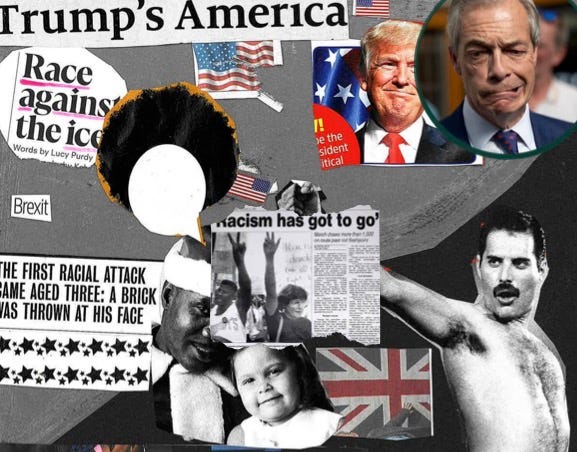
What will happen to social media if nothing is done to monitor hate comments? Casual, unfiltered racism is beginning to slip through the cracks of moderation systems online. As a result, nasty discriminatory thoughts from either ignorant online accounts or ragebait bots attacking content creators. Linking this to the significant rise in the popularity and prominence of the far right political party Reform UK, discrimination online against ethnic minorities has spiked.
From April 2024 to September 2025, Reform UK had been associated with 20 incidents of racist or Islamaphobic behaviour by its members, candidates and activists observing their actions (Bear, 2025). These incidents, documented with evidence either online or in real life, displayed MPs associated with Reform UK brazenly displaying their racist and discriminatory views. An example from 29 May 2025 displays a former Reform UK councillor in Doncaster, Mark Broadhurst, posting a meme suggesting that Adolf Hitler would have been “a legend” if only he’d chosen to exterminate Muslims instead of Jews. Broadcast was later expelled due to the meme, but the simple fact that he posted it displays the acceptance of fascist views in the party.
Discrimination online isn’t new. “Trolls have existed for years and there can’t be a social media post without one or two hate comments. But what happens when an epidemic of right wing views become normalised by political parties, in a society that uses social media to appeal to the public? How far will online discrimination go?
“The only thing that I would really get slightly irritated at is if I click on the profile and like some actual person and you can tell he has friends and stuff, so actual people believe that.”
I recently conducted an interview with Testimony Adegbite, a black content creator in Scotland, who posts on both Instagram and Tiktok. His TikTok content, which usually reaches younger people, aged 12-late 20s on TikTok, seems to have a more tighter grip on moderation than Instagram, which reaches out to a broader age demographic - 40-50 year olds. As of January 2026, 19% of voters aged 25-49 intended their vote for Reform UK. This links racist comments posted on Instagram to Reform UK supporters who have an online presence on Instagram.
Testimony tends to notice that on Instagram, discriminatory comments against black people are more prominent and unmoderated than on TikTok. “TikTok naturally folds or doesn’t allow comments that are bigoted, I suppose. The main difference in it is Instagram, as a whole could be more negative on the comments than TikTok, which is a lot more friendly.”
The lack of comment moderation on Instagram could lead to even more bigoted viewpoints being distributed online. Individuals who have seen discriminatory remarks said by political figures such as Broadhurst leads to lack of shame and a falsified “community viewpoint” leading to far right views being shared more openly. Alongside Instagram’s lack of moderation for these comments, discrimination becomes more frequent, with little to no way of hiding or deleting them for other eyes to see.
Throughout the past two years, social media users have observed that there has been a significant rise in the number of hateful comments.
Philia Okorie, a student at Oxford Brookes has observed that there has been a rise in hateful comments in the past two years.
“I’ve been on social media for 8 years now, the content I’ve seen is a mix of positive and negative. Sometimes I’ll see a positive video, but when I see the comments they are very negative.”
From Testimony’s own personal experiences and perspectives, discrimination against black people stands out the most to him. Examples of the racism observed by him online are Saka’s missed penalty in the Euro 2020 final defeat to Italy, and more recently, the attacks on black people around the UK as a result of the EDL (English Defence League) riots.
In regards to his personal emotions regarding hate online, Testimony feels desensitised to it.
“For me, it’s not real, but for other people, that might not work as it obviously can be real, and it can feel real. I think it’s a journey that everyone goes on by themselves in a sense of how they deal with it.
Like, I’ve said it’s not real. I think making sure you take a certain distance from the common section is important in general.”
“The only thing that I would really get slightly irritated at is if I click on the profile and like some actual person and you can tell he has friends and stuff, so actual people believe that.”
Catherine Rahman, a 21 year old South Asian student also commonly distinguishes bots and humans on social media.
“I’m on Instagram almost every day. When I scroll on instagram the thing I notice the most is very racist comments. And you can’t tell if they’re made by bots or people”.
The use of bots on social media further adds to the divisions online. Social media bots are automated software programs that simulate human behavior - liking, posting, and following - on platforms like Instagram. These bots are often used primarily to boost the apparent popularity of other accounts, to create false personas to spread a narrative.
Bots on social media that have been paid for by far right political groups aim to distribute negative viewpoints that aren’t actually shared by real people.
These bots assist with the rise of these hateful comments as they distribute a negative viewpoint about black people that isn’t real.
The rise of discrimination as a result of political groups and their use of bots will rise if instagram does not take accountability for the moderation of their content. When will they take accountability? How can we continue to use social media if it continues to grow into a far right wasteland?