


One of the biggest problems facing the beautiful game in this country is the prevalence of discrimination at all levels of the game. As recently revealed by the BBC, more than 2,000 extremely abusive social media posts were sent about managers and players in the Premier League and Women’s Super League in a single weekend. This problem is not just limited to the top of English football; it’s particularly acute within grassroots football.

Across the 2024/25 season there were 325 total incidents of discrimination at the grassroots level reported to Kick It Out; the organisation actively campaigns against all forms of discrimination in football and releases an annual report describing the types of discrimination reported to it.
The Oxfordshire FA has around 800 matches played on any given weekend; every match is reported on, from youth football to Sunday league. With 1400 clubs and over 22,000 players across the county. With only £200,000 a year With only 8 full-time staff, they’re like lots of county FAs, heavily reliant on volunteers.
How do county FAs police discrimination when the logistics are so massive?
Jonathan Duckworth, the Chief Executive and HR Director for the Oxfordshire FA, provided his insights about the difficulties faced by county FAs.
He revealed: “95% of football in this country is delivered by County Football Associations for what equates to only 5% of the English national Football Association revenues, and our FA Grant for the year is less than the average weekly wage of a Premier League footballer. With 22,000 players to look after every week that means our FA funding works out at just over £10 per player per year, so scale is a problem, and we are never complacent, as “you don’t know what you don’t know.
“Education and training are key, particularly with the global companies sadly moving away from progressive EDI initiatives as a whole; for the local level, it’s about taking away the barriers around football.
The difficulties of policing discrimination are not just limited to the football pyramid; universities have also struggled to clamp down on the issue. A recent report into the ‘toughness sheet’ at Oxford Brookes University Boat Club uncovered severe systemic issues within the club, including “multiple and varied instances” of sex discrimination and sexual harassment, alongside evidence that revealed a toxic environment characterised by bullying, “personalised profanity”, and three incidents of “racial slurs”.
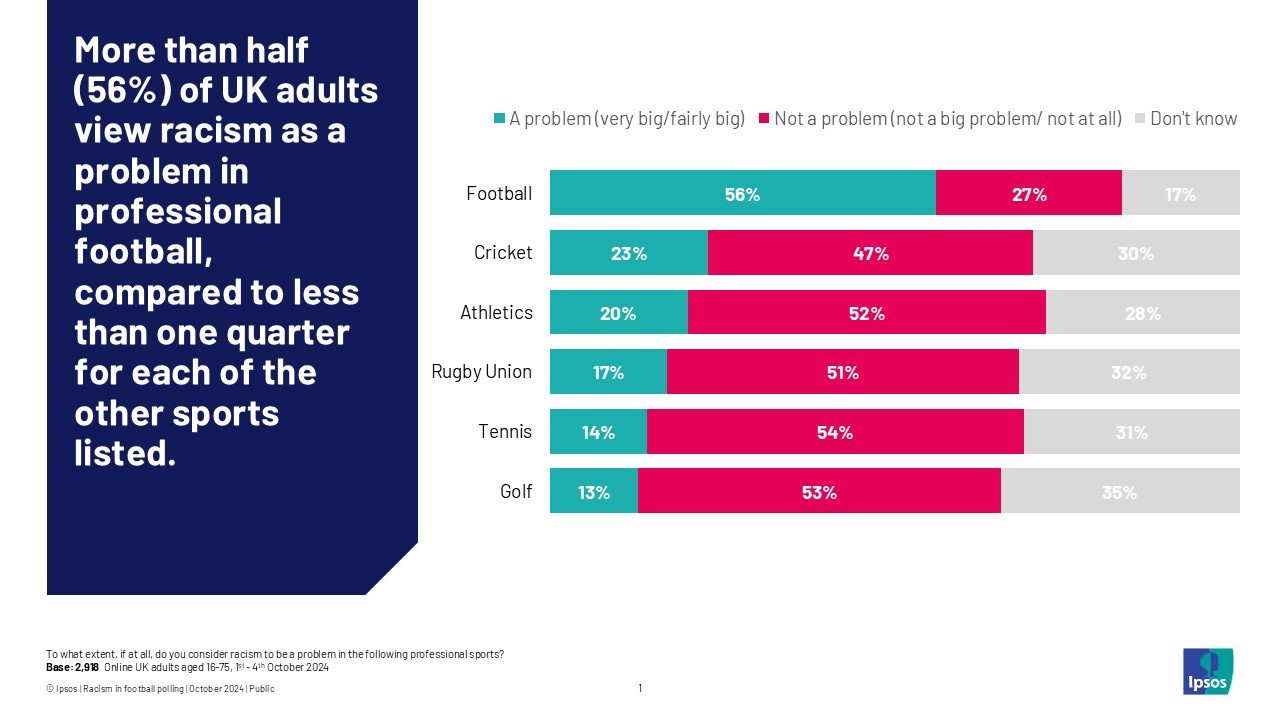
A poll conducted in October 2024 by Ipsos found that 56% of UK adults view racism as a problem in professional football. Given the spotlight of professional football, the problems are easier to spot under the cameras and lights of the top game, but when most grassroots games consist of one man and his dog for spectators, it makes it a lot harder to police.
This is where another troubling trend is vitally important to highlight: the rise in reports from the youth game. According to Kick It Out’s research, youth football makes up 57% of the grassroots reports; this is a six-year high for the proportion of grassroots youth reports. 17% of reports were where the victim was female; this represents double the number of reports of discrimination towards girls received in 2023/24.
Jonathan Duckworth, the Chief Executive and HR Director for the Oxfordshire FA, provided his insights about the difficulties faced by county FAs in policing discrimination in a recent interview.
Mr Duckworth commented on how youth football represents a large challenge for county FAs, saying: “70% of players in the county are children, and parents are very passionate about their child’s football. We use silent weekends where parents are told not to talk on the side-lines so that players can listen to each other and their coaches, which is all about encouraging players to be bold and seeing they can talk.
“Most commonly you’ll see parents trying to tell the children to do one thing when the coach wants them to do another, so it’s a constant struggle to foster engagement for the parents and allow kids to have fun and enjoy themselves, which is what grassroots football should be all about.”
For four seasons in a row, sexist abuse has risen in all areas of the game, with the grass roots level seeing a 119% increase from 2023/24 to 2024/25. Nearly two-thirds of the sexist reports received this season were questioning or belittling women’s place in the game. Either towards women players (at all levels), fans attending games, officials or members of club staff. However, reports of sexually degrading language have halved, proportionally.
This surge in misogynistic behaviour, particularly the questioning and belittling of women’s presence, suggests that as women gain greater visibility and success in the sport—symbolised by the Lionesses’ repeated final appearances—they are met with a backlash designed to reinforce traditional gender boundaries within the sport.
The 119% jump at the grassroots level is especially alarming, indicating that the prejudice is deeply embedded and active among the participants, with a recent incident where a non-league match was abandoned after allegedly sexist abuse was aimed at a female referee. This is a perfect example of how this type of abuse is found throughout the levels of the game. This, combined with research contended back in September 2024, also by Kick It Out, that more than 50% of female football fans have experienced sexism on match days in England.
The organisation Women in Sport (a charity and campaign group for the development of women’s football) outlined their desired changes to tackle misogyny in sport: they called for all organisations to introduce anti-misogyny policies and training within their organisations. As well as for all government funding for sports organisations to be conditional upon the implementation of these anti-misogyny policies and training, as well as the achievement of 50-50 representation of the sexes on their boards and within the senior executive team. Finally, they urged the UK government to introduce dedicated legislation against misogyny, making actions like threatening rape a criminal offence.
Overall the results of Kick It Out’s statistics lay bare an incredibly important issue that we don’t take seriously: the lack of government funding or support is striking given the emphasis put on the football governance bill by both this current Labour government and the previous Tory governments. The Independent Football Regulator (IFR), created by the Football Governance Act 2025, says its role is to “protect and promote the financial soundness of regulated football clubs”, “protect and promote financial resilience of English football” and “safeguard the heritage of English football”. One begins to wonder whether this might have needed to include measures to support the lower levels of football governance with this issue. Maybe it’s just the government trying to look like it cared about football when it really didn’t, which is surprising given how many MPs receive, er, tickets from football clubs. It’s almost like the owners of these clubs are trying to lobby against more regulation; with the likelihood of them having to fork over millions, they would rather keep it.