



For a growing number of university students, it doesn’t look like loneliness. It looks like full calendars, busy groups chat, last minute plans. It looks like a crowded kitchen in the student halls, music spilling into the corridors, people laughing over cheap drinks. It looks like a connection.
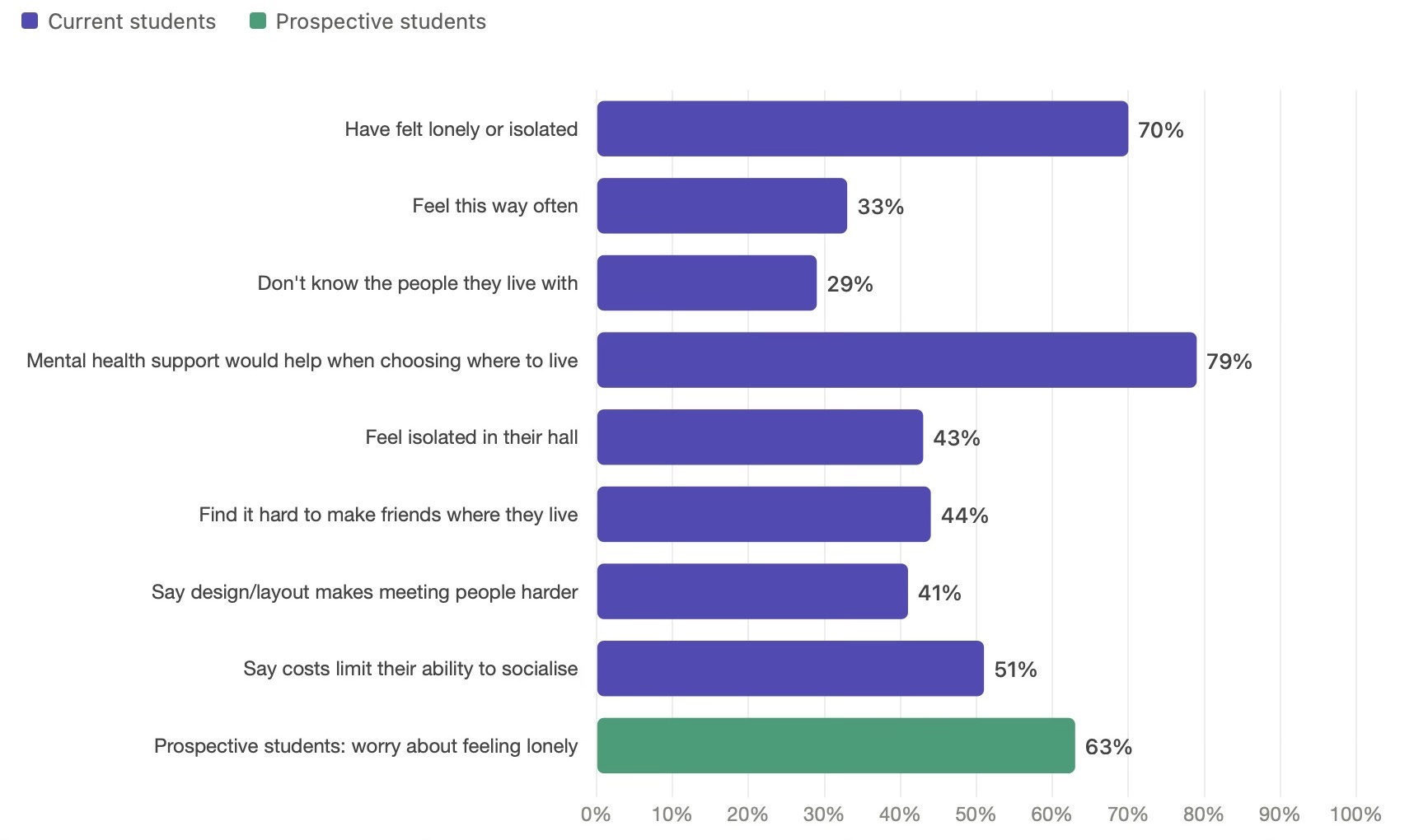
But behind that noise, something else is quietly taking hold. A December 2025 study by PfP Students found that 70% of students in the UK have felt lonely or isolated, with one in three saying they feel this way often. Nearly half struggle to make friends where they live, and 43% say they feel isolated in their own accommodation.
These concerns start even before university begins. Government research shows that more than half of students (52%) worry about loneliness more than money, academic pressure, or even fitting in.
In cities like Oxford, where something is always happening, this reality feels counterintuitive. Students are constantly surrounded. By people, by notifications, by opportunities to connect.
And yet, for many, something doesn’t quite translate. Connection is everywhere, closeness is not.
Student loneliness in university halls in England
“I knew lots of people, but I didn’t feel close to anyone”
We have never been so connected. Messages are instant. Our social lives are on full display. Apps promise friendships, romantic relationships, and endless opportunities to meet people.
But being connected does not mean being close.
Loneliness isn’t simply the absence of people. It’s the gap between the relationships we have and those we’d like to have. You can be surrounded by acquaintances and still feel that nobody really knows you.
Mahesh Singh, 29, is an international student from India. He arrived in Oxford hoping to have a busy social life. “At first, it was exciting. I was constantly meeting new people. In lectures, at events, and through societies.”
His days were soon filled with socialising. On the surface, he was far from isolated.
“But after a few weeks, I realised something was missing. I knew lots of people, but I didn’t feel close to anyone.” This feeling became more apparent in those quiet moments. “You go out, you talk to people, you laugh… but then you go home, and there’s only silence.”
Maintaining relationships with loved ones back home brought him some comfort, but also highlighted the distance. “You lead two lives at the same time. One where everything is familiar, and the other where everything is new. And sometimes, you don’t fully belong to either.”
“You have loads of conversations, but they remain superficial”
We often think of loneliness as a state of isolation. But for many students, it manifests itself in the midst of a very active social life.
Shirine Rabbat, 20, a second-year Swiss student, describes herself as an extrovert. She goes out regularly, is a member of several societies and rarely spends a weekend on her own. “I’m always busy. I know lots of people, I go to events, I’m constantly surrounded by people.”
But that doesn’t necessarily translate into closeness.
“It might sound strange, but you can be surrounded by people all the time and still feel quite lonely. You have loads of conversations, but they remain superficial.” She describes a pattern familiar to many students: superficial conversations and fleeting interactions.
“You meet people, you say ‘we should meet up’, but it rarely leads to anything deeper. It’s as if you’re socially busy, but emotionally not really connected.”
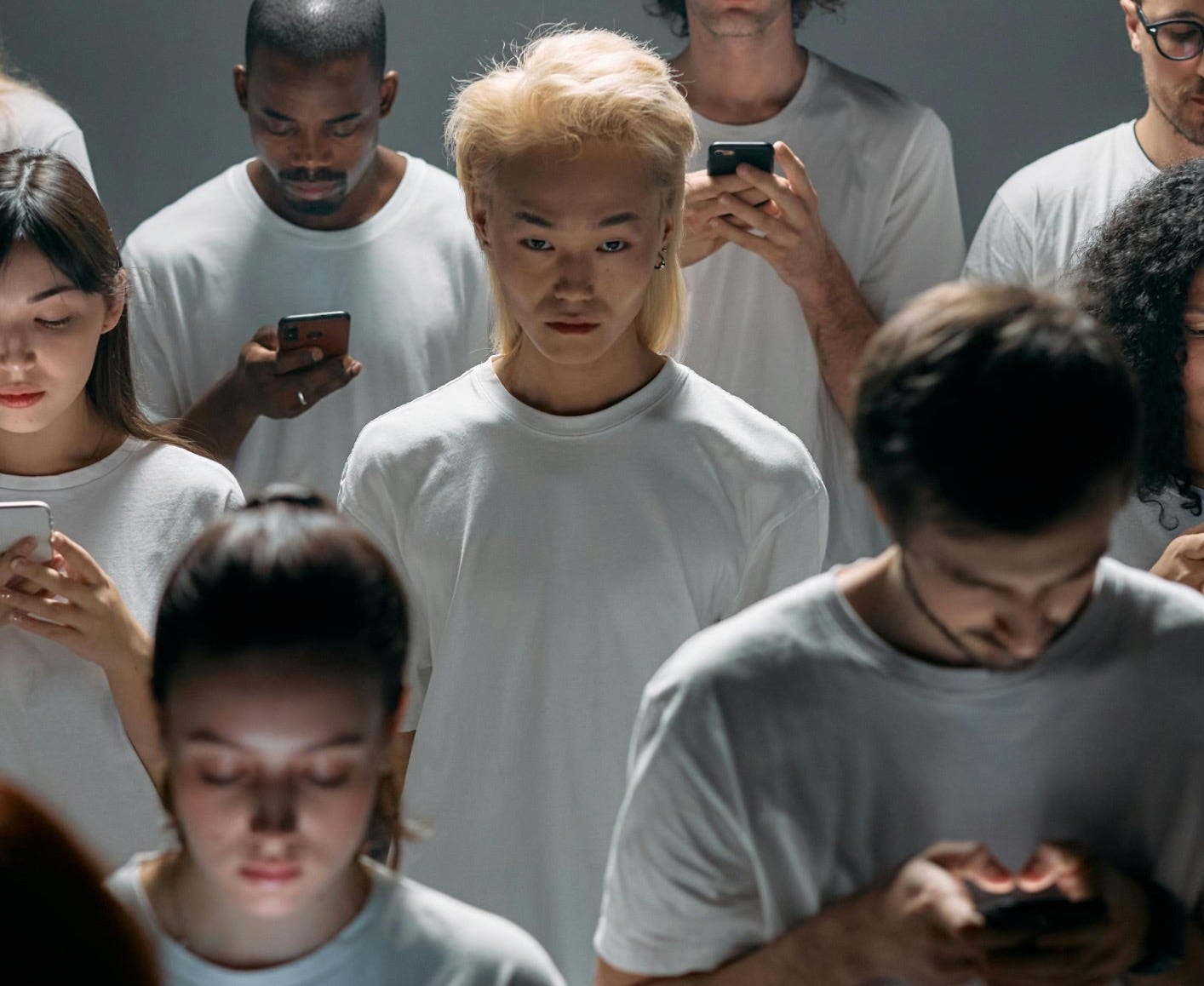
If there’s one thing that should make relationships easier, it’s technology. Students are constantly reachable. Via Instagram, WhatsApp, dating apps or never-ending group chats. But this constant connectivity often creates the illusion of closeness rather than the reality.
A study by the University of Manchester published in July 2025 suggests that passive use of social media (scrolling, watching, comparing) can actually heighten feelings of loneliness and inadequacy.
For international students, this challenge is often compounded by cultural and language barriers, making it harder to move beyond superficial interactions.
“Social interaction is essential. But it has to be meaningful.”
For mental health researcher Rosemary Chigevenga, these experiences reflect a broader shift. “Loneliness is not simply about being alone. It’s about lacking meaningful social support.”
She points to the environments students are navigating, often highly individualistic, fast paced, and digitally mediated. “In more collectivist cultures, there is a stronger emphasis on togetherness and everyday interaction. In more individualistic contexts, people can become more isolated, even when they are surrounded.”
She also highlights the role of digital habits. “If a platform makes you feel worse, it’s important to step away. Students need to be intentional about who they surround themselves with. People who genuinely support them.”
Her message is clear: connection requires more than proximity. “Social interaction is essential. But it has to be meaningful.”
Part of the difficulty lies in what the students leave behind. The friendships forged over the years cannot be recreated overnight. Back home, bonds formed naturally. An inside joke, an eye contact; at Oxford, it’s back to square one. Phone calls help, but they also highlight the distance.
“You’re constantly maintaining your old life whilst trying to build a new one. It’s exhausting” explains Mahesh. This in-between space, neither quite here nor quite there can heighten the feeling of isolation.
Some students are actively working to change this dynamic. William Nadin, member of the French society, explains that loneliness has become a recurring theme.
“We’ve noticed that people come to events, but still struggle to form lasting connections.” To address this, his society has started organising more intimate and targeted gatherings: coffee meet-ups, alcohol free events and discussion groups.
“The idea is to move away from large, noisy events. These are great, but they don’t always help people form deeper connections.” Instead, the focus is on creating environments where conversations can last longer than a few minutes. “When you give people time and space, they open up more. That’s when real connections start to form.”