


WRITTEN BY EVE GARDNER

Barclays Women’s Super League hold some of the best featured women’s football players (such as Lauren Hemp for Manchester City, Olivia Smith for Arsenal and Kiko Seike for Brighton) and produces such great examples of football talent, yet can’t hold down the same attendance numbers as some of the men’s matches in their league.
In the last men’s league final, the attendance numbers skyrocketed which led to the event having to be capped at 50’000, confirmed by Majors of London’s Office, after being capped just the previous year before at 40’000. In comparison to the last Subway Women’s League Final, which held a record high of 21’619 attendees at the Ashton Gate Stadium in 2026.
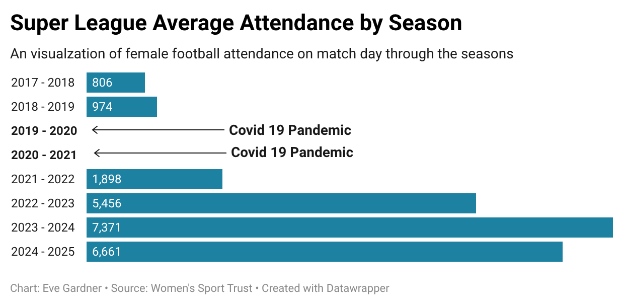
Women’s attendance data has recently shown a slow increase within the past couple of seasons in these matches – especially after Covid, as numbers seem to have surged and made numerous attendance records.
The Impact of Media Exposure on Women’s Sport
Women’s sport is now growing due to media coverage and more sporting platforms broadcasting these matches – which, in turn, allows these women to be noticed more when they have breakout moments in their careers.
With this higher audience engagement now in the sporting space, it’s become more crucial to maintain this trend. It is important because it fosters better growth for women’s clubs, higher potential for sponsorships, and better support for these women. Having more tickets bought and more people in seats automatically equals more revenue for these athletes. Consequently, a portion of the revenue goes toward these women’s salaries and gradually closes the remaining gender pay gap.
Nevertheless, the data show that after the steady growth in attendance, there is a slight dip, which could indicate that sporting events may be watched in alternative ways (not just in person anymore), as fewer attendees are showing up to these women’s matches.
The Public’s Say
Several respondents highlighted broadcasting, affordability and accessibility as factors influencing how they watch women’s sport. As stated in a recently published survey, one fan stated, when asked where she watched these sporting events, “At the pub” (F, Ella, 20 yrs), which mirrored the majority of answers – along with a few responses stating they stay home and watch it on their televisions instead of attending in person. For instance, an international sporting fan and participant based in Australia (F, Sophie Buck, 24) stated that she watched all her women’s sporting events on British broadcasting services to keep up with the scores from overseas. And for her in-country matches, she strictly watches only at the pub rather than in stadiums, adding that the pints are cheaper.
Within the wider world of women’s sports, an older sporting fan (F, Barb Busnu, 68), whose interests lie in rugby, cycling, swimming, and athletics rather than just football, suggests she also stays indoors when spectating sporting events rather than attending in person due to her disabilities. Accessibility and safety being a concern have limited her to these sporting events and suggest social media as an alternative method to keeping up to date with the live score, as she states, “It is good for me due to disability”.
A male sporting fan (Billy Stokes, 21 yrs) continues this conversation when asked if he believes social media is a good place to broadcast sporting news and events, stating,
“News definitely - very easily accessible. Sporting events would be great, allowing more people to watch, BUT unless it’s BBC or ITV, then football is always behind a paywall, so I don’t think that would ever happen. Although maybe in the future I could see TikTok getting the rights to show some football and livestream it, but put it behind a paywall.”
Evidently, these types of conversations happen all around the sporting world within these sporting communities, which can be summarised as an increase in broadcast coverage of women’s sporting events, which people are more likely to watch. Socialisation, community, and accessibility also come into play as factors - just not the leading cause of the dip in data.
So, What Does the BBC News Show?
Despite the evident need for more women’s sports broadcast coverage, these major sports networks still, and will continue to, let us women down. Over the weekend, multiple matches took place, yet we still only see a brief mention of the women’s events. For instance, on the BBC News Sport site, they always have a “goals of the weekend” feature, but it often overlooks the accomplishments of women athletes; this week, there were only three mentions of a female-scored goal compared to the other eight male goals. Some could argue this is due to fewer female matches, and yes, it could be, but by taking a glance at the webpage itself, anyone can see it’s predominantly male.
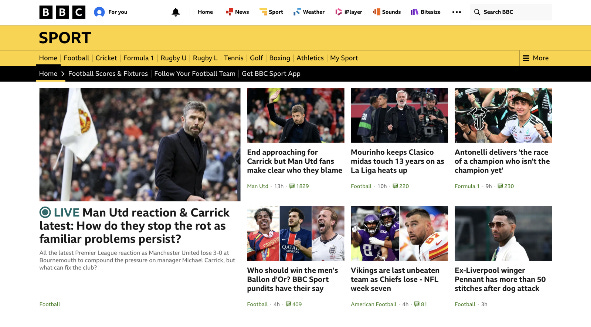
Based on survey responses, the community’s response, the dip in data, and underrepresentation in broadcasting and social media outlets, we can deduce that, yes, overall, female stadium attendance is likely to continue decreasing as seasons progress, as fans often prefer watching the game from the comfort of their own home or from the pub.
With this in mind, sporting outlets have a responsibility to listen and deliver on what the majority of the public needs: wider access to women’s sporting matches on television.
There is already an increase in female representation in broadcasting, yet we still deserve more; we still deserve better. And at the lesser end of that, we still deserve to be equal.