


Have you ever spent way too much time trying to find a TV show or a movie to watch on Netflix? Or maybe you tried to hunt down your favourite show just to find out that Netflix booted it off a few weeks ago. I’d say just grab the DVD, but most of us seem to have made the switch to streaming service subscriptions rather than choosing to outright own a media product.
Everything that is online is just that, online. So what would happen if all of your beloved TV shows and movies just dropped off the internet? Or what about your favourite artist’s most recent album? Nowadays we are so driven towards digital consumption, maybe because it’s less cluttered and more convenient, but we don’t seem to actually own anything anymore. You don’t own the Friends series anymore, you pay a monthly fee to be able to access it, providing that whoever your money goes to decides it’s worth it for them to keep providing it to you.
Data from the Digital Entertainment and Retail Association (ERA) shows that back in 2016, physical sales accounted for a respectable 37%, which in 2025, dwindled to just 6%.
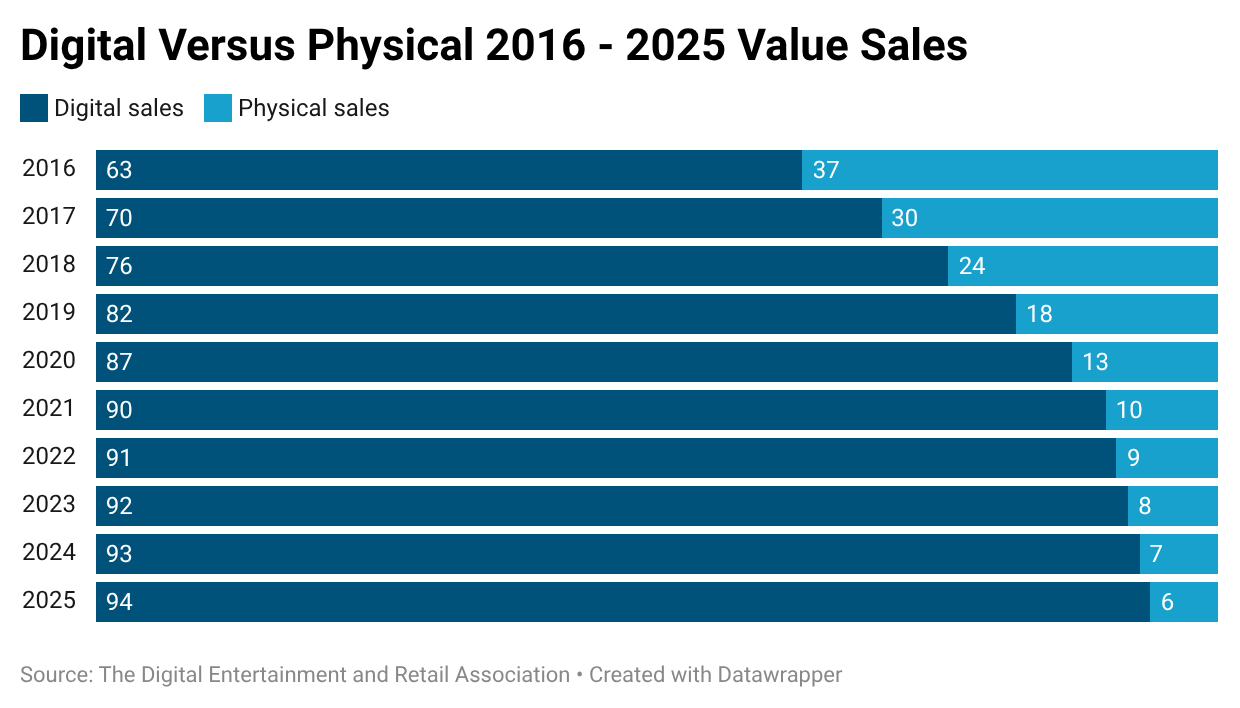
Just over 10 years ago, while it was still split pretty evenly, ownership of products such as videos, games, and music, reigned supreme.
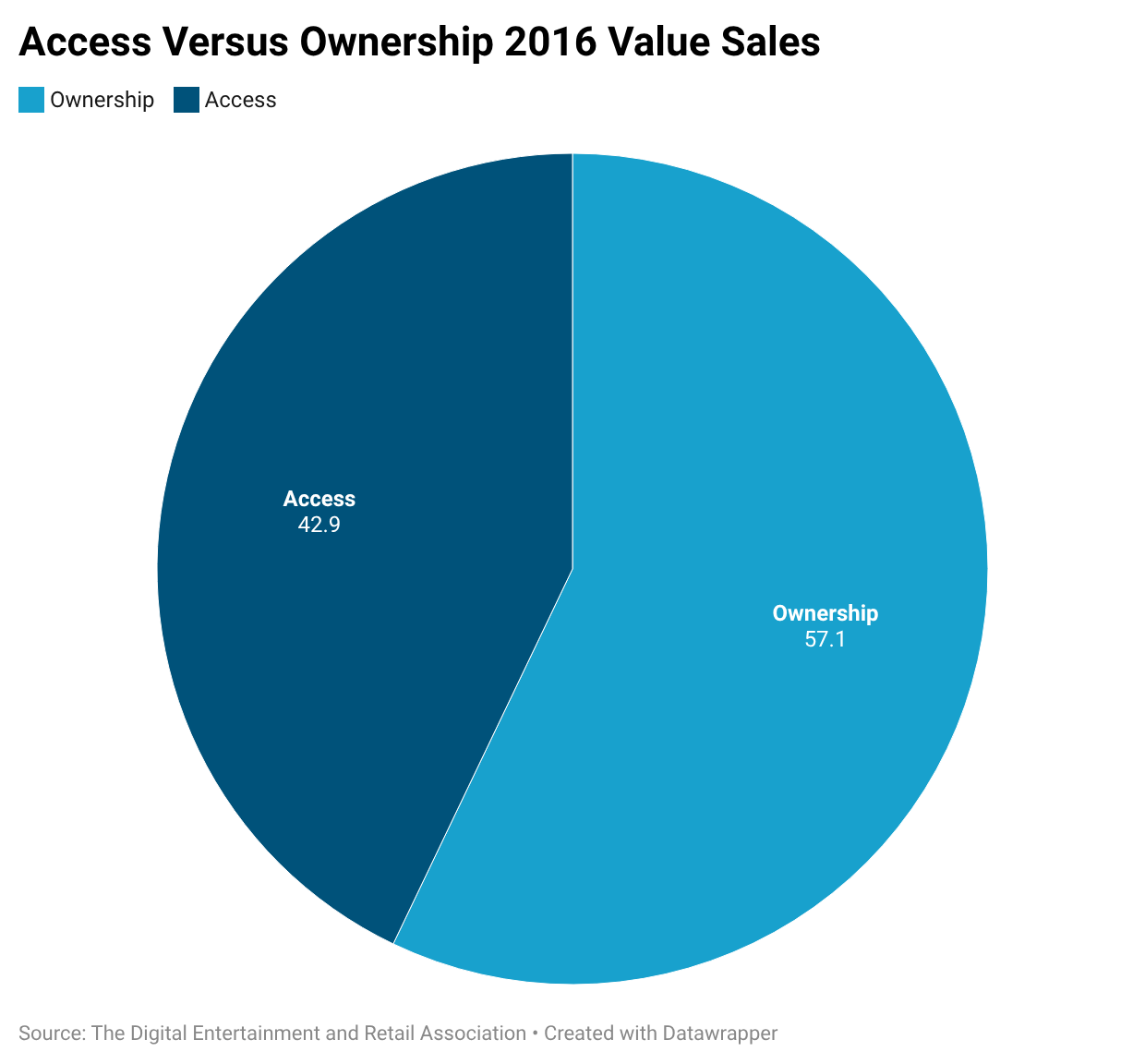
Between 2016 and 2025, Music and Video took the hardest hits. Music suffered a 46.3% drop in ownership based access, while Video dropped by 47.1%.
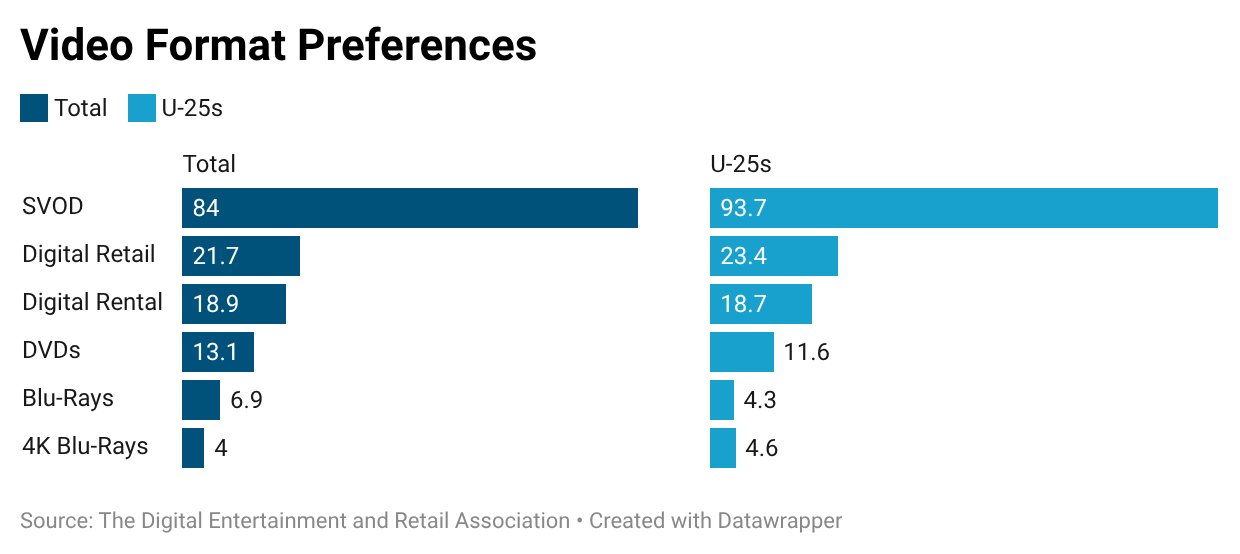
These two sectors are arguably the easiest products to access through streaming services, and according to the Entertainment Retailers Association (ERA), Subscriptions like Netflix, or SVODs (Subscription Video on Demand), are now the most popular ways to consume video, especially for under 25s, with 93.7% choosing this medium.
For music, Spotify provides monthly subscriptions starting as low as £5.99 a month for students, and £12.99 for standard customers. Streaming services such as Netflix and Amazon Prime Video provide multiple different plans at varying prices, but the add-ons never end.
Netflix has recently introduced a lower-tier subscription service which means ads will be shown throughout TV series and films. While Amazon Prime Video does include many products for free with the subscription price, many of their other products come at a price. It also offers many additional subscriptions through their platform such as MUBI, HBO Max, and Paramount Plus among others.
So while it may seem expensive to indulge in a physical product every time we want to listen to or watch a new release, are we really getting our money’s worth with our subscriptions? And does it mean more to own a physical product? Something you can pick up and touch is much more sentimental and permanent than a file on your phone which with one mistake, could be permanently erased.
Despite this, SVODs made up 90% of the video market in 2024, with DVD making up only 1% of the market.
However, the gaming industry seems to be largely unaffected by the hit suffered by the music and video sectors. The sector saw just over a 10% decrease in ownership based access between 2016 and 2025.
But why has video and music suffered so much while gaming still continues to thrive in both formats? Possibly due to a nostalgia factor, gaming consoles still remain a big part of the market and remain in production, with the Nintendo Switch 2 being released in June of 2025, and consoles like the Xbox and PlayStation still going strong.
Access based subscriptions do exist for gaming consoles and platforms, but focus still remains on physical game cards. For example, on the Nintendo Switch, owning a physical game card means you can download the same game onto multiple devices, without paying more than once. So what is the benefit to purchasing an online version? For the Switch you can access the Nintendo shop directly through the console, providing that you have a live internet connection, so maybe it’s the convenience.
Sony has recently announced that they are planning to end physical disc production by January of 2028 for new games released on PlayStation consoles, reportedly ‘In response to shifting trends in consumer preference’. However, reactions to this news seem to prove them wrong. A petition was launched shortly after the announcement on Change.org, titled ‘Don’t Kill the Disc: Tell Sony to Keep Physical PlayStation Games’, and has received close to 400,000 signatures as of November 2026.
Oxford Brookes Motorsport Engineering student and gamer, Alex (21), spoke on the disappointing actions from Sony regarding the shift away from physical discs, explaining that customers no longer feel like the appeal is there. ‘I mean they’ve ruined their legacy and honestly gaming as well’. He also spoke wider about Sony and how they are supposedly losing relevance, ‘A lot of people have figured out how to emulate a PlayStation, so there’s really no need to own one anymore.’
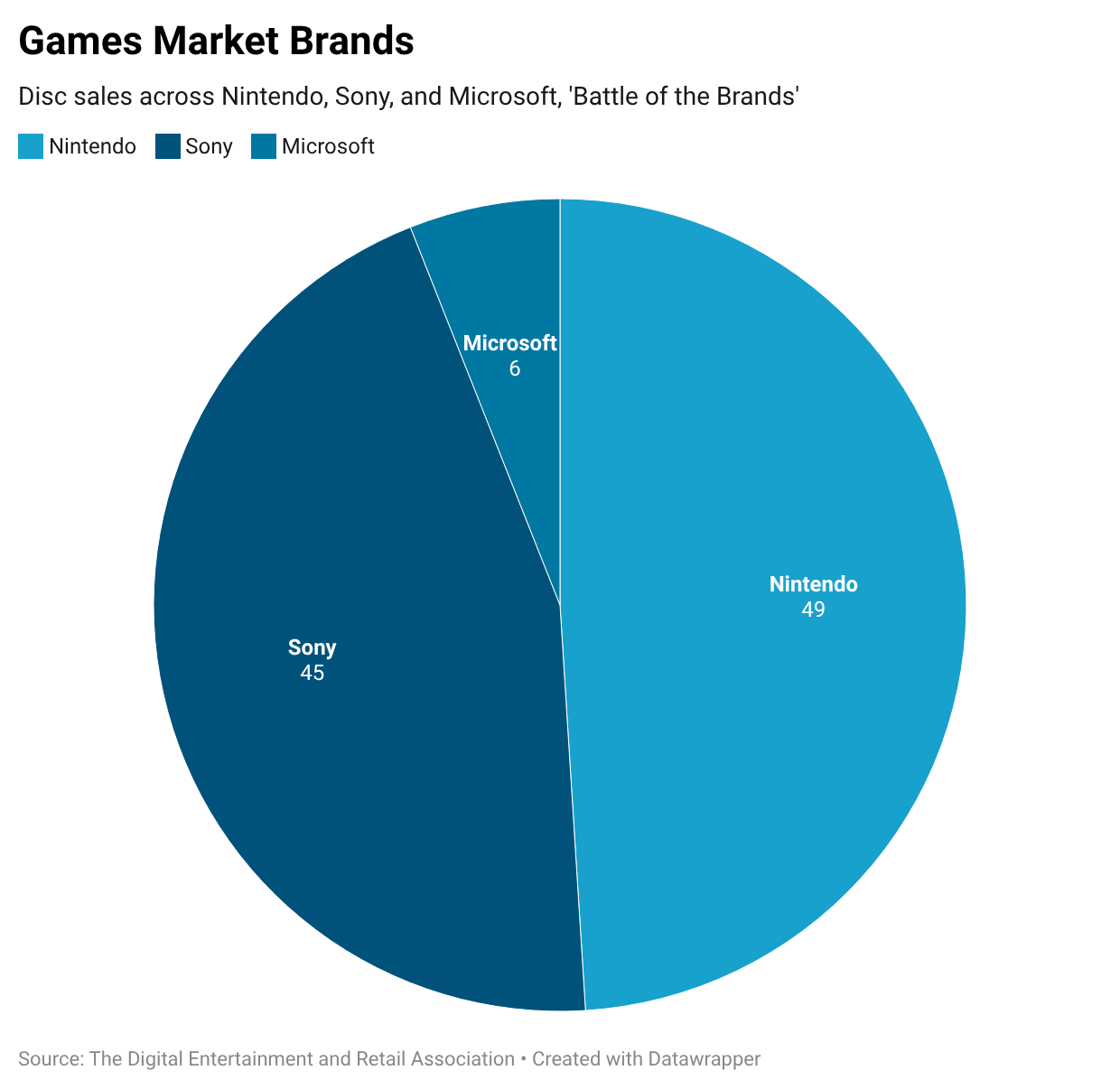
So what is this market that Sony is talking to? The Sony PlayStation 5 still made up 40% of the physical games market as of 2025, and if this clearly isn’t what their consumers are after, why the need for the switch? Maybe it’s an effort to reduce costs and increase profits, but why make such a rogue move when their biggest competitor when it comes to physical sales is Nintendo, who still produces and focuses on physical sales. According to the ERA 2026 Yearbook, Nintendo overtakes Sony in physical sales.
On top of this, Sony is also receiving backlash for re-communicating to their customers during a lengthy legal battle that a digital purchase does not mean they actually own the product, only that they own a licence to use it. As stated in their terms and conditions, when you purchase or download a digital product from their online store, ‘You buy a personal licence to use Digital Products for private use’. In response to this term, student Alex said ‘If buying isn’t owning, piracy isn’t stealing.’ This discourse begs the question, are Sony actually pushing their customers away, rather than working to keep them hooked?