


Is The Premier League Abandoning its Working Class Routes?
Football has served as an escape from everyday life for over a century- families would attend games as an affordable form of entertainment. As Premier League ticket prices rise year on year and households need an increasing amount of streaming services to watch their team, the question arises if teams are prioritising profit over their working-class supporters.

Football was affordable as it expanded throughout the 20th Century. Manchester United Ticket prices were as little as 17.5p in 1960. The average ticket was priced at £66 as of 2024. Food, drinks and travel also account for increasing costs. Due to the current cost of living crisis, families are forced to make everyday sacrifices in order to go to games with their families.
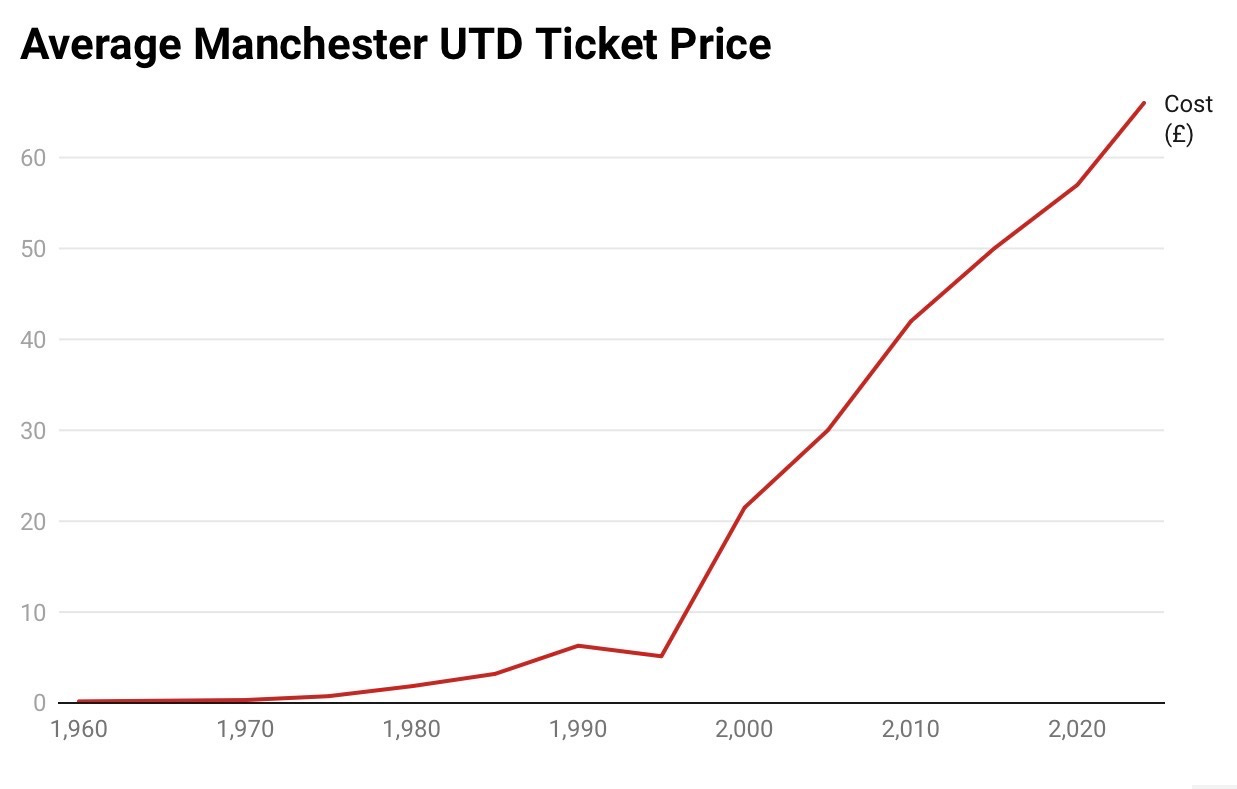
If supporters decide to save money and not go to games, not all games are shown on tv. To watch all available games for a Premier League team competing in the Uefa Champions League, fans are required to be subscribed to three subscription services. These costs have seen a massive rise in people using illicit streaming services (often referred to as dodgy streaming sites).
Henry Marsh, Liverpool and Bristol Rovers supporter, said:
I would hazard a guess that every football fan has probably illegally streamed at least one game in their lives. Even pubs do it. They don’t want to pay excessive amounts for broadcasting rights when they just want to show football.
Many followers of the sport have started critiquing both clubs and broadcasters, claiming that is becoming a headache for fans. Marsh continued:
‘I think if you aren’t a season ticket holder, 100 percent. There are so many games and people have busy schedules. Even travel costs make things difficult. The games just aren’t very accessible anymore.’
These views reflect wider frustration amongst Premier League supporters. In the last few years, multiple Supporters Trusts including Fulham FC (FST) and Manchester United (MUST) have run campaigns hitting out against the rise in costs. As part of their campaign, the FST have called for a price freeze on tickets from the 2026/27 season.
Football influencer, Mr Black discussed how the return a viewer receives for their money is not fulfilling enough:
‘It’s ridiculously expensive… It’s cheaper for me to go on holiday for the weekend than to go and watch Spurs’
Fellow influencer Rory Cook reflects these views:
‘It’s confusing, costly, and entirely consumer unfriendly’
Football matches in the Premier League have not seen a decrease in ticket sales in recent times. Tourism has been a huge factor in this. Watching a football game has become a popular attraction to tourists. A large portion of Premier League footballers are celebrities, games serve as alternatives to plays and concerts. Ownership regimes therefore have little incentive to change ticket prices to encourage working-class fans to attend games because it will be less lucrative for the clubs.
Black claims that ticket prices are not the only reason that football clubs are losing a sense of community and therefore causing a lack of atmosphere in the stadium.
‘I would be willing to bet anything that the percentage of tourists watching Premier League games has gone up significantly over the last ten years because people actually living in England can’t afford it. People coming over here once will just spend the money on tickets because they are on holiday’
Marsh supported Black’s claim regarding Premier League teams:
‘I think for some top teams there is a lot more tourism and it feels like a business, whereas when I watch Bristol Rovers, the fans aren’t trying to gain an experience. They are just going to watch their team. I think in that sense the working-class identity is still there. Higher-ups control teams financially, not the fans.’
He highlighted how teams are run in Germany and suggested that in an ideal world, this model could be a good solution to rising ticket costs alienating working class communities surrounding football clubs.
‘Looking at Germany, the teams are majority owned by the fans, so they have a better relationship with the club. That identity will never die out in football’

Teams in lower divisions of English football have offered more affordable solutions in recent times. Over the April Bank Holiday Weekend, Swansea City AFC hosted a ‘Junior Jacks Takeover’. The match was ‘hosted’ by young fans of the side. Tickets were as little as a pound for children under the age of 14 on the day. This effort meant that local families could get an easy affordable day out for the entire family during an expensive period.
Football still relies on its working-class identity. Rising ticket costs and growing numbers of subscriptions needed to watch from home are testing that relationship. For many supporters, the game is becoming increasingly difficult to watch both at home and in stadiums. If the sport continues with this trend, it risks losing the identity it built itself upon.