


The rise of the reform party after their rebrand formerly known as the Brexit party has stunned the younger generations of voters with their heavy anti-immigration ideals and continued support of its leader Nigel Farage despite their controversial policies and openly racist behaviour.
From 2019 to 2024 there has been a massive decrease in conservative party support in favour of the reform party group within the UK political scene. Alongside this decrease, there has been an incline in Labour support by 12% from 2024 since then.
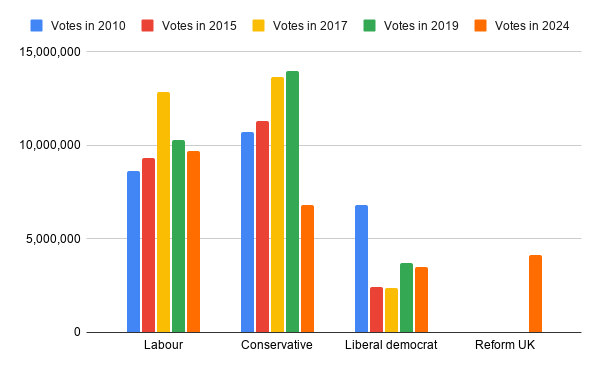
2017-2019 was the Conservatives peak with 13,966,454 million voters and they achieved less than half since then with 6,828,925 in 2024. Reform in 2024 had a staggering 4,117,610 votes. A feat even the green party could not come by after 14 years. The conservatives from 2010-2024 lost 57% of their votes in those 14 years altogether.
Conservative and Labour parties since Brexit have been falling out of favour with the public, with more than 6 prime ministers having joined and left the cabinet and the political instability, the fall in favour for these groups has led to massive increased support for Reform as they are similar but more extreme in terms of ‘conservative ideals’.
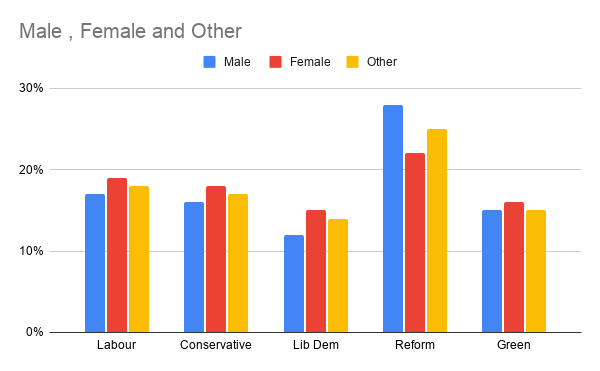
Men are the highest voters for reform by 28% whilst women are behind with 22%. Most reform voters however are the older from 39-50 and above primarily voting reform compared to younger voters who instead vote for Labour or the Green party. The older generations of typical conservative voters have shifted to Reform. Reform's ideals appeal more to the older generations playing on their frustrations with the current government and the redirection of their 'fears' of immigration for example.
3rd year politics student Taylor Hamilton that was interviewed mentions the concern around Reform picking up around 1500 councils with Labour having lost the same amount that Reform had gained. Claiming that the reformers are taking the Tories place as the main right-wing party and conservatives becoming even more conservative leading to rise in Reform voting.
In asking about how incel/ red pill possibly affects the growing population of reform voters/ right wing party support, Taylor states that they go ‘hand in hand’ feeding on each other.
‘People feel more comfortable participating with others knowing they feel the same way’
‘They feel freer to support more extreme and divisive political candidates and political leader know that they can be even more extreme and still have support’
Red pill, manosphere and incel culture mainly lived in smaller subcultures on reddit and 4chan before moving to more mainstream means such as TikTok, Instagram reels and podcasts which have had a major spike in popularity since 2019. Younger men and boys are having more frequent red pill content appear on their social media resulting in more harmful rhetoric that has already been echoed by right wing parties like reform as it is the most extreme.
Even though a majority of younger voters for the green party are 18–24-year-old men and women, the increasing mainstream flow of manosphere/ red pill content circulating online reaching younger audiences of teens males and boys does beg the question if there would be major change in the voting of young men in upcoming general election in 3 years’ time.
Already studies have shown that 44% of content shown to men on algorithm within the first month of creating new accounts on social platforms contained content surrounding ‘masculinity’ which then translated to showing concerningly misogynistic content. An echo chamber is created once social platforms see the popularity in manosphere content that men consume, showing differing opinions doesn’t benefit the platform or algorithm and so it will keep pushing out this content to men Taylor states when she was asked about if there was a gender specific reason for the rise in right wing parties.
Whilst acknowledging these factors of extremism, on the flip side we are seeing more green party support from younger people with around 300% increase thanks to the younger generation of voters.
The green party’s policies appeal to younger audiences as there more of a promise for better futures for themselves but for generations after there’s as well. From scrapping university tuitions fees and addressing global warming to bringing down carbon emissions; the green party has managed to capture and hold a strong persistent age group of university aged students as the parties are thinking more with their future in mind.
Looking at these numbers and the staggering state of the conservative party, it begs to answer what our general election will look like in 2029. Taylor assumes that the trend is possibly coming to an end with the extreme right-wing parties with Nigel Farage losing favour steadily and the rise in the Labour party once again.
UK politics tend to follow closely with American politics, and Taylor suspects that the overwhelming democratic support in Americas recent midterm elections will translate over to the UK with more left leaning support. Smaller party groups like ‘Your Party’ led by Jeremy Corbin which is a left wing socialist political party will possibly gain support if there is more traction to it or an even bigger support growth of the Green party. But we will only know in upcoming by-election if this is the case until 2029.