



In a world where AI is taking over, the way that news is consumed is also rapidly changing. With the convenience of AI, audiences can now ask questions about news stories, which would have required more time and research before the time of chatbots. However, where does trust come into the conversation?
The Reuters Institute for the Study of Journalism is a research institute, committed to add to the conversations regarding the future of journalism. According to their 2026 Digital News Report, the usage of AI for the purpose of news has grown from 7% to 10% compared to last year, and this percentage is taken up mostly by younger audiences. With the inclusion of AI, social media and video networks now take up 56% of the news consumption habits of the public. So what does this mean for the future of news?
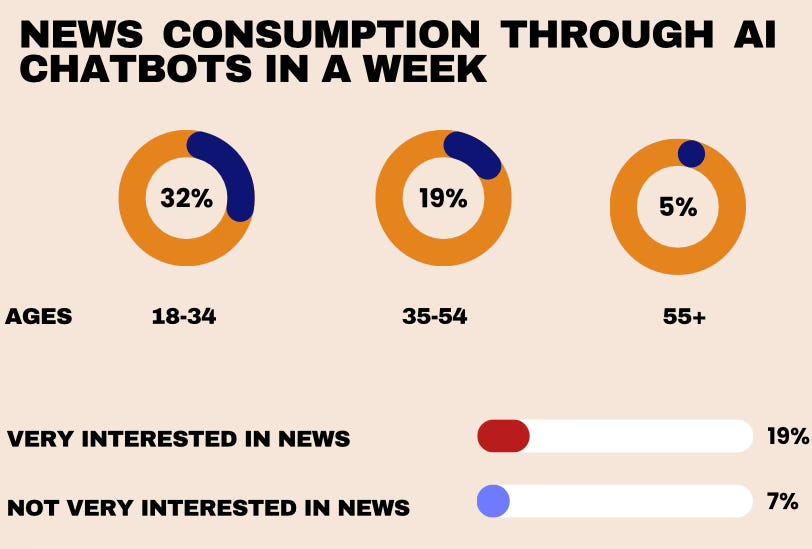
First, it is important to look at the age range within which AI is consumed most for the purpose of news. The highest percentage of usage comes from young adults between 18-34, taking up 32%. The percentages are significantly lower for adult audiences, with 19% for 35-54 year olds, and only 5% for 55+. It is also crucial to note that most of these percentages include ‘news lovers’, so their usage is higher due to their curiosity towards news, with 19% representing those who are very interested in news, and 7% those who are not.
Besides AI, social media is leading the way within news consumption, but the result of this is that the need for traditional media is becoming increasingly lower. An interesting parallel can be drawn, as even though audiences consume more news on social media and through AI chatbots, they are also afraid of unreliable sources and fake news. As we live in a fast paced world where people want quick and specific answers, AI can act as a useful tool to get information. However, AI is still not 100% accurate, which is why it is important not to completely rely on it, and to gain information from other sources as well.
Trust is one of the most important subject matters that needs to be discussed within this topic. Another one is convenience. Interestingly, people are afraid of fake news and believe that social media and AI can be viewed as unreliable, however these have become the most convenient and quickest ways to access news, which is why they are at the top of audience’s lists.
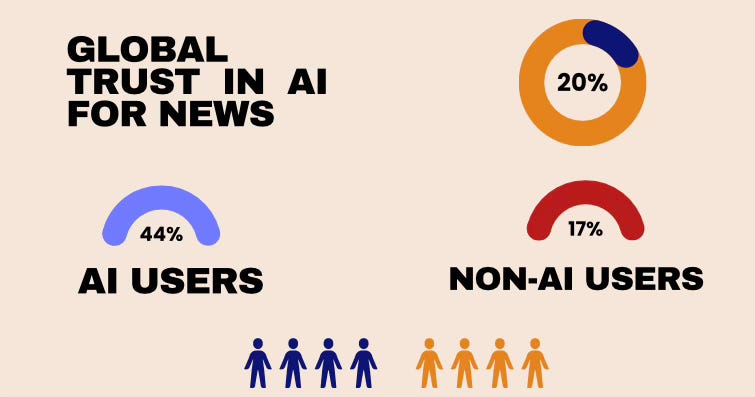
What is a compelling addition to this is that those who are regular users of AI are also more likely to get their news stories there as well. Overall, 20% of the population trusts AI for news, but when looking at those who frequently use AI chatbots, 44% of them said that they would trust AI to access news as well. On the other hand, within the 17% who don’t use AI, they expressed that they would not trust AI for news.
It is also important to establish in what capacity audiences are using AI to learn more about news. 42% of people use AI because if they ask follow-up questions about a news story, they will be presented with more information, and 39% because they consider AI to be the quickest source of news. Other responses got similarly high percentages, with 36% for those who choose AI because it ‘summarises complicated stories’ and 35% for those who prefer AI because it can provide an answer to any given question, and can gather articles from other publications and make it ‘into a single response’.
So, are we talking about trust, or convenience? And what is the price that has to be paid for convenience?
The Massachusetts Institute of Technology highlights the dangers of excessive dependency on AI, as their Media Lab Study has found that ‘participants who relied on AI systems to verify facts actually got worse at detecting misinformation on their own when chatbots were taken away’.
During this research, participants had the option to test how well they can detect fake news with and without the help of AI. The success rate was high with the help of AI chatbots, as participants were 21% more likely to detect fake news, however, when it came to their ability through independent identification, the percentage dropped by 15%. As a result, participants in this study ‘gradually shifted from active self-reliance to passive acceptance of AI guidance’.
As people will rely more and more on AI, their skills to do research on their own and their ability to spot fake news will get harder as time passes. Audiences need to learn how to use AI efficiently without falling into the trap of chatbots doing all the research for them, relying solely on information they provide. To protect unbiased and trustworthy journalism in the future, even if audiences are using AI for news consumption, it is crucial for them to click-through to published news articles, and to use AI in moderation.