


Graduates in the UK from 2023/24 are having more difficulty finding employment than in previous years, with many settling for work outside the industries they’ve studied for.
Data from the Higher Education Statistics Agency demonstrates the unemployment rates of 2024 graduates fifteen months after achieving their degrees:
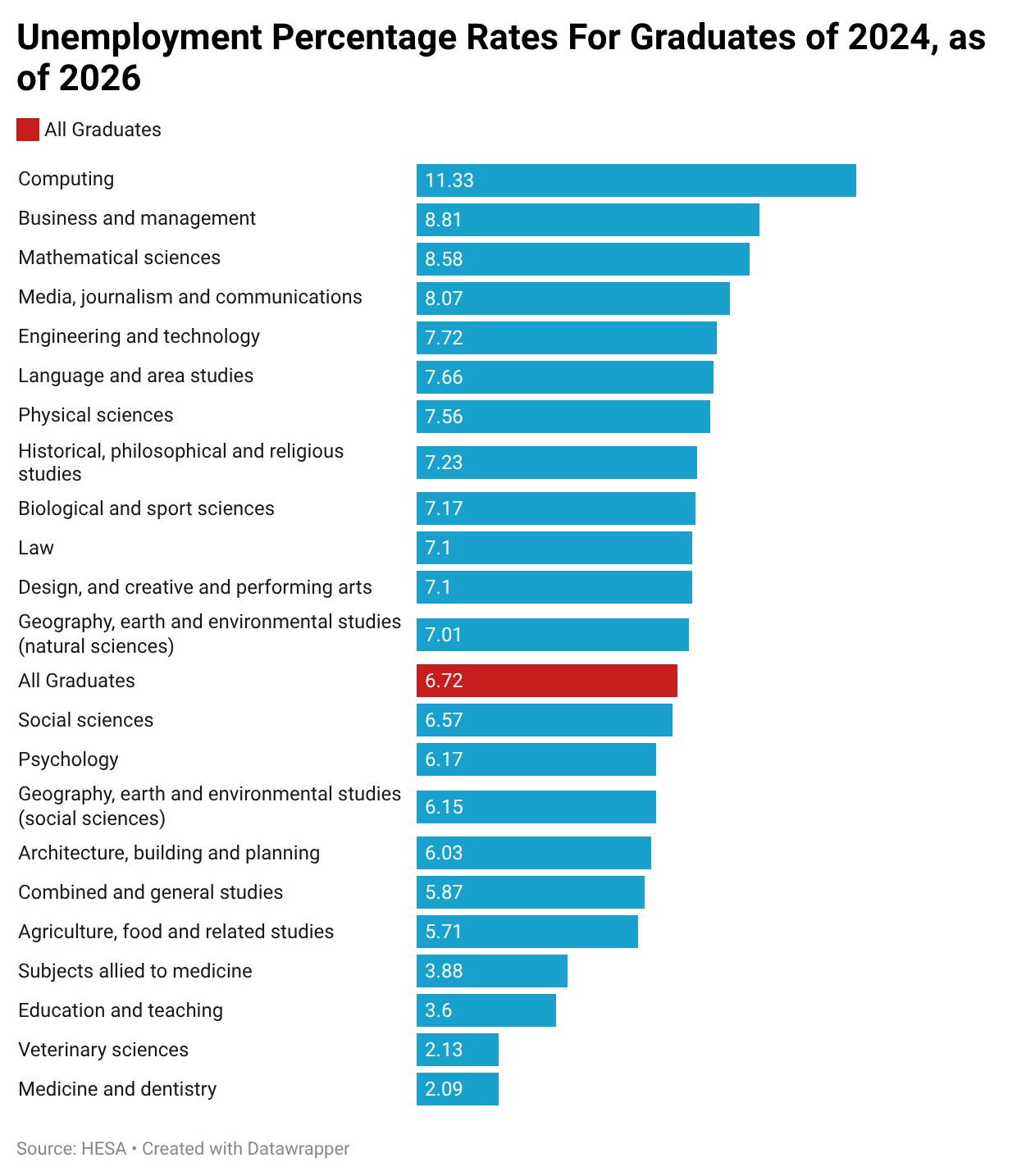
Graduates who studied computing have the highest rate of unemployment at 11.33%, whilst ‘business and management’ (the most popular category by number of graduates) follows closely behind with 8.81%.
When compared with data for 2022/23 graduates, approximately 80% of degrees have seen an increase in their unemployment rates.
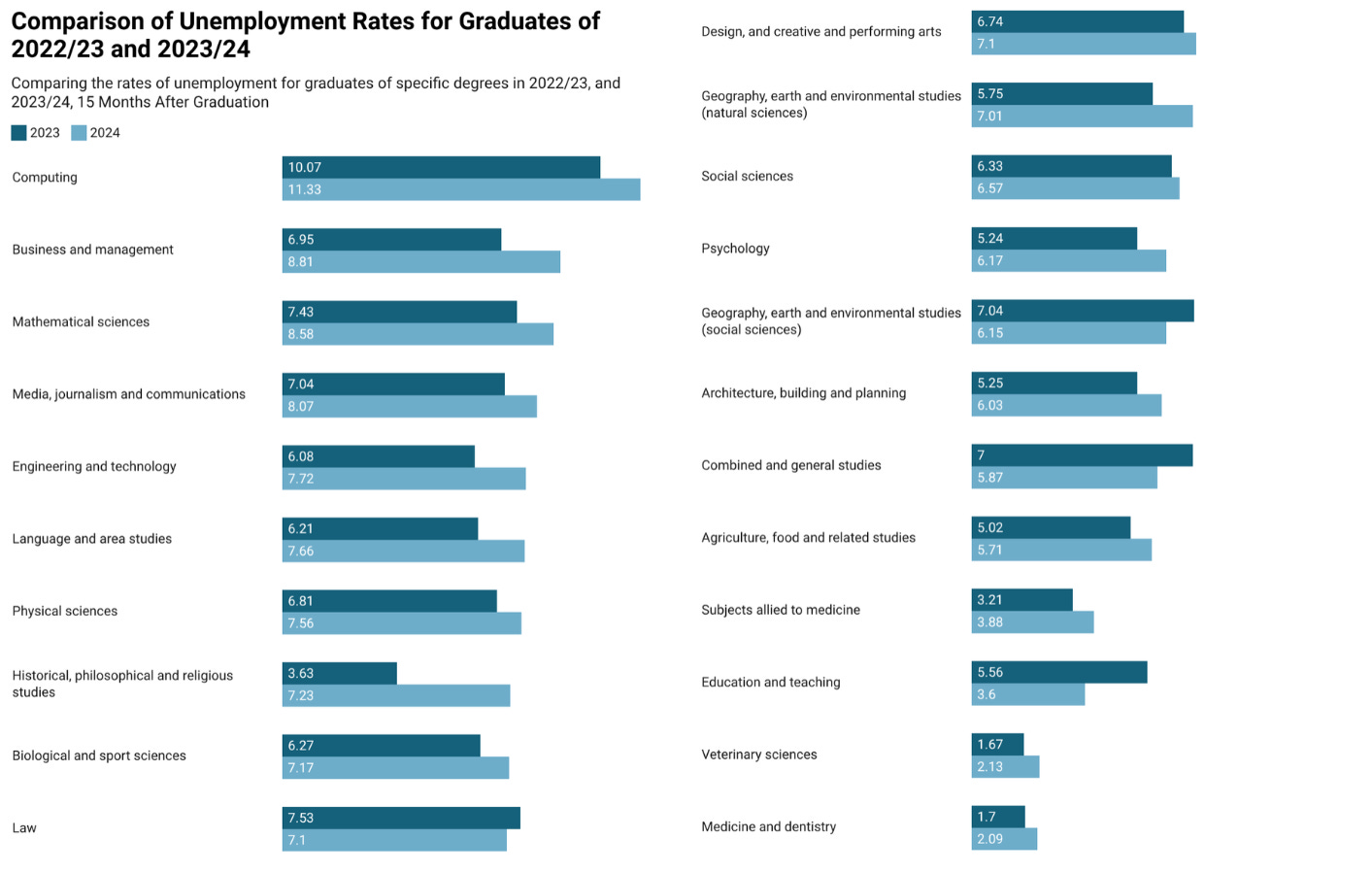
The highest increase has been in historical, philosophical and religious studies, where unemployment has gone from 3.63% to 7.23%, almost doubling.
Across all categories combined, the average unemployment rate has increased from 5.89% to 6.72%, a 0.83 percentage point increase.
Further data from HESA demonstrates how widely graduates disperse across fields of employment:
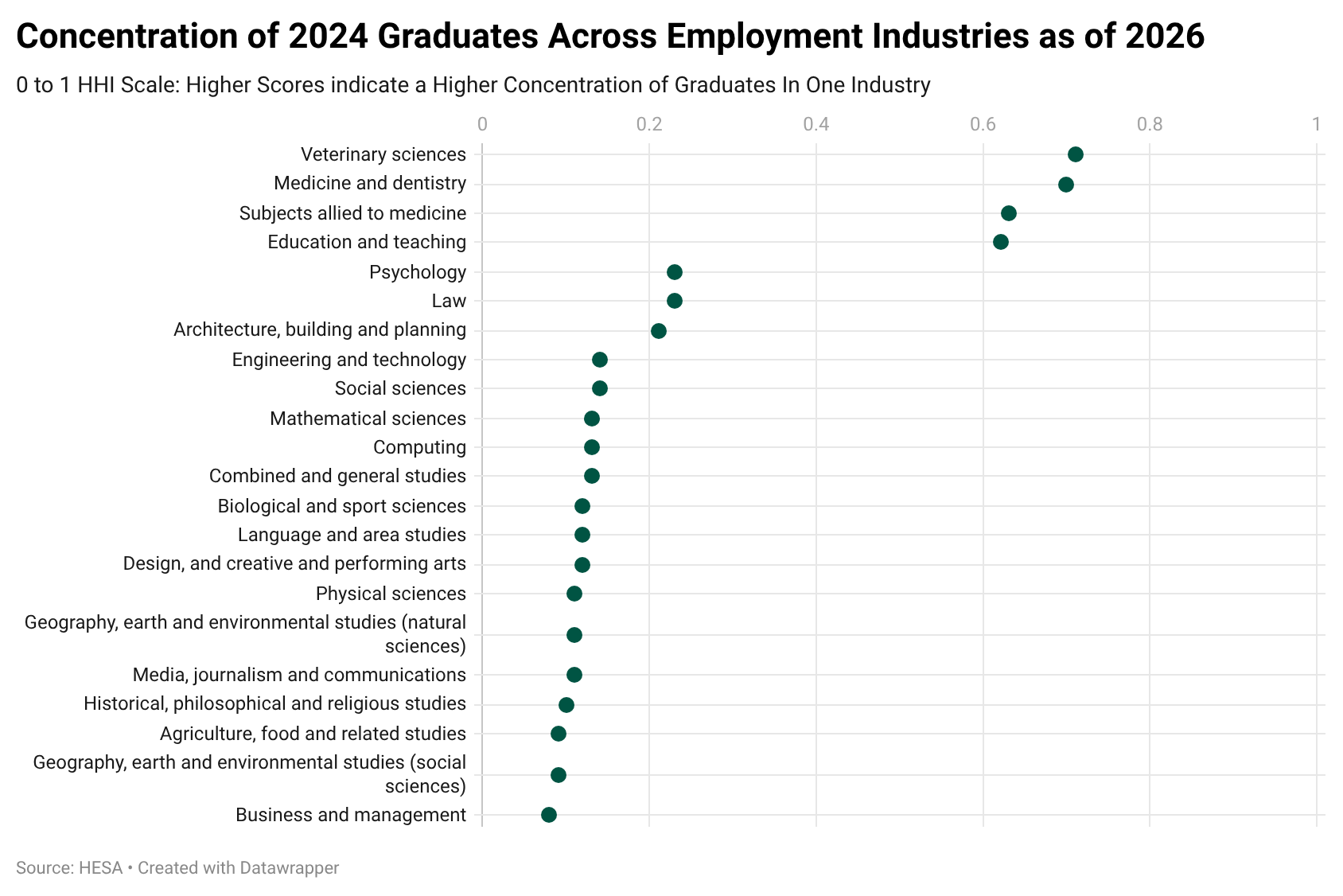
The majority of degree categories demonstrate vast spreading of graduates across different industries of the workforce, with only four categories breaking this trend.
In some cases, such as in ‘combined and general studies’, this lack of concentration in a given industry could be attributed to degrees offering wider employability.
However, low scores for categories with more specific areas of study, such as ones in agriculture or computing, may indicate increased competition within their respective job markets.
The four categories with scores of above 0.5 all represent graduates working in the same field that they’d been studying for.
Opinions From Recent Graduates
Having studied zoology (categorised under ‘biological and sport sciences’) at the University of Lincoln, Hannah, 22, has now returned to her hometown of Bicester, where she’s back to working in hospitality.
After job searching for a few months, she’s found there to be many obstacles preventing her from progressing into her desired field of work:
“The degree allows me to get my foot in the door, but what you really need is experience, which university didn’t really offer enough of.”
Furthermore, Hannah has found difficulty in being able to commute to possible new workplaces:
“In terms of positions, there are quite a few, but they aren’t very local to Oxfordshire.”
“Thanks to the cost of living, a lot of people who didn’t drive before university didn’t learn whilst being a student. Others don’t have cars, and it’s hard to find the finance for one fresh out of university.”
Rosie, 21, graduated from Oxford University with a first in Theology and Religion, and after completing an internship in India over the summer, has returned home to Shropshire. She is now applying to find longer-term employment. Similarly to Hannah, she’s returned to working in hospitality.
Her field of study has seen the biggest proportionate increase in unemployment rates compared to last year.
She too has found issues with requiring experience to work:
“Often the roles you look at for an entry-level job all require years of experience.”
When asked if she believed her degree was worthwhile, she said:
“There’s a lot of people re-evaluating how useful their degrees were. I don’t know if I feel that way. I’ve acquired certain skills and feelings of confidence from my degree.
“I, among friends of mine, feel university’s been a mixed bag.”
What Seems To Be Going Well
Despite most degrees seeing increases in unemployment, there have been a few notable exceptions.
‘Education and training’ is one of four degree categories to see a decrease in unemployment. It saw a decrease of almost 2 percentage points, more than any other category. It also ranks highly in how concentrated its graduates are in the job market, with 78% of graduates going on to work in the education industry.
Law also saw a decrease in unemployment, and is the fifth highest scoring category for industry concentration, with 42% of graduates going on to work in ‘Professional, scientific and technical activities’.
Both ‘veterinary sciences’ and ‘medicine and dentistry’ have continued to display the lowest rates of unemployment, despite seeing slight increases this year.
Furthermore, both categories continue to exhibit the highest levels of employment concentration into specific fields.
Source Information: HESA, Graduate Outcomes 2023/24 and 2022/23