


2025 was a big year in film. High profile releases from respected directors like Paul Thomas Anderson, Ryan Coogler and Danny Boyle gave fans an excuse to head down to the cinema pretty much every month. And blockbuster adaptations from comics, plays, books and videgames meant there was something for pretty much everyone this year. These movies fit a fairly broad range of genres, but perhaps most suprising is the massive range in critical reception to these films.
Rotten Tomatoes is a review aggregator that brings together the averages reviews from professional critics and the traditional movie-going audience to give an indicator for a movies quality. When observing the highest grossing films of 2025 in the US, one starts to see just how massive a disparity there can be between a film’s commercial success and critical reception, and the sometimes massive gap between critic and audience opinions on films.
Below is a chart showing the thirty highest grossing films on the US box office in descending order accompanied by both critic and user scores on Rotten Tomatoes.
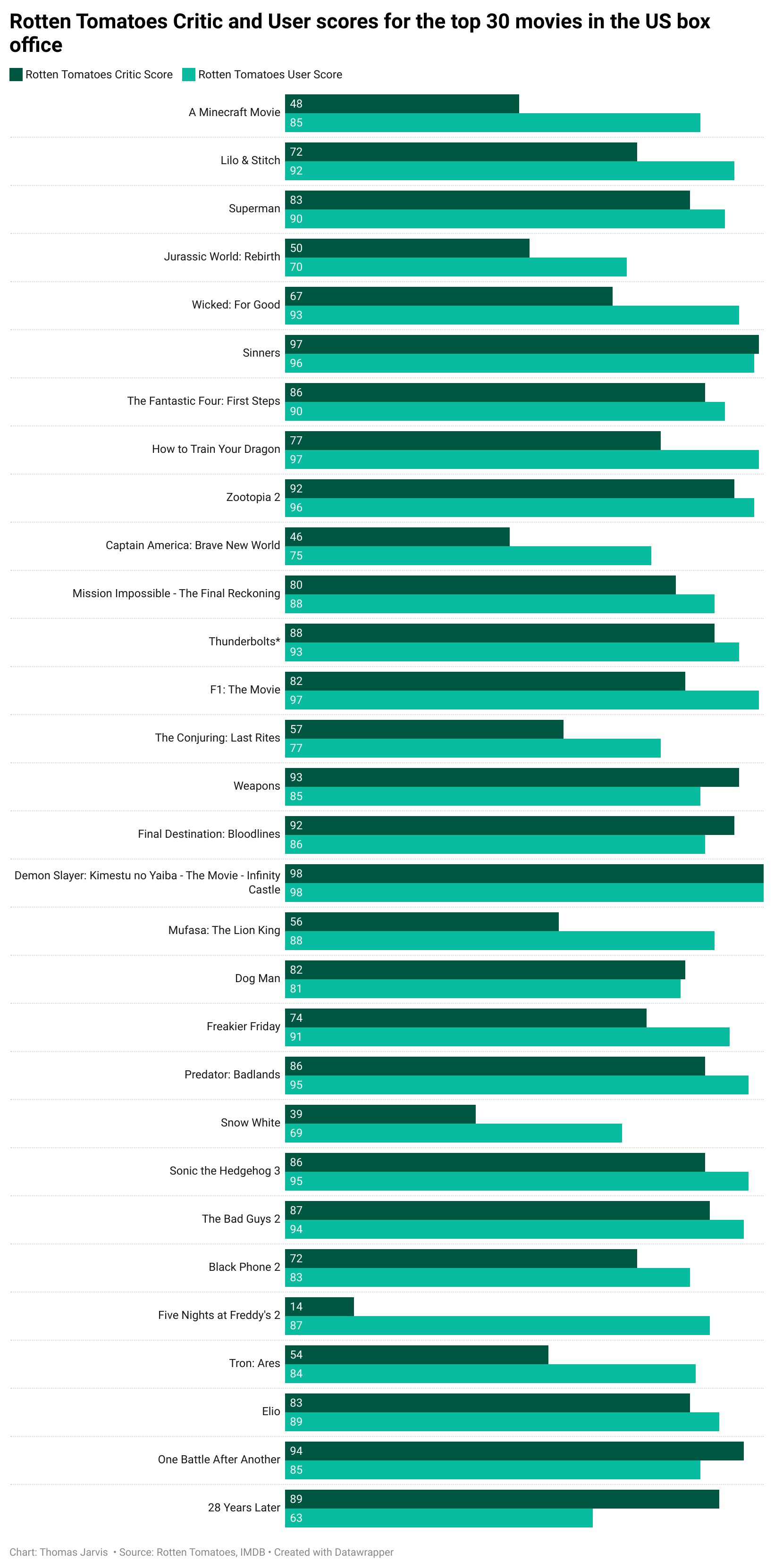
This data paints an interesting picture about the nature of the type of movies that become a success in the US before we even discuss the Rotten Tomato scores. From the top thirty only three movies: Elio, Sinners and Weapons with every other film on the list being some kind of sequel, adaptation or cinematic universe continuation.
Another interesting realisation arises when you compare box office success to those Rotten Tomatoes scores. Some of the years most succesful films did not perform particullarly well on the critical stage.
This scatter graph shows the relation between US box office gross and Rotten Tomatoes average critic score. While there isn’t a direct correlation between the two, this highlights some of the most interesting cases. The standout is the years most succesful film A Minecraft Movie, making an impressive $423,949,195 at the box office but acheiving a pretty damning 48% average critic score. Traditionally, one would think that a movie being panned by critics would cause a drop in audience interest in a film. However looking into the other properties on this list it becomes clear that critical reception is not whats driving audiences to the cinema, but something that might be a little suprising.
As mentioned earlier, all but three of the films on this list are based on some sort of existing property. When you look at the most succesful films of the year (A Minecraft Movie, Lilo & Stitch, Superman, Jurassic World: Rebirth, Wicked: For Good) it becomes clear what mass audiences want to see on the big screen. Minecraft is one of the most succesful games, Lilo & Stitch and Jurassic World are pre-existing film franchises, Superman is the return of one of the biggest characters in comics to the big screen and Wicked: For Good is the follow up to one of 2024’s biggest hits.
MInecraft, Lilo, Superman and Wicked all performed extremely well in Rotten Tomatoes user score, an average of reviews logged by users of the platform achieving over 85%. These are all big franchise films, and this highlights just how successful they can be in both the box office and how popular they can become amongst audiences. Even big franchise films that have been massively panned by critics like Five Nights at Freddy’s 2 or Captain America: Brave New World still performed pretty well in audience metrics. This could suggest that what general audiences enjoy in films might be different to that of the average critic. All of these films are sequels, adaptations or reboots of familiar ideas, and the data starts to suggest that many general audience members prefer to see a film covering failliar stories and characters.
How does this relate to the box office? Well it suggests that the traditional idea that critics dictate what can and can’t become a theatrical success is no longer fully relevant. Given the rise of social media, its been easier and easier for anyone to share their opinion on a film. This means that while something may be panned by the traditional professional critics, less traditional outlets such as influencers and fan forums can make it easier for fans to spread positive word of mouth. This has created a cycle that seems to result in many members of the public believing less in the opinions of critics and more in that of the masses online.
Film studies graduate and budding critic Jacob Gilchrist told me that, ‘The critical view from official outlets has become less important as a larger group of people can voice their opinions - we are no longer limited to the views of journalists.’ He pointed out that platforms like Letterboxd and Rotten Tomatoes allow for anyone to be a movie critic, and while this makes the so called “official outlets” opinions less important he believes that opening up film criticism to all is a good thing for the industry.
These charts make it pretty clear that critical acclaim does not translate into financial success, and that the most successful films are those that became hits amongst the general audience often in spite of the views of the traditional critic.