


Megan Temple - Nidd, 2025
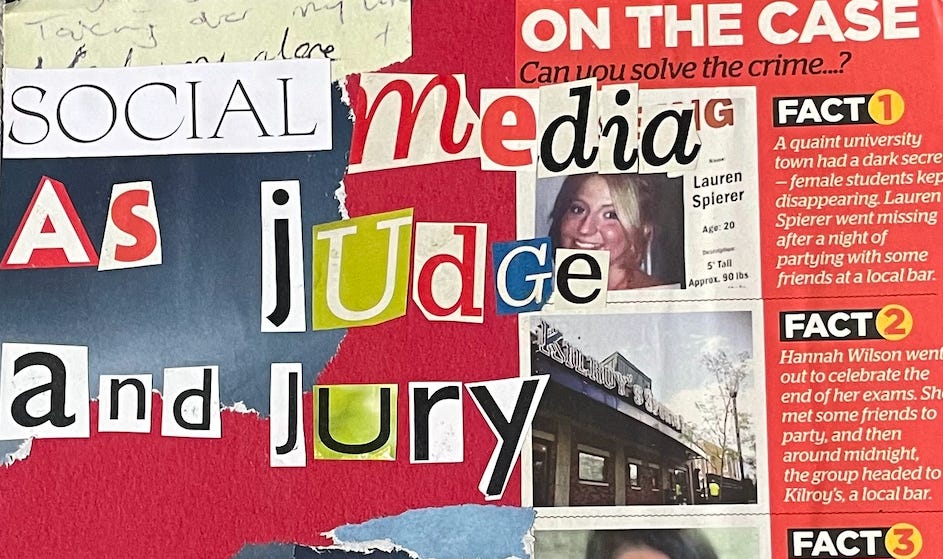
Messages flooding in, “I cant believe you did this” “you should be in jail” “i hope they put you away forever” and much worse flood your social media. Why? Four days ago someone was murdered and you were seen walking past by members of the public. They’ve taken to social media and deemed you the killer.
Scary right? How one day you are going about your day and the next you’ve been accused of a crime you didn’t commit and it’s all over the internet.
This is something over 70% of adults in the UK are concerned about. The spreading of false information on social media.
As people jump on social media when they first hear of a high profile case they have stopped just discussing it and have begun to interfere with criminal proceedings as well as causing harm to the individuals they collectively name as the culprit.
A prime example of this was in 2010 when Joanna Yeates was murdered. The public and news media jumped at the chance to find the killer and resulted in a contempt of court order for two mainstream UK newspapers.
Christopher jefferies, Yeates’ landlord was harassed by the media and the public for Yeats death. As he described in his witness statement of events that “the tabloid press had decided i was guilty” and once released by the police he couldn’t return to his home for his “own safety”.
When speaking on the case with Norbert russ, a legal consultant for Oxford; he commented that “everybody was an investigator [ ] everybody was looking for a guilty person”. He described how big of a sensation the case became with him remembering how “exposed [it was ] on all platforms”.
When we go to social media and see others push the narrative that a person is guilty, it can be easy not to agree and fact check. This is the big problem - and what can lead to contempt of court.
Photo by Egor Komarov, Unsplash
Contempt of court is described by Norbert Russ as “something or someone that interferes with the furnace of legal proceedings”. This includes any social media comments and posts made and can even count as something verbally recorded.
After all the public outrage and media hate that Christopher jefferies received he was found innocent with Joanna Yeates’ neighbour being the one who murdered her. Jefferies went on to sue two newspapers for contempt of court but as described by Norbert, “nobody apologised [ ] for all the death threats, and all the trauma and harassment”.
Full link to interview with legal consultant Norbert Russ:
Another well known case that was blasted on social media with everyone eager to find the killer leading to false accusations once again was the Idaho murders.
In 2022, 4 out of the 6 housemates within a college house were found murdered in their bedrooms. The case attracted lots of attention on social media, especially on tiktok with influences flying out to make content surrounding the killings.
One man, Jack Showalter was falsely accused by thousands of tiktokers eager to solve the case of the deaths. He recalled in an interview with the BBC “the threats and harassment his family received”. It wasn’t until the real killer, Bryan Kohberger was arrested and charged with the crimes that the harassment stopped.
With cases attracting such media attention on platforms such as tiktok it can make it much harder for a criminal investigation to proceed with suspects being named without real evidence being supplied and the potential of bias being created amongst jurors.
When asking the public about how trustworthy they find social media for factual information and if they depend on other sources to find truthful information, one response from Meghan Byrne said she will “sometimes will move on if it’s not something I’m particularly interested in”, and other times fact check with news sources on subjects that interest her. When it came to criminal investigations she agreed that social media played a role in how criminal proceedings were conducted now and that “they can create a bias [ with everyone deciding that] this person is involved and this person is also involved”, without any truth being observed.
Further into our conversation with Norbert we asked him if the laws around contempt of court needed to be stricter and how to make sure people can post about criminal cases that have grabbed their attention without causing harm to others and breaking the law.
He made a point of mentioning how easy it is to break the law with contempt of court and mentioned the case of Tina Malone. In 2019 she posted photos of Jon Venbales; one of James Bulger’s killers. Due to the lifelong ban on naming either of the boys new identities since killing a 2 year old in 1993 Tina broke the law by posting his new name and a photo of him on facebook. In return she was given a £10,000 fine and an eighth month suspended sentence.

Photo by Katka Pavlickova, Unsplash
Norbert said the issue with social media is that “posts spread, and they spread widely and instantly” allowing no chance for mistakes when it comes to the law. His advice is that more education is needed on what you can and can’t say about criminal cases and the people involved in them. He also suggested that “people need to get their information from reliable sources and not to make [ ] assumptions, because an assumption is very different than a fact”.
With everyone having an opinion they can blast on social media, will people learn to seek the truth before the press post or will it not be long until the suspect of a crime has to face the internet before they face a jury.
I've spent the last three and a half years creating content about the Idaho 4. Social media has replaced critical thinking and common sense. It's not getting better. It's getting worse.