


In a report last month (4th March) from the Women and Equalities Committee (WEC), it was found that ‘women’s health is not being sufficiently prioritised in the Government’s system-wide NHS reforms.’ As part of this problem, the report identified the issue of online censorship, specifically recommending that ‘ministers must recognise that shadow banning is harmful and unacceptable, and the new Strategy should set out measures to tackle it.’
But what does this shadow banning actually look like? In what ways is it harmful and how do we address it? To answer these questions, I spoke to one of the experts on women’s health censorship: co-founder of the advocacy and research initiative CensHERship, Anna O’Sullivan.
How did Anna come across women’s health censorship?
With Anna’s background in journalism, PR, and communications in industries like the financial services or education, she didn’t have to worry too much about ‘what words you can use,’ but that all changed when she started Future Fem Health – which explores innovation in women’s health. It was here that she found, when speaking to founders, censorship was ‘one of those barriers to them growing their business because so many businesses use social media, understandably, to reach new customers, but if you can't actually talk about what your product is, then how can you reach those people?’
She then met co-founder Clio Wood – a writer on women’s sexual health, wellbeing, and being postpartum who had experienced censorship herself – who suggested that the two join up on a research project exploring the issue. Anna explains that it started with ‘just a survey, essentially, and then we got, I think in the first few weeks it was between 50 and 80 responses.’ Their surveys’ results were then covered in The Times and The Daily Mail and the pair found that it ‘really resonated’ with people as ‘an under-talked about issue.’ After this, Anna says:
‘We kept exploring, we kept speaking to people and it’s really gone from that now into much more of a full blown lobbying and advocacy work. You know, we’re trying to go down the regulatory route, meet with policymakers, continue with the PR, like really try and take what was just awareness, but move it into now action and change.’
What has CensHERship’s research found?
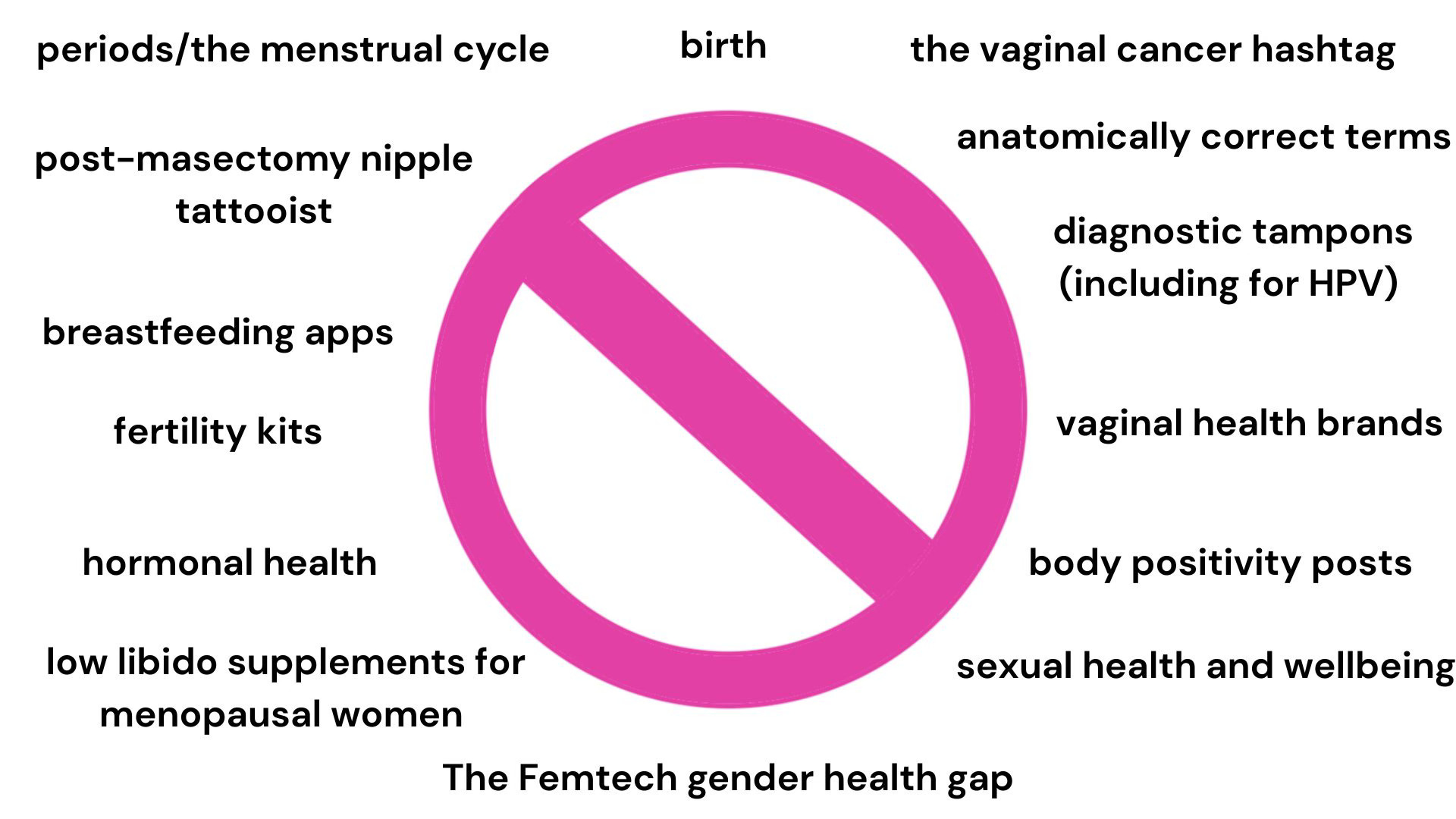
Since their initial start in 2024, the initiative has updated their surveys on the experiences of businesses in women’s health, finding that 95% of 115 women’s health creators in 2024–25 reported censorship. They found that creators were experiencing this on various platforms including Facebook, Instagram, TikTok, X, Google, Amazon, Youtube, Pinterest, and LinkedIn. Creators covering a range of topics (shown in the graphic below), had content, ads, and even their accounts restricted, shadow banned or deleted. Shockingly, their report also found that 38% of those surveyed had experienced 10 or more of these types of incidents in the last 12 months.
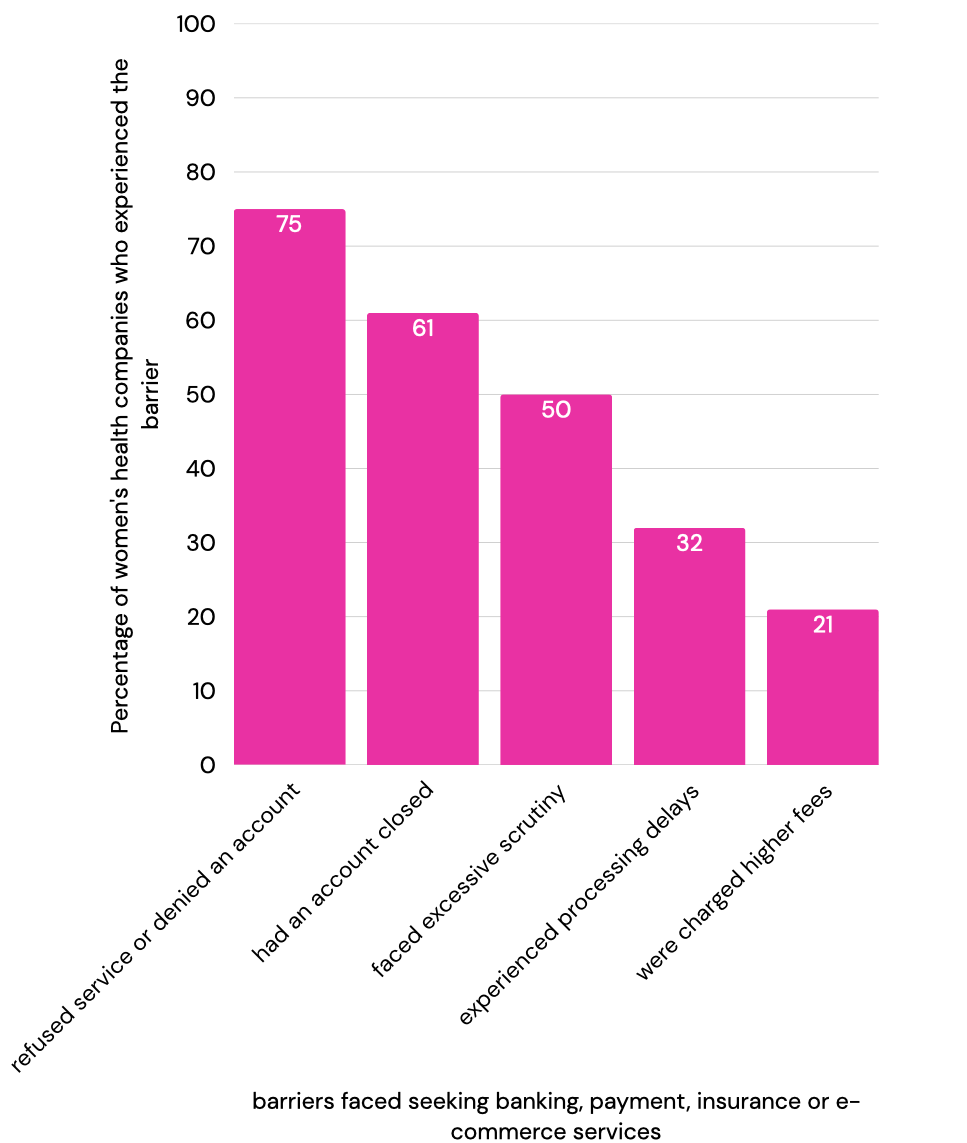
CensHERship’s work has also explored the problems these businesses face in their finances, which they attribute to misclassification (where women’s health and sexual wellbeing are misread as adult content) and misunderstanding (where women’s health is overlooked as too new, complex, or unfamiliar to fit existing risk templates). The two concepts create significant financial obstacles for these businesses, shown in their survey of 28 founders, 100% of whom experienced barriers accessing banking, payment, insurance, or e-commerce services.
Anna says that: ‘We’ve heard anecdotally that people have been in the pitch room with investors and the investors have said to them, what’s your marketing plan here? Because we know that you’re going to struggle on social media and we know you’re a consumer-facing business, so how are you going to grow?’
She explains that ‘what compounds this is the existing barriers as well where [...] most of the VCs [venture capitalists], the decision makers are men and don’t understand women’s health or don’t choose to understand women’s health. So automatically, you have that bias towards investing in women’s health anyway.’
She adds that ‘taboo and stigma, embarrassment around women’s health doesn’t help either, because it creates less of an open dialogue to remove some of those barriers.’
Censorship can also impact repeat investment because, as Anna explains: ‘For example, you’ve got your initial investment fine, you commit to investors that you’re going to grow at this trajectory and when you can’t do that and can’t meet those targets (because the algorithm suddenly decided to not show your content, or perhaps your whole advertising account is blocked) then you literally cannot meet those targets.’
CensHERship finds that these problems have serious negative consequences for these businesses, with 82% losing time resolving issues, 64% losing revenue, and 43% delaying their launch. In Hertility’s case, who provide at-home fertility and hormone tests for women, Anna said that the business ‘have estimated they’ve lost 600,000 website visitors per month due to those changes.’
What wider impacts can it have on public understanding of women’s health?
In response to the problems these businesses have been facing, Anna says that 53% now self-censor to avoid being censored and facing losses. Something which she adds can effect everyday women self-censoring too:
‘The trickle down effect is, I guess, in a couple places. One, we’re not normalising that language. So if we can’t say the vagina on social media, women are not going to reflect back that language.
‘Then there’s also that kind of shame, embarrassment, taboo around it which prevents people using it. So yeah, I think there’s kind of several ways where it can trickle down to women not being not feeling like they can use those terms either.’
What needs to be done?
Anna believes that ‘what we see in the social media platforms is basically a symptom of, actually, our society at large, which is largely male default that sexualises the female body, that has a lot of taboo, stigma, and shame associated around women’s health, that for generations silence and minimise pain.’
She explains that ‘all of that feeds into how those platforms were built to reflect society, but also, you know, who they’re being built by and the data that they’ve used to be built. So yeah, it’s a completely much broader issue than simply kind of tackling what’s happening within the platforms.’
On the platforms though, Anna says that ‘we talk about meeting people where they are in this sort of digital way of communicating, people are on social media. So if you want to meet them there, it needs to be that safe place and that open place.’
She went on to discuss an NHS meme which used Harry Styles to get women to go to cervical cancer screening, saying that its impact was possible because the word cervical cancer was thankfully not censored. She says that ‘just shows the power, I think of what social media can do when it has this free dialogue there.’
It’s clear from CensHERship’s findings and Anna’s own observations that change is needed from both culture and these platforms, but for the latter Anna explains that ‘one of the main concerns is that there’s no way to really get in touch with these platforms and complain or ask them to review their decisions.’
She similarly added that the experience of complaining via Ofcom is poor without the ability to add hyperlinks or attachments, but did say that CensHERship has a number of ongoing complaints with the European Digital Services Act and that the potential interest of MPs in the cause is an exciting prospect.
The initiative have also recently launched their Women’s Health Visibility Alliance, which brings together brands, charities, and subject-matter experts who will work together ‘to influence policy, drive legislative reform, and secure meaningful parliamentary action’.
What does it all mean for the Government?
In the Government’s general 10 year health plan in July last year, they claimed that they wanted to make the NHS both ‘the most digitally accessible health system in the world’ and ‘the most AI-enabled health system in the world.’ But such a movement towards the digital, with what we now know, ultimately seems incompatible with the digital censorship of women’s health.
If women are to trust that digital systems can work for them, the Government needs to more adequately address the existing problem of online censorship for women’s health. From CensHERship’s work and Anna’s explanations, we see that it is not just about trust either; censorship threatens to limit women’s understanding of their own bodies, of the help that is available to them, and threatens to hold back the industry as a whole with the barriers it presents to businesses. So really, the Government must also address censorship not just to stop it from hindering progress but to stop it from actively hurting women’s health.